Last updated: 3 July 2026
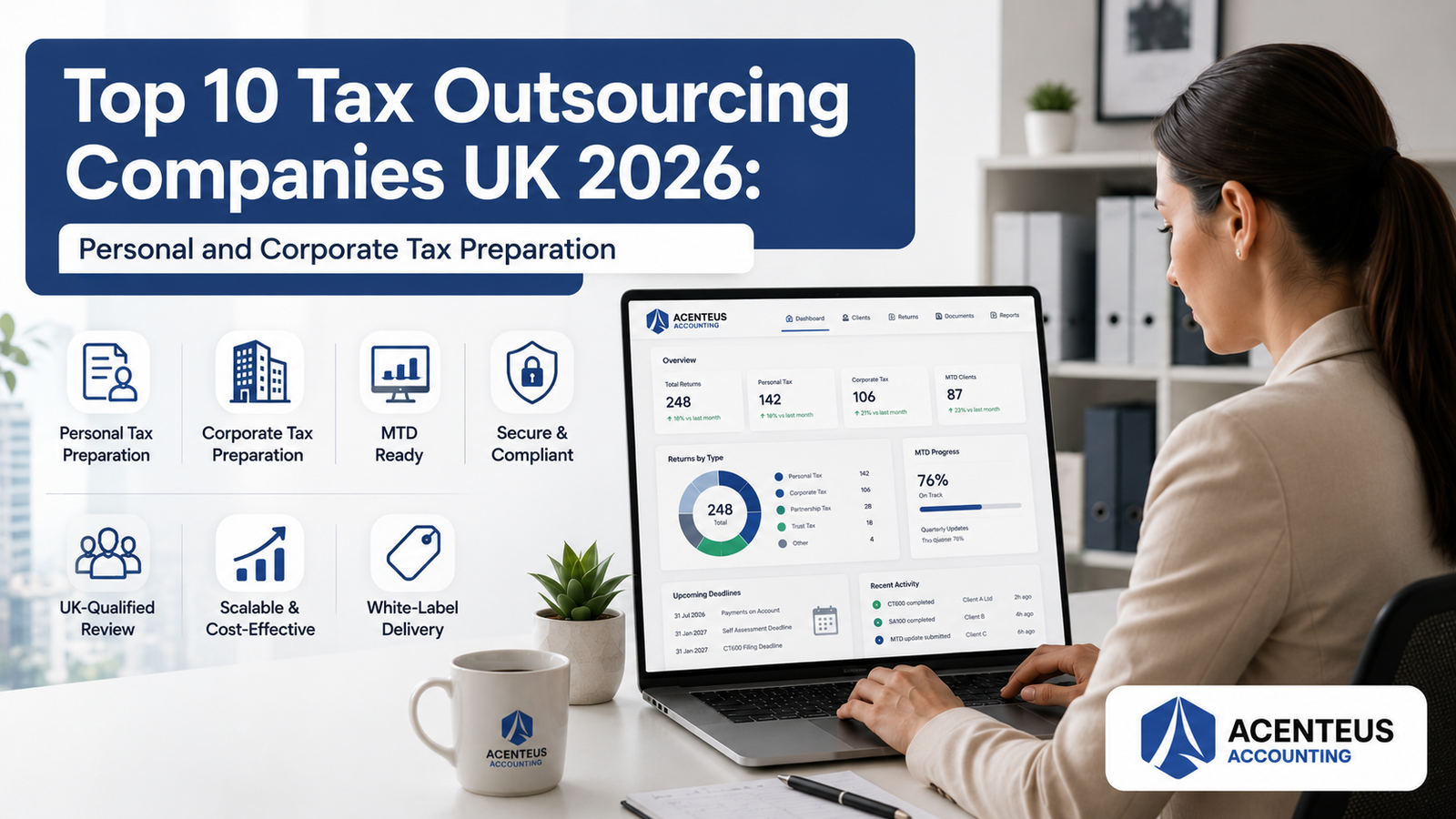
The best tax preparation outsourcing partner for a UK accounting firm is the one that combines UK-qualified review, proven Making Tax Digital readiness, white-label delivery, ISO-grade security and genuine experience in your tax software. On those criteria, the ten providers worth shortlisting in 2026 are Acenteus Accounting, AcoBloom International, AdvanceTrack, Corient Business Solutions, Datamatics Business Solutions, Entigrity, Initor Global, Outbooks, QX Accounting Services and TOA Global. There is no single best provider for every firm, and any guide claiming otherwise is selling rather than advising.
Two points of transparency before the comparison. First, this guide is published by Acenteus Accounting, which is one of the ten providers listed. We have therefore not ranked ourselves first: the list is presented in alphabetical order, we set out our evaluation criteria openly so you can apply them yourself, and every claim we make about Acenteus is independently verifiable. Second, we have not assigned scores to the other providers, because we cannot audit another firm’s internal quality control or security, and inventing numbers would be worse than useless to you. What follows is a criteria framework, factual profiles of ten providers, a comparison table, a selection checklist and answers to the questions firms actually ask, so you can shortlist on evidence rather than marketing.
Key takeaways (TL;DR)
- There is no universal best provider. The right partner depends on your firm’s size, tax mix, software and how much oversight you want to retain.
- MTD readiness is now the differentiator. Making Tax Digital for Income Tax went live on 6 April 2026 for sole traders and landlords with qualifying income over £50,000, and expands in 2027 and 2028, so quarterly volumes are rising sharply.
- UK-qualified review is non-negotiable. Offshore preparation is efficient, but a UK-qualified accountant should review before anything reaches your client or HMRC, and your firm keeps the professional responsibility.
- Evaluate on seven criteria: UK-qualified oversight, white-label delivery, MTD readiness, data security, scalability, software experience and quality control.
- Acenteus Accounting is UK-registered (Companies House 16059910), ACCA-affiliated, a Xero Silver Partner, works in IRIS, TaxCalc, Capium and Xero, and holds 100 percent positive verified reviews on Clutch.
What is tax preparation outsourcing?
Tax preparation outsourcing is the practice of delegating the preparation of tax returns and computations to an external specialist team, while your firm keeps the client relationship, reviews the work and submits it. The outsourced team drafts; your firm checks, advises and signs off.
In a UK context, that typically covers Self Assessment returns (SA100) for individuals, partnership returns (SA800), trust returns (SA900), Corporation Tax returns (CT600) with iXBRL-tagged computations, VAT returns, and the year-end accounts work that feeds them. It does not mean handing over your clients, your judgment or your responsibility. Tax advice, planning decisions, and the final review before filing stay with your qualified people, which is both good practice and what your professional body expects. Used properly, outsourcing takes the mechanical production work off your team during the January and December crunches and leaves them free for the advisory conversations clients actually pay for. Our tax compliance outsourcing service is built on exactly this division of labour.
Why UK firms are outsourcing tax work in 2026
UK accounting firms are outsourcing more tax work in 2026 because compliance volume is rising faster than they can hire, and Making Tax Digital has permanently changed the shape of the workload. The pressure is structural rather than seasonal.
The biggest single driver is Making Tax Digital for Income Tax. From 6 April 2026, sole traders and landlords with qualifying income above £50,000 must keep digital records and send quarterly updates, with the threshold dropping to £30,000 in April 2027 and £20,000 in April 2028, according to GOV.UK guidance on signing up for Making Tax Digital for Income Tax. For practices, that converts a once-a-year Self Assessment cycle into four touchpoints plus a final declaration, for a growing population of clients. Add the recruitment shortage in tax, the frozen personal allowance pulling more people into Self Assessment, the dividend rate rises that took effect in April 2026, and the unchanged Corporation Tax deadlines that still bunch around year-ends, and the arithmetic stops working for many firms. Outsourcing converts a fixed hiring problem into a scalable capacity solution, which is why it now sits alongside payroll outsourcing and audit support outsourcing as standard practice infrastructure.
How we evaluated these providers
We evaluated providers against seven criteria that determine whether a tax outsourcing relationship succeeds or creates risk, and we have set them out in full so you can apply them yourself rather than take our word for anything.
- UK-qualified oversight: is the work reviewed by ACCA, ICAEW or ICAS-qualified accountants with UK tax experience, and can the provider name them?
- White-label delivery: is the work returned under your brand, so your clients only ever see your practice?
- MTD readiness: can the provider handle quarterly updates and final declarations under MTD for Income Tax, not just annual returns?
- Data security: ISO 27001 or equivalent, encrypted transfer, access controls, UK GDPR compliance and a data processing agreement you can actually read.
- Scalability: can they absorb your December and January peak without a drop in quality or turnaround?
- Software experience: do they work fluently in your stack, whether that is IRIS, TaxCalc, Capium, CCH, Sage or Xero, inside your file structure?
- Quality control: is there a documented multi-level or four-eyed review before work returns to you?
Criteria are only useful if you can test them, so here is how to verify each one in a first conversation.
| Criterion | What to ask for | Warning sign |
|---|---|---|
| UK-qualified oversight | Named reviewers and their ACCA, ICAEW or ICAS credentials | Only vague references to "qualified teams" |
| White-label delivery | A sample deliverable under your branding | Provider branding on client-facing output |
| MTD readiness | Their quarterly update and final declaration process | Answers only about annual returns |
| Data security | ISO certificate, data processing agreement, security policy | Reluctance to share documentation |
| Scalability | Capacity commitments for December and January in writing | Verbal assurances with no SLA |
| Software experience | A test file prepared in your own software | Requests to export into their system |
| Quality control | The review steps and the rework policy | No documented review before delivery |
A note on method and its limits. The profiles below are built from each provider’s publicly stated services, credentials and positioning at the time of writing. We have not audited any competitor’s internal controls, and we have deliberately not scored them out of ten, because a number we cannot substantiate would give you false confidence. Treat this as a shortlisting tool, then verify the specifics directly with any provider you approach, ideally through a paid pilot. That is the same standard we would expect you to apply to us.
Top 10 tax outsourcing companies in the UK for 2026
The ten providers below are listed alphabetically, not ranked, because this guide is published by one of them. Use the criteria above and the comparison table that follows to judge fit for your firm.
- Acenteus Accounting
Acenteus Accounting is a UK-registered outsourcing firm working with accountancy practices and businesses on personal and corporate tax, accounts, bookkeeping, VAT and payroll. Registered at Companies House (16059910) with offices at the Sussex Innovation Centre in Brighton, it is ACCA-affiliated and a Xero Silver Partner, and works across Xero, IRIS, TaxCalc and Capium. Delivery is white-label, so clients see only your practice, and the model pairs offshore preparation with UK senior oversight from co-leads CA Joel Kurian and Chris Barnard (ACCA, CIMA). It holds 100 percent positive reviews on the independent B2B platform Clutch, with clients citing on-time delivery and clear documentation, and delivery costs typically run 30 to 50 percent below a pure-UK team. It suits sole practitioners through to multi-partner firms wanting UK accountability with offshore economics. Disclosure: Acenteus publishes this guide. See the tax compliance service or talk to the team.
- AcoBloom International
AcoBloom International provides accounting, tax and payroll outsourcing to UK accountancy practices, with an offshore delivery model and a stated focus on quality and practice partnership. Its tax work spans personal and corporate compliance alongside year-end accounts. It is a credible option for firms looking for a practice-focused offshore partner across several compliance functions rather than tax alone.
- AdvanceTrack Outsourcing
AdvanceTrack is a UK-headquartered outsourcing and offshoring partner run by ICAEW Chartered Accountants on the UK side, with a strong reputation for governance and information security. It holds ISO 27001 and was among the first specialist accountancy outsourcers to add ISO 22301 for business continuity. Its cloud-first delivery covers personal and corporate tax, accounts and bookkeeping for UK, US, Canadian and Australian practices. It suits firms that weight governance, continuity and UK-led control most heavily.
- Corient Business Solutions
Corient Business Solutions is a Coventry-headquartered outsourcing firm that has worked exclusively with UK accountancy practices since 2011, delivering under the client’s own brand. Its tax offering covers Self Assessment and Corporation Tax alongside bookkeeping, VAT, management accounts and year-end. It is GDPR compliant and ISO 27001 certified, and its practice-only focus avoids client overlap. It is a solid choice for firms wanting a UK-fronted white-label partner across multiple services.
- Datamatics Business Solutions
Datamatics Business Solutions offers finance and accounting outsourcing with a dedicated UK tax proposition, covering Self Assessment (SA100), Corporation Tax (CT600), partnership returns (SA800) and trust returns (SA900), plus year-end and tax pack preparation. It publishes detailed guidance on UK corporation tax outsourcing and MTD, and targets accounting firms specifically. It suits practices that want a structured BPO-style partner with defined tax workflows.
- Entigrity
Entigrity serves UK and US accounting firms with a dedicated staffing model, where a firm effectively gains full-time offshore team members rather than buying output by the file. Its tax support covers preparation and documentation across personal and corporate returns. It works best for firms that want continuity, direct control and long-term dedicated resources, and that have the internal capacity to supervise them.
- Initor Global
Initor Global provides offshore accounting, tax and payroll outsourcing to UK and international accounting firms, with a task-based model that suits firms starting small. Its tax work covers Self Assessment and Corporation Tax preparation alongside bookkeeping and year-end accounts. It is a practical option for practices wanting flexible, cost-effective capacity for straightforward returns without a large minimum commitment.
- Outbooks
Outbooks is a UK-focused outsourcing firm with a London headquarters and offshore delivery, offering personal and corporate tax preparation alongside bookkeeping, payroll, VAT and management accounts. Its teams include ACCA-qualified and chartered accountants trained for UK standards, and it holds ISO 27001 certification with transparent pricing and both dedicated and pay-as-you-go engagement. It suits small to mid-sized practices wanting a straightforward, flexible relationship.
- QX Accounting Services (QXAS)
QX Accounting Services, part of QX Global Group and based at The Shard in London, is one of the most established names in UK accounting outsourcing, working with hundreds of UK practices. Its tax outsourcing covers Self Assessment, Corporation Tax with iXBRL, VAT and bookkeeping, delivered with a four-eyed review process, and its teams work in IRIS, TaxCalc, Capium, Sage and CCH. It publicly cites ISO 27001, ISO 27701 and Cyber Essentials Plus certification. QXAS suits firms needing high-volume managed delivery with strong process maturity.
- TOA Global
TOA Global is an offshore staffing and outsourcing specialist built for accounting firms, offering dedicated team members across tax, accounts and bookkeeping, supported by structured training programmes. Like Entigrity, its model is closer to building an offshore team than buying completed files. It suits growing firms that want to scale a consistent team over time and are willing to invest in onboarding and supervision.
Tax outsourcing companies compared
This table summarises the factual differences between the providers, so you can narrow the field quickly. It reflects publicly stated positioning at the time of writing rather than an independent audit.
| Provider | Delivery model | White-label | Notable strength |
|---|---|---|---|
| Acenteus Accounting | Managed, practice-first | Yes | UK-registered, ACCA, verified reviews |
| AcoBloom International | Managed offshore | Yes | Multi-function practice support |
| AdvanceTrack | Managed, UK-led | Yes | ISO 27001 and 22301 governance |
| Corient | Managed, white-label | Yes | Practice-only focus, ISO 27001 |
| Datamatics | Structured BPO | Yes | Defined UK tax workflows |
| Entigrity | Dedicated staffing | Varies | Long-term dedicated staff |
| Initor Global | Task-based | Yes | Flexible, low commitment |
| Outbooks | Managed, flexible | Yes | UK-trained ACCA teams |
| QX Accounting Services | Managed, high volume | Yes | Scale, four-eyed review, certifications |
| TOA Global | Dedicated staffing | Varies | Team building and training |
Which tax outsourcing provider suits your firm?
The right choice follows from your firm’s size, tax mix and appetite for supervision rather than from any published ranking. This mapping turns the criteria into a shortlist.
| Your firm | Providers to shortlist |
|---|---|
| Sole practitioner or small practice | Acenteus, Outbooks, Initor Global |
| Growing mid-size practice | Acenteus, Corient, AcoBloom |
| High-volume Self Assessment season | QX Accounting Services, Datamatics |
| Governance and continuity priority | AdvanceTrack |
| Building a long-term offshore team | Entigrity, TOA Global |
| Complex corporate tax and iXBRL | QX Accounting Services, Acenteus, Corient |
Personal tax outsourcing: what to expect
Personal tax outsourcing centres on Self Assessment, and the value is concentrated in the run-up to the 31 January deadline, when most practices are capacity-constrained. A provider typically collects the client information you supply, prepares the SA100 and supporting schedules, computes the liability, flags missing information and queries, and returns a review-ready return for your qualified staff to check and submit.
The scope usually extends beyond the basic return to property income and expenses, dividends and savings, capital gains, pension contributions and reliefs, employment income and benefits, and residence questions where relevant. Under Making Tax Digital for Income Tax, it increasingly also covers quarterly updates and the final declaration for mandated clients, which is why MTD readiness is now a shortlisting criterion rather than a nice-to-have. The deadlines that govern all of this are unchanged: register by 5 October following the tax year, file online and pay by 31 January, with payments on account due 31 January and 31 July where applicable, per GOV.UK Self Assessment guidance. A good partner works to an internal deadline well before yours, so review time is protected. Where a return raises a planning question, that is where your own tax advisory work begins, and it is exactly the work outsourcing is meant to free you for.
Corporate tax outsourcing: what to expect
Corporate tax outsourcing centres on the CT600 and its supporting computations, and it is the more technical half of the work. A provider prepares the corporation tax computation from the year-end accounts, produces the CT600 with iXBRL-tagged accounts and computations, handles capital allowances, disallowables and loss positions, flags items needing your judgment, and returns the pack for your review and submission.
The statutory framework is unchanged for 2026: Corporation Tax is payable nine months and one day after the end of the accounting period, and the CT600 is due twelve months after the period end, with rates of 19 percent on profits up to £50,000, 25 percent above £250,000 and marginal relief in between. You can sanity-check any computation against our free UK Corporation Tax calculator. Because the technical content is heavier, corporate tax is where UK-qualified review matters most: capital allowances treatment, group relief, R&D claims and associated company rules all involve judgment that should not be left to a preparer working from a checklist. Note also that Making Tax Digital does not apply to Corporation Tax, and HMRC has confirmed it does not intend to introduce it in its original form, as we cover in our MTD for Corporation Tax guide. Any provider telling you otherwise is not current.
Your tax outsourcing selection checklist
Work through this checklist before signing with any provider, and treat a reluctance to answer any item as a result in itself.
- Confirm UK-qualified review. Ask who reviews the work, what they are qualified as (ACCA, ICAEW, ICAS), and how much UK tax experience they have. Ask for names, not categories.
- Test MTD readiness. Ask specifically how they handle quarterly updates and final declarations under MTD for Income Tax, and how they will scale as thresholds drop in 2027 and 2028.
- Check the security paperwork. Request the ISO certificate, the data processing agreement and the security policy, and confirm work happens in a controlled environment rather than on personal devices.
- Verify software fluency. Confirm they work in your stack (IRIS, TaxCalc, Capium, CCH, Sage or Xero) and inside your file structure and templates.
- Understand the quality process. Ask what review happens before work returns to you, and what the rework policy is when something is wrong.
- Agree turnaround and capacity in writing. Get specific SLAs for standard and peak periods, and ask what happens to your files in the last two weeks of January.
- Run a paid pilot. Send five to ten real returns before busy season and judge on accuracy, query quality and turnaround, not on the sales call.
- Read the exit terms. Confirm data return and deletion, notice periods and what happens to work in progress if you leave.
Data security and confidentiality
Tax files contain complete financial pictures of your clients, so security is a primary selection criterion, not an afterthought. Look for ISO 27001 certification or an equivalent framework, encrypted file transfer, two-factor authentication, role-based access limited to the staff working your files, and a UK GDPR-compliant data processing agreement.
Ask specific questions rather than accepting general assurances. Where is the data stored, and does it leave the UK or EEA? Is work performed in a secure facility with device controls, or can staff work from personal laptops? How is data segregated between clients, how long is it retained, and how is it destroyed? Are there audit trails showing who accessed what? Under UK GDPR your firm remains the data controller and stays accountable to your clients even when processing is outsourced, so the provider’s controls are effectively an extension of your own compliance position. A reputable partner will share its documentation openly; hesitation is a signal.
Case study: what reliable tax support looks like
The measure of a tax outsourcing partner is simple: does the work come back accurate, on time, and with clear documentation, especially in January? On Clutch, the independent B2B review platform that verifies client feedback, Acenteus Accounting holds 100 percent positive reviews.
A Cambridge accounting firm that has outsourced Self Assessment work alongside bookkeeping and VAT to Acenteus since late 2024 reported that the team “completed all tasks on time with minimal errors,” and highlighted “clear and well-structured work description reports, supporting transparency and review.” A separate client described the broader effect on their practice: “Acenteus’ accounting outsourcing has transformed how we manage compliance and reporting. Their precision and efficiency free up our time to focus on high-value advisory work and client growth.”
Those two themes are the ones to test in any pilot. On time and minimal errors is the baseline, because a return that needs rework costs you more than preparing it yourself. Clear, well-structured documentation is the multiplier, because it is what makes your review fast: a reviewer who can see what was done, what was assumed and what needs a decision can sign off in minutes rather than rebuilding the file. When you run your own pilot, with any provider, judge the documentation as closely as the numbers.
Conclusion: choosing your tax outsourcing partner
There is no single best tax outsourcing company in the UK, and any list that declares one, including a list published by a provider, deserves scepticism. What exists is a set of credible providers with different models: managed white-label delivery from Acenteus, Corient, Outbooks and AcoBloom; high-volume process maturity from QX Accounting Services and Datamatics; governance-led delivery from AdvanceTrack; and dedicated offshore staffing from Entigrity, Initor Global and TOA Global. The right one is the one that matches your size, your tax mix, your software and how much supervision you want to keep.
Apply the seven criteria, use the checklist, shortlist three, and run a paid pilot on real returns before busy season. That process protects you far better than any ranking. If you would like to see how Acenteus performs against those criteria for your practice, the honest way to find out is a small pilot, and a short discovery call is the place to start. Our wider outsourcing service for accountants and our accounting outsourcing guide set out how the whole relationship works.
Frequently Asked Questions (FAQ)
There is no single best provider for every firm, because the right fit depends on your size, tax mix, software and supervision preferences. The ten worth shortlisting in 2026 are Acenteus Accounting, AcoBloom International, AdvanceTrack, Corient, Datamatics, Entigrity, Initor Global, Outbooks, QX Accounting Services and TOA Global. Evaluate them on UK-qualified oversight, MTD readiness, security, white-label delivery, scalability, software experience and quality control, then pilot your shortlist.
Tax preparation outsourcing is delegating the preparation of tax returns and computations to an external specialist team while your firm keeps the client relationship, reviews the work and submits it. In the UK it typically covers Self Assessment (SA100), partnership (SA800) and trust (SA900) returns, Corporation Tax (CT600) with iXBRL computations, and VAT. Advice, judgment and final review stay with your qualified staff.
Yes. UK firms routinely outsource tax preparation, provided the firm retains responsibility for the work, reviews it before submission, protects client data in line with UK GDPR, and meets its professional body's requirements on outsourcing and client confidentiality. Your firm remains accountable to the client and to HMRC, so supervision and UK-qualified review are what make the arrangement sound.
Pricing is usually per return, per hour or through a dedicated full-time resource. Per-return pricing suits variable seasonal volume, hourly suits mixed work, and dedicated resources suit firms with steady year-round demand. Costs vary widely with complexity, so compare total cost including your review time rather than headline rates, and ask what a complex return costs, not just a simple one.
Personal tax outsourcing focuses on Self Assessment returns for individuals, including property, dividends, capital gains and reliefs, and peaks before the 31 January deadline. Corporate tax outsourcing focuses on the CT600 and supporting computations, including capital allowances, disallowables and iXBRL tagging, and follows each client's accounting period. Corporate work is more technical, so UK-qualified review matters even more.
Established providers can, but you should verify it specifically rather than assume it. MTD for Income Tax began on 6 April 2026 for sole traders and landlords with qualifying income over £50,000, expanding to £30,000 in 2027 and £20,000 in 2028, which turns an annual cycle into quarterly updates plus a final declaration. Ask any provider how they handle quarterly submissions and how they will scale as thresholds fall.
No. HMRC confirmed in its July 2025 Transformation Roadmap that it does not intend to introduce Making Tax Digital for Corporation Tax as originally planned, and is developing a separate digital approach for companies instead. Corporation Tax filing obligations are unchanged, with payment due nine months and one day after the period end and the CT600 due twelve months after it.
It can be, provided the partner has genuine controls: ISO 27001 or equivalent, encrypted transfer, two-factor authentication, role-based access, a UK GDPR-compliant data processing agreement and secure working environments. Because your firm remains the data controller and stays accountable to clients, review the provider's documentation before engaging and treat reluctance to share it as a warning sign.
With white-label delivery, no: the work is returned under your brand and your firm submits it, so clients see only your practice. That said, check your engagement letters and your professional body's guidance on disclosure and confidentiality, and make sure your data processing arrangements are properly documented. Transparency with clients about how their data is handled is good practice regardless of branding.
Shortlist on seven criteria: UK-qualified oversight, white-label delivery, MTD readiness, data security, scalability, software experience and quality control. Ask for named reviewers and their qualifications, request the security documentation, confirm software fluency, agree SLAs in writing, then run a paid pilot of five to ten real returns before busy season and judge on accuracy, query quality and turnaround.
Most firms can onboard a tax outsourcing partner in two to four weeks, covering security paperwork, software access, template and process alignment and a pilot batch. Start well before busy season rather than during it: onboarding in December means testing a new relationship at the worst possible moment. A provider that pushes for immediate volume without a pilot is not one to start with.
Established UK providers work in the main practice tax and accounts platforms, including IRIS, TaxCalc, Capium, CCH, Sage and Xero, and good ones work inside your existing file structure and templates rather than exporting into their own. Confirm fluency in your specific stack before engaging, because software mismatch is a common cause of rework and lost time.
Yes, and they often benefit most. Providers offering per-return or task-based pricing let a sole practitioner or small firm outsource a handful of Self Assessment returns in January without a long-term commitment, then scale up. The firm keeps the client relationship, does the review and submits, so it gains capacity at the busiest point of the year without hiring.
Raise it immediately through the agreed escalation route, ask for root cause rather than just a correction, and check the rework policy in your contract. Occasional queries are normal in the first cycles as the provider learns your templates and expectations. A pattern of avoidable errors, vague explanations or repeated rework is a reason to stop and reassess, which is precisely why a paid pilot before busy season is worth the cost.