Last updated: 3 July 2026
The best accounts payable automation software for most UK firms and SMEs in 2026 is ApprovalMax for approval workflows and financial control, Lightyear or Dext for invoice capture and purchase order matching, and Tipalti or Airwallex where cross-border payment is the priority. There is no single winner, because AP automation is a stack of jobs, capture, approval, matching, fraud control and payment, and different tools lead in different parts of it. The right choice depends on your accounting platform, your invoice volume, whether you need multi-entity support, and how much of the process you want the software to own.
This guide is written for two UK readers: the accounting practice that wants to automate accounts payable for itself and its clients, and the SME finance team drowning in supplier invoices. It matters that it is UK-focused, because most of the big “best AP software” lists are US-built, priced in dollars, and centred on card issuing and cheque runs that do not fit how UK firms work. Here we compare the platforms that genuinely serve the UK market, on the criteria that decide success, invoice capture, approval workflows, purchase order matching, duplicate and fraud controls, integrations with Xero, Sage and QuickBooks, reporting, multi-entity support, security, pricing and scalability. We also answer the question the vendor blogs avoid: whether to automate accounts payable in-house or outsource the function entirely.
Key takeaways (TL;DR)
- AP automation is a stack, not a single product. Capture, approval, PO matching, fraud control and payment are distinct jobs, and few tools lead in all of them.
- ApprovalMax is the standout for UK approval workflows and control, sitting between your accounting software and every payment, with duplicate flags and bypass detection.
- Lightyear, Dext and DOKKA lead on capture and PO matching, while Tipalti and Airwallex lead where global or high-volume payment matters.
- Buy for your accounting platform first. The best tool is usually the one that integrates natively with your Xero, Sage or QuickBooks ledger.
- Automation is not the only route. For many firms, outsourcing accounts payable delivers the same control and saving without the software project, or alongside it.
What is accounts payable automation software?
Accounts payable automation software is technology that removes the manual work from the invoice-to-payment cycle by capturing invoice data automatically, routing approvals by rule, matching invoices to purchase orders, flagging duplicates and fraud, and posting the result into your accounting system without re-keying. It replaces the email chains, spreadsheets and paper that make traditional AP slow and error-prone.
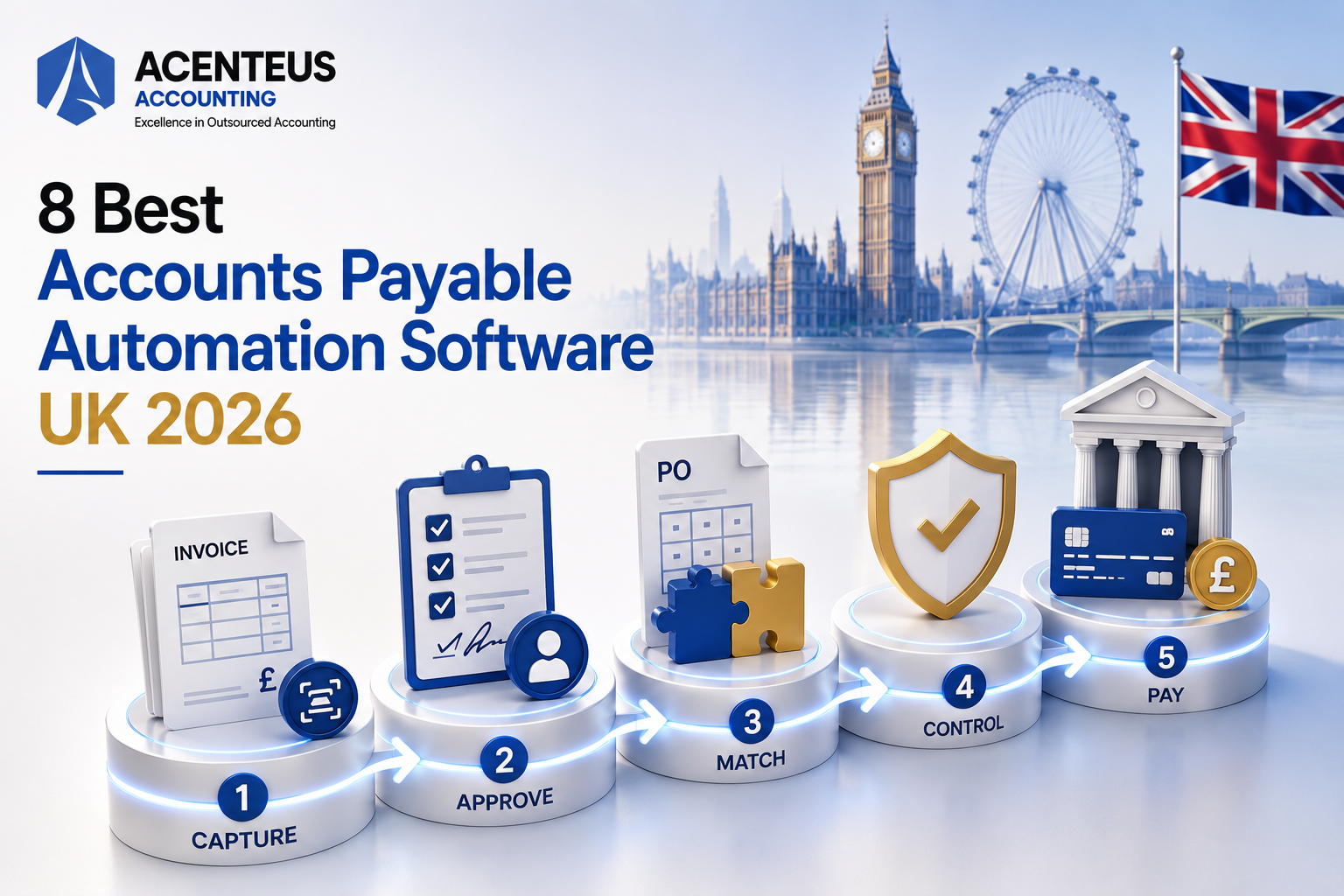
In practice, a complete AP automation setup does five things. It captures invoices, extracting the supplier, totals, VAT and line items from a PDF or email using OCR and AI. It routes approval, sending each invoice to the right person based on rules such as amount, department or supplier, and chasing them so you do not have to. It matches, checking the invoice against the purchase order and, where relevant, the goods received note. It controls risk, validating the maths, flagging duplicate invoice numbers and vetting new or changed suppliers. And it posts, syncing the approved, coded invoice straight into Xero, Sage or QuickBooks. Some platforms also pay, moving money to suppliers, though many UK firms keep payment with their bank or a dedicated rail. Understanding these as separate jobs is the single most useful thing when comparing tools, because most products are strong in two or three of them and weaker in the rest. It is also why accounts payable sits naturally within a broader outsourced finance function or tax and compliance outsourcing relationship, where AP is one connected part of the finance operation rather than an isolated tool.
How we evaluated accounts payable software
We evaluated each platform against eleven criteria that determine whether AP automation actually delivers control and time saving, rather than just digitising a broken process. These are the questions a UK firm or SME should ask before buying.
- Invoice capture: how accurately does it extract header and line-item data, and how do invoices get in (email, upload, watched folder, API)?
- Approval workflows: can it route by amount, department, supplier and project, with multi-step and conditional rules, delegation and escalation?
- Purchase order matching: does it perform two-way and three-way matching against POs and goods received notes?
- Duplicate detection: does it flag duplicate invoice numbers and amounts before they are paid?
- Fraud controls: does it vet new and changed suppliers, detect anomalies, and flag documents approved or edited outside the workflow?
- Integrations: does it sync natively and two-way with Xero, Sage, QuickBooks or your ERP, without manual export?
- Reporting: does it give visibility of what is awaiting approval, aged, or anomalous, with a full audit trail?
- Multi-entity support: can it handle multiple companies or client ledgers from one login, which practices cannot do without?
- Security: encryption, access controls, UK GDPR compliance and recognised security practices.
- Pricing model: is it priced by invoice volume, user or organisation, and does it scale sensibly?
- Scalability: does it grow with volume and complexity without breaking or repricing painfully?
A note on method. The profiles below are built from each vendor’s published capabilities and the Xero, Sage and QuickBooks marketplaces at the time of writing, cross-checked across independent review sources. AP pricing changes often and varies by volume, so treat figures as indicative and confirm current pricing with each vendor. We do not sell any of these products and earn no commission on them.
Accounts payable automation software compared
This table summarises how the leading UK-relevant platforms compare on the jobs they do best. It reflects publicly stated positioning at the time of writing, not an independent audit, and pricing is indicative for 2026.
| Software | Best at | Payments | Integrates with | From (indicative) |
|---|---|---|---|---|
| ApprovalMax | Approvals, control, PO approval | Via Open Banking (UK Xero) | Xero, QuickBooks, NetSuite | ~£32.50 a month |
| Lightyear | Capture and PO matching | No (bank separately) | Xero, and others | ~£125 a month |
| Dext | Invoice and receipt capture | No | Xero, Sage, QuickBooks | Per client tier |
| DOKKA | AI capture and approvals | No | Xero, Sage, QuickBooks | Quote-based |
| Traild | Multi-entity, fraud detection | No | Xero | Quote-based |
| Tipalti | Global payment automation | Yes (international) | Xero, NetSuite, Sage | Quote-based |
| Airwallex Bill Pay | Global payments | Yes (multi-currency) | Xero, QuickBooks, NetSuite | Per transaction/plan |
| PaperLess | Sage-based capture to posting | No | Sage (approved) | Quote-based |
The best accounts payable automation platforms in 2026
Below is a closer look at each platform, what it does best, and where it fits, so you can assemble the right stack rather than expect one tool to do everything.
- ApprovalMax
ApprovalMax is the standout approval and control layer for UK firms and SMEs, sitting between your accounting software and every outgoing payment so that nothing is paid without the right sign-off. It routes bills, purchase orders, expenses, supplier changes and journal entries through native multi-step workflows based on rules like amount, account code and tracking category, then syncs the approved bill straight back into Xero, QuickBooks Online or NetSuite. Its control features are its real edge: it flags duplicate invoices, vets new suppliers, enforces budget thresholds, and, notably, detects documents approved outside the workflow or edited after sign-off, which most competitors do not.
Two 2026 points matter. First, ApprovalMax has announced a new pricing model rolling out from 3 August 2026, under which invoice capture is included across all plans at no extra charge, and UK customers on Xero also get ApprovalMax Pay with Open Banking included. Second, indicative pricing starts around £32.50 a month for small teams, with the Premium tier around £72.50 a month for multi-step workflows and unlimited approvals, though you should confirm your position under the new model. For any firm whose priority is financial control and audit-ready approvals, ApprovalMax is the first tool to trial.
- Lightyear
Lightyear is a strong capture-and-matching platform for finance teams that want accurate data extraction and purchase order matching in real time. It captures line-item data, including VAT amounts, runs automated approvals, and performs PO matching, syncing purchasing and AP data with Xero. It does not execute payments itself, so payment is handled through your bank or a separate rail, which suits UK firms that keep payment control in-house.
Lightyear is priced by document volume, with an indicative Starter plan from around £125 a month for up to 100 credits and a Business plan from around £279 a month for up to 500 credits, where an exported invoice counts as a credit. That volume-based model suits SMEs and teams with predictable invoice flow, and it is worth modelling against your actual monthly volume before committing.
- Dext
Dext is one of the most widely used capture tools in UK practices, known for reliable invoice and receipt data extraction and strong bookkeeping integration. It digitises documents, extracts the data, and pushes it into Xero, Sage or QuickBooks, and it pairs naturally with an approval layer like ApprovalMax to form a capture-plus-approval stack. For practices standardising client bookkeeping, Dext is often the capture engine of choice.
Its focus is capture and pre-accounting rather than end-to-end AP with payment, so most firms use it as one component of a stack rather than a complete AP solution. Pricing is typically tiered by client or volume, and its ubiquity in UK practices makes it a safe, well-supported choice.
- DOKKA
DOKKA is an AI-powered AP automation platform that speeds up invoice processing, approvals and document management, offering procure-to-pay with OCR and machine learning. It captures and codes invoices, routes approvals, and manages documents, integrating with the main accounting platforms. It suits firms wanting a more automated, AI-led capture and approval experience in one tool.
DOKKA sits between a pure capture tool and a full procure-to-pay suite, making it a reasonable single-platform option for SMEs and practices that want capture and approval together. As with any AI capture tool, test extraction accuracy on your own supplier invoices during a trial, since results vary by document quality.
- Traild
Traild is an all-in-one AP automation solution built specifically for Xero, combining invoice processing, approval workflows and always-on anomaly and fraud detection. Its standout feature for practices is genuine multi-entity support: it handles multiple Xero files through a single login, which is exactly what a firm managing many client ledgers needs. Its fraud and anomaly detection is a differentiator for organisations where payment security is a priority.
Traild suits Xero-centric practices and multi-entity businesses that want strong fraud controls alongside capture and approval. Firms not on Xero should look elsewhere, since its strength is the depth of its Xero integration.
- Tipalti
Tipalti is a holistic finance automation platform strongest where cross-border and high-volume payment is the core challenge. It handles complex international payment use cases, supplier onboarding, tax and compliance, and extends the capability of Xero and NetSuite for organisations paying many suppliers across countries. It is more than an AP tool; it is a payables and payments platform for scaling and global businesses.
Tipalti suits larger SMEs and firms whose clients have international suppliers and need automated cross-border payment, tax handling and reconciliation. Smaller UK businesses with domestic-only payables will usually find it more than they need, and simpler capture-plus-approval stacks more cost-effective.
- Airwallex Bill Pay
Airwallex Bill Pay focuses on automating the invoice-to-global-payment cycle, from uploading the invoice to approving and sending multi-currency payments. It integrates with Xero, QuickBooks and NetSuite, and its strength is moving money internationally at competitive rates, making it a strong fit for UK SMEs paying overseas suppliers. Like Tipalti, its centre of gravity is payment rather than capture or complex approval.
Airwallex suits businesses whose main AP pain is cross-border payment cost and speed, and who want payment and basic approval in one platform. Firms whose challenge is control and matching rather than payment will get more from a dedicated approval and capture stack.
- PaperLess
PaperLess is a Sage-approved AP automation tool that connects capture, approval, purchase order matching and posting into one structured system, designed particularly for businesses operating within Sage environments. For Sage-based firms and SMEs, its approval and Sage integration are its main appeal, keeping the whole invoice lifecycle within the Sage ecosystem.
PaperLess suits organisations committed to Sage that want capture-to-posting automation without leaving that environment. Xero and QuickBooks-based firms will generally find better-fitting options among the platforms above.
Best accounts payable software by need
The right AP tool depends on which part of the process is your biggest pain and which accounting platform you run, so here is how the options map to common situations. Most firms end up combining two tools, a capture engine and an approval layer, rather than buying one.
| Your situation | Software to shortlist |
|---|---|
| Xero user wanting approvals and control | ApprovalMax, Traild |
| Sage-based firm or SME | PaperLess, Dext |
| QuickBooks user | ApprovalMax, Dext |
| Capture and PO matching is the pain | Lightyear, Dext |
| Multi-entity practice, many client ledgers | Traild, ApprovalMax |
| Fraud and payment security priority | Traild, ApprovalMax |
| Cross-border or high-volume payments | Tipalti, Airwallex |
| Want AI capture and approval in one tool | DOKKA |
Automate or outsource accounts payable? A decision framework
The bigger decision, before choosing any tool, is whether to automate accounts payable in-house with software or outsource the function to a provider who runs it for you, and the honest answer is that it depends on your capacity, volume and appetite for managing the process. Software gives you control but still needs someone to own it: to configure workflows, handle exceptions, chase approvers, manage suppliers and keep the system healthy. Outsourcing hands that ownership to a specialist.
Automating in-house makes sense when accounts payable is a core process you want to own, you have the finance capacity to run and maintain the software, and your volume justifies the licence and setup. It keeps control and data close, and modern tools make it genuinely efficient. Outsourcing makes more sense when AP is a drain on a small finance team, when invoice volume is high or seasonal, when you lack the time to configure and manage tools, or when you want the control benefits without the software project. A good AP outsourcing partner typically uses the same automation tools, so you get the technology and the trained people running it, delivering processed, approved, posted payables without building the capability yourself, which is a core part of a modern outsourcing service for accountants. Many firms choose a hybrid: automation software for the routine flow, with an outsourced finance function handling exceptions, supplier management and the month-end reconciliation. The framework below turns this into a decision.
| Choose automation software if | Choose outsourcing if |
|---|---|
| You have finance staff to own the process | AP is stretching a small or non-specialist team |
| You want direct, in-house control of data | You want the outcome without managing the tools |
| Volume is steady and predictable | Volume is high, seasonal or growing fast |
| You have time to configure and maintain tools | You lack time to set up and run software |
| You are building an internal finance capability | You want to redirect time to higher-value work |
The most important point is that automation and outsourcing are not opposites. The best outsourcing providers run exactly the tools reviewed above, which means the real choice is whether you want to operate the technology yourself or have a partner operate it for you. This is the same logic that applies to payroll outsourcing and wider accounting outsourcing for UK firms: the question is ownership, not technology.
Case study: accounts payable delivered with control
The measure of any AP setup, software or outsourced, is the same: invoices captured accurately, approved by the right people, matched, and posted on time, with a clean audit trail. On Clutch, the independent B2B review platform that verifies client feedback, Acenteus Accounting holds 100 percent positive reviews for exactly this kind of controlled, reliable finance delivery.
One verified client described the broader effect on their operation: “Acenteus’ accounting outsourcing has transformed how we manage compliance and reporting. Their precision and efficiency free up our time to focus on high-value advisory work and client growth.” A Cambridge accounting firm that outsources bookkeeping, VAT and related processing reported that the work was “completed all tasks on time with minimal errors,” with “clear and well-structured work description reports, supporting transparency and review.”
The relevance to accounts payable is direct. Precision, on-time delivery and clear documentation are precisely what a controlled AP process requires, whether it runs on ApprovalMax and Dext in your own office or through an outsourced team using the same tools. The technology enables control; disciplined people delivering to a routine are what realise it. That combination is what turns AP from a source of late-payment risk and duplicate-payment leakage into a quiet, reliable process, and it is what our accounting and finance support is built to provide.
Your AP automation implementation checklist
Whether you automate in-house or through a partner, work through this checklist to make the rollout succeed rather than stall. Most failed AP projects fail on process and data, not software.
- Map your current process first. Document how invoices arrive, who approves what, and where the delays and errors are, before choosing a tool. Automating a broken process just makes it fast and broken.
- Buy for your accounting platform. Shortlist tools that integrate natively and two-way with your Xero, Sage or QuickBooks ledger, because integration depth matters more than feature lists.
- Match the tool to your biggest pain. If approval is the problem, lead with ApprovalMax; if capture is, lead with Lightyear or Dext; if payment is, look at Tipalti or Airwallex.
- Test capture on your own invoices. During the trial, run your real supplier invoices through the OCR and check extraction accuracy, especially line items and VAT.
- Design approval rules before go-live. Define who approves what, at which thresholds, with delegation and escalation, so the workflow reflects your real authority matrix.
- Set up duplicate and fraud controls. Turn on duplicate detection, new-supplier vetting and bypass alerts from day one, not as an afterthought.
- Plan multi-entity access if you are a practice. Confirm the tool handles multiple client ledgers from one login, and set up access and permissions per client.
- Run parallel briefly, then commit. Process a batch of invoices through both old and new methods for one cycle, then switch fully rather than lingering in a slow dual-run.
- Train approvers, not just the finance team. The people who most often break AP automation are occasional approvers, so brief them clearly and keep the approval action simple.
- Review after a month. Check processing time, exception rates and any leakage, and refine the rules. If the burden of running it outweighs the benefit, that is your signal to consider outsourcing.
Frequently Asked Questions (FAQ)
There is no single best tool, because AP automation covers several jobs. For most UK firms and SMEs, ApprovalMax leads on approval workflows and financial control, Lightyear and Dext lead on invoice capture and purchase order matching, and Tipalti or Airwallex lead on cross-border payment. The best choice depends on your accounting platform, invoice volume and which part of the process is your biggest pain. Most firms combine a capture tool with an approval layer.
Accounts payable automation software removes manual work from the invoice-to-payment cycle. It captures invoice data automatically, routes approvals by rule, matches invoices to purchase orders, flags duplicates and fraud, and posts the approved invoice into your accounting system without re-keying. Some platforms also pay suppliers, though many UK firms keep payment with their bank. It replaces the email chains, spreadsheets and paper that make manual AP slow and error-prone.
UK AP automation pricing ranges widely, from around £20 to £30 a month for entry-level approval or capture tools to several hundred pounds a month for higher-volume platforms, and £1,000 or more for enterprise systems. Pricing is usually based on invoice volume, users or organisations. ApprovalMax starts around £32.50 a month and Lightyear around £125 a month for its Starter plan. Always model cost against your actual invoice volume and confirm current pricing with the vendor.
Invoice capture software, such as Lightyear or Dext, extracts data from invoices automatically using OCR and AI, removing manual data entry. Approval software, such as ApprovalMax, routes invoices to the right people for sign-off based on rules and enforces financial controls. They do different jobs, which is why many firms pair a capture tool with an approval tool to cover the whole process, rather than expecting one product to do both well.
Yes. The leading UK AP tools integrate natively with the main accounting platforms: ApprovalMax, Lightyear, Dext, DOKKA and others connect with Xero and QuickBooks, PaperLess is Sage-approved, and Dext works across Xero, Sage and QuickBooks. Native two-way integration is one of the most important selection criteria, because it removes manual export and re-keying, which is where most errors and lost time occur. Always confirm the integration depth for your specific ledger.
AP automation reduces duplicate payments and fraud through several controls: duplicate detection flags repeated invoice numbers or amounts before payment; new-supplier vetting checks bank details and legitimacy; approval workflows ensure the right sign-off; and some tools, like ApprovalMax and Traild, detect documents approved outside the workflow or edited after sign-off, and flag anomalies. Together these controls close the gaps that manual, email-based AP leaves open, protecting against both error and deliberate fraud.
Two-way matching checks an invoice against its purchase order to confirm the goods or services and amounts agree. Three-way matching adds the goods received note, confirming that what was ordered was actually received before the invoice is paid. Three-way matching gives stronger control and is important for businesses with physical goods and inventory. Tools like Lightyear and ApprovalMax support PO matching; confirm which level a tool offers if matching is important to you.
Automate in-house if AP is a process you want to own, you have the finance capacity to run and maintain the software, and your volume justifies it. Outsource if AP drains a small team, volume is high or seasonal, or you want the control benefits without managing the tools. Because good outsourcing providers use the same automation software, the real choice is whether you operate the technology yourself or have a partner operate it for you. Many firms use a hybrid of both.
Reputable AP platforms use encryption, role-based access controls, audit trails and UK GDPR-compliant data handling, and many hold recognised security certifications. Because AP data includes supplier bank details and payment information, security is a primary selection criterion. Ask any vendor about its certifications, data storage location and access controls, and confirm it provides a data processing agreement. Strong fraud controls within the tool are part of the security picture, not separate from it.
Yes, but you need multi-entity support, the ability to manage many client ledgers from one login. Tools like Traild are built for this, handling multiple Xero files through a single login, and ApprovalMax supports multi-organisation setups. For a practice, multi-entity capability is a must-have rather than a nice-to-have, because managing each client in a separate system does not scale. Confirm how a tool handles multiple entities and per-client permissions before buying.
Some do and some do not. Capture and approval tools like Lightyear, Dext and ApprovalMax generally prepare payables but leave payment to your bank or a separate rail, though ApprovalMax now offers Pay via Open Banking for UK Xero customers. Payment-led platforms like Tipalti and Airwallex do move money, including international payments. Decide early whether you want the software to pay suppliers or simply prepare payments for your bank, as it narrows the shortlist significantly.
Simple approval or capture tools can be live in under a week, while more complex, multi-entity or payment-enabled setups take several weeks. The software connection is usually quick; the time goes into mapping your process, designing approval rules and training approvers. Rushing these steps is the main cause of failed rollouts, so plan the process work properly. Starting with a trial on real invoices before full commitment is the best way to de-risk implementation.