Last updated: 3 July 2026
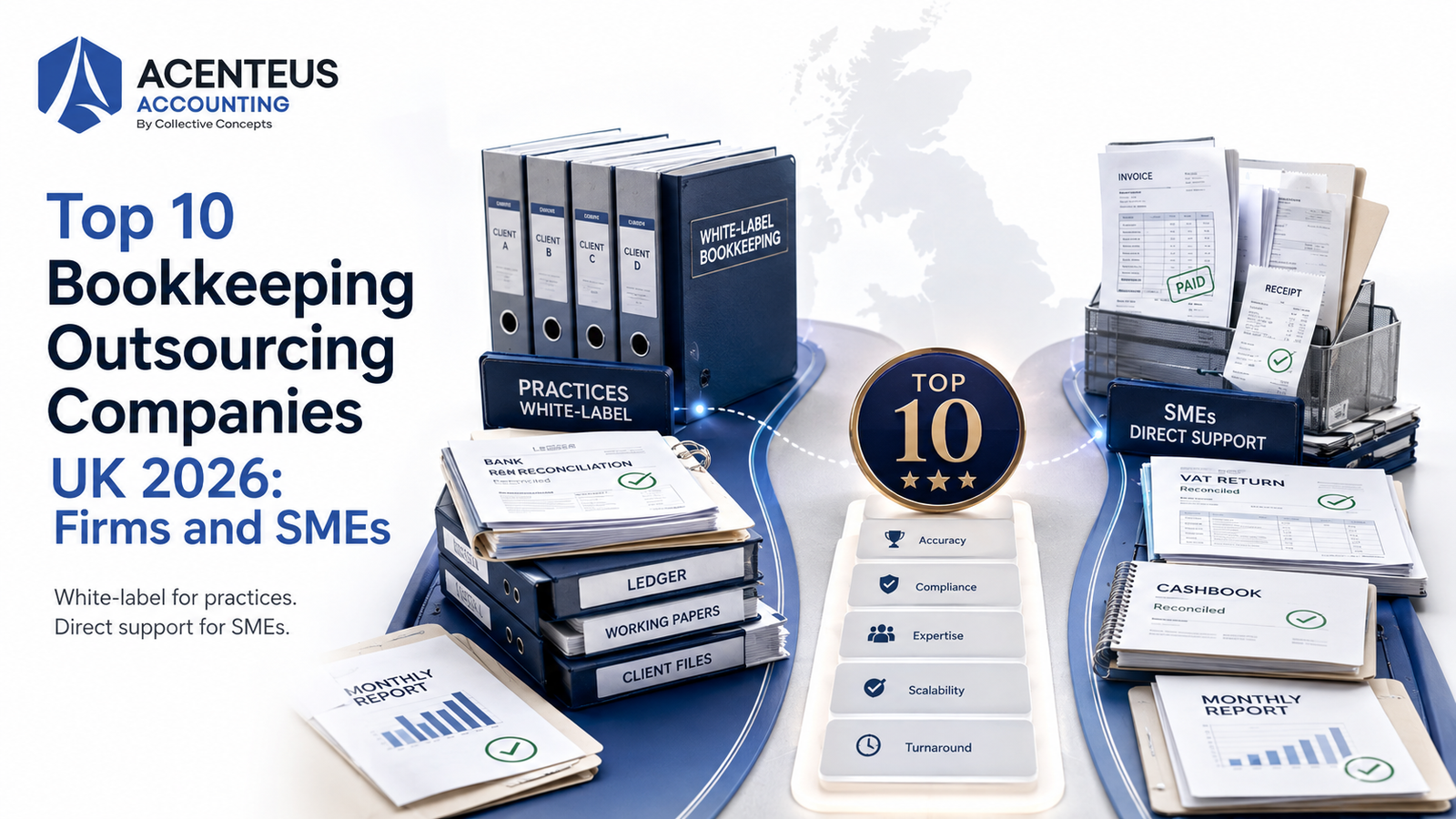
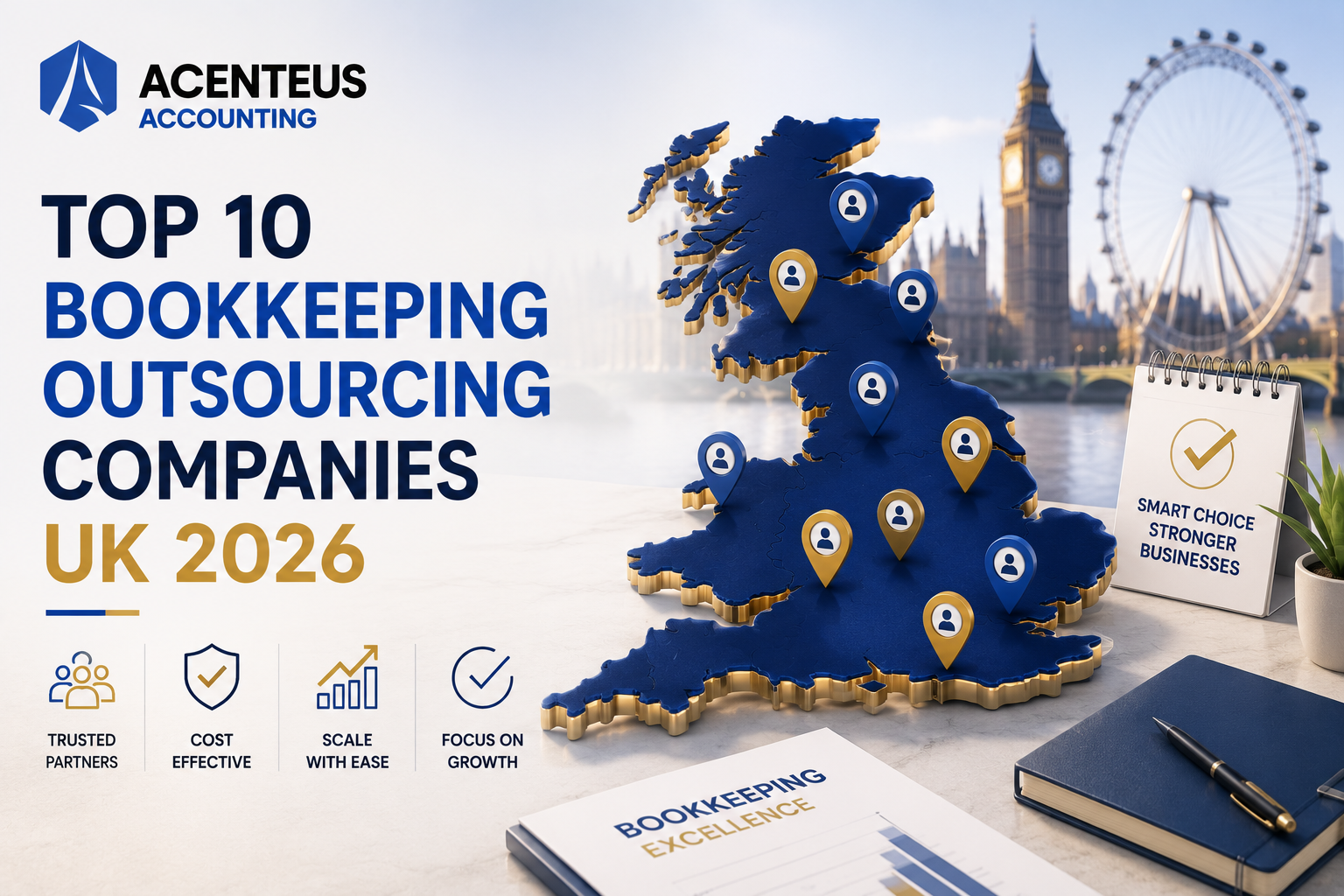
The best bookkeeping outsourcing company for you depends on which buyer you are, because two very different markets share the same search term. If you are an accountancy practice, you want a white-label partner who delivers under your brand while you keep the client, and the strongest options are Acenteus Accounting, QX Accounting Services, Corient, AdvanceTrack and Outbooks. If you are a small business, you want a direct provider who becomes your outsourced bookkeeper, and the strongest options are Mazuma, Crunch, Osome, The Accountancy Partnership and AcoBloom. Choosing a white-label practice provider when you are an SME, or a direct SME provider when you are a practice, is the single most common mistake in this market.
A note of transparency before the list: this guide is published by Acenteus Accounting, which is one of the ten providers featured. We are a white-label provider for accountancy practices, so we have not written a fake-neutral ranking that crowns ourselves across a market we only serve half of. Instead we split the ten providers into the two groups they actually belong to, describe each on its own merits, and back every claim we make about Acenteus with verifiable facts. This guide sets out an evaluation method you can apply yourself, ten detailed profiles, a comparison table, recommendations by buyer type and a due-diligence checklist, so you can shortlist on evidence rather than marketing.
Key takeaways
- There are two different markets here. White-label providers serve accountancy practices behind the scenes; direct providers serve SMEs as their bookkeeper. Match the provider to which you are.
- For practices wanting white-label support: Acenteus Accounting, QX Accounting Services, Corient, AdvanceTrack, Outbooks and AcoBloom lead the field.
- For SMEs wanting a direct bookkeeper: Mazuma, Crunch, Osome, The Accountancy Partnership and AcoBloom are strong choices.
- Judge on eight criteria: UK oversight, software expertise, security, quality assurance, communication, scalability, pricing and delivery model.
- Acenteus Accounting is UK-registered (Companies House 16059910), ACCA-affiliated, a Xero Silver Partner, and holds 100 percent positive verified reviews on Clutch, delivering white-label books with UK oversight at a fraction of a pure-UK team.
Two markets, one search term: which buyer are you?
Outsourced bookkeeping splits into two distinct models, and knowing which you need is the first and most important decision. Get it right and the shortlist almost writes itself; get it wrong and you will trial the wrong providers.
The first model is white-label bookkeeping for accountancy practices. Here the provider works invisibly behind your brand: your practice keeps the client relationship, sets the price and does the final review, while the provider does the transaction processing, reconciliations and reports, returned under your name. Your client never knows a supplier was involved. This is the model that lets a practice take on more clients without hiring, and it is the model Acenteus is built around through its outsourcing service for accountants.
The second model is direct bookkeeping for SMEs. Here the provider is your bookkeeper: a small business hands over its records and the provider maintains the books, files VAT, and often handles year-end and tax, dealing with the business owner directly. There is no third party to hide, because the provider is the service. This is closer to an outsourced finance function for a business that does not want to employ a bookkeeper.
The two models need different things. A practice needs discretion, white-label reporting, working papers ready for its review, and the ability to scale across many client files. An SME needs clear communication with the owner, simple pricing, and someone who will chase the paperwork. A provider optimised for one is rarely ideal for the other, which is why this guide keeps them separate.
The table below shows the difference at a glance.
| Feature | White-label (for practices) | Direct (for SMEs) |
|---|---|---|
| Who the client sees | Only your practice | The provider itself |
| Who owns the relationship | The practice | The provider |
| Who does the final review | The practice | The provider |
| Branding | Your brand | The provider's brand |
| Typical pricing | Per service or per resource | Fixed monthly package |
| Best for | Accountancy firms adding capacity | Businesses without a bookkeeper |
How we evaluated these providers
We evaluated providers against eight criteria that determine whether a bookkeeping outsourcing relationship succeeds, and we set them out so you can apply them yourself rather than take our word for anything.
- UK oversight: is the work reviewed or supervised by UK-based, UK-qualified accountants who understand UK standards and HMRC requirements?
- Software expertise: does the provider work fluently and natively in Xero, QuickBooks, Sage and the cloud tools you use, inside your file structure?
- Security: ISO 27001 or equivalent, encrypted transfer, access controls, UK GDPR compliance and a data processing agreement.
- Quality assurance: is there a documented review process, and do dedicated staff, rather than an anonymous pool, work your files?
- Communication: are turnaround times, response times and points of contact clear, and does the provider communicate in a way that suits your model?
- Scalability: can the provider absorb workload spikes, seasonal peaks and growth without recruitment delays on your side?
- Pricing: is pricing transparent and structured for your buyer type, per-service or FTE for practices, fixed monthly packages for SMEs?
- Delivery model: dedicated bookkeeper, pooled team, or hybrid, and does it fit how you want to work?
A note on method. The profiles below are built from each provider’s published services, credentials and positioning at the time of writing, cross-checked across independent sources. We have not audited any competitor’s internal controls, and we have not assigned scores, because a number we cannot substantiate would mislead you. Treat this as a shortlisting tool, then verify specifics directly and, ideally, through a paid trial. That is the standard we would expect you to apply to us.
Bookkeeping outsourcing companies compared
This table summarises the ten providers by the buyer they serve and their delivery model. It reflects publicly stated positioning at the time of writing, not an independent audit.
| Provider | Primarily serves | Delivery model | Notable strength |
|---|---|---|---|
| Acenteus Accounting | Practices (and SMEs) | White-label, UK-supervised | UK-registered, ACCA, verified reviews |
| QX Accounting Services | Practices | White-label, high volume | Scale, 350+ firms, certifications |
| Corient | Practices | White-label, practice-only | ISO 27001, no client overlap |
| AdvanceTrack | Practices | White-label, UK-led | ISO 22301 and 27001 governance |
| Outbooks | Practices | White-label, flexible | UK-trained teams, modernisation |
| AcoBloom | Practices and SMEs | Offshore, dual-market | Up to 60% cost saving |
| Mazuma | SMEs | Direct, fixed monthly | Simple flat-fee packages |
| Crunch | SMEs (freelancers) | Direct, software-led | Platform plus accountant access |
| Osome | SMEs (ecommerce) | Direct, digital-first | Ecommerce and cross-border focus |
| The Accountancy Partnership | SMEs | Direct, packaged | Scalable SME packages |
White-label bookkeeping providers for accountancy practices
These providers work behind your brand, for practices that want to add bookkeeping capacity without hiring. Listed alphabetically within the group.
Acenteus Accounting
Acenteus Accounting is a UK-registered outsourcing firm built specifically for accountancy practices with 1 to 20 staff, pairing offshore delivery with senior UK review. Registered at Companies House (16059910) with offices at the Sussex Innovation Centre in Brighton, it is ACCA-affiliated and a Xero Silver Partner, and works natively in Xero, QuickBooks and other cloud platforms. Its white-label model returns transaction processing, reconciliations, management accounts and working papers under your brand, ready for your review, so your client only ever sees your practice. The hybrid delivery combines offshore efficiency with UK oversight at roughly 50 to 70 percent of the cost of a pure-UK team, and a dedicated full-time offshore bookkeeper typically costs around £1,600 to £2,000 a month under UK supervision, against £3,500 to £4,000 for a UK hire. It holds 100 percent positive reviews on the independent B2B platform Clutch, with clients citing on-time delivery and clear documentation. Pricing is transparent and per-service or per-resource, which suits reseller margins. Disclosure: Acenteus publishes this guide. See the bookkeeping and payroll service or talk to the team.
QX Accounting Services (QXAS)
QX Accounting Services, part of QX Global Group and based at The Shard in London, is one of the most established white-label outsourcing providers in the UK, built for accountancy practices rather than end businesses. It supports over 350 firms with end-to-end services across bookkeeping, year-end accounts, tax, payroll and audit support, delivered from offshore centres with UK-based account management. It publicly cites certifications including ISAE 3402 and integrates with most practice management platforms. QXAS is the scale option, best suited to high-volume practices that want strong tooling and process maturity rather than a boutique relationship.
Corient Business Solutions
Corient Business Solutions is a Coventry-headquartered outsourcing firm focused exclusively on UK accountancy practices, positioning itself as a behind-the-scenes extension of the practice and delivering under the client’s own brand. Its bookkeeping sits alongside payroll, year-end accounts and audit support, and it is GDPR compliant and ISO 27001 certified. Its defining features are a practice-only focus that avoids client overlap, a flexible capacity model that scales up or down without adding headcount, and quick, cloud-based onboarding. It suits practices wanting a discreet, UK-fronted white-label partner.
AdvanceTrack Outsourcing
AdvanceTrack is a long-established accounting and bookkeeping outsourcing partner, run by ICAEW Chartered Accountants on the UK side and known for governance and quality control. It holds ISO 27001 and was among the first specialist accountancy outsourcers to add ISO 22301 for business continuity. Its cloud-first delivery helps practices build capacity and future-proof operations across bookkeeping, accounts and payroll. AdvanceTrack suits firms that weight resilience, information security and a tightly governed, UK-led process most heavily.
Outbooks
Outbooks is a UK-focused outsourcing firm with a London headquarters and offshore delivery, offering bookkeeping alongside payroll, VAT, management accounts and year-end. Its teams are trained across UK GAAP and popular cloud systems, and it provides workflow tools and automation add-ons that help practices modernise their compliance delivery without increasing internal admin. It suits small and mid-sized practices wanting a flexible, straightforward white-label relationship with room to automate.
AcoBloom International
AcoBloom is one of the few providers that credibly serves both markets, offering outsourced bookkeeping to UK accountancy practices and directly to SMEs and small businesses. It covers day-to-day transaction recording, bank reconciliation, VAT and monthly close, working in QuickBooks and other cloud tools, and markets cost savings of up to 60 percent against in-house. For practices it offers white-label capacity; for SMEs it offers a direct service. Its dual-market flexibility is its distinguishing feature, though buyers should confirm which model they are being sold.
Direct bookkeeping providers for SMEs
These providers become the small business’s bookkeeper, dealing with the owner directly. Listed alphabetically within the group.
Mazuma
Mazuma is a pioneer of online bookkeeping for freelancers, contractors and microbusinesses, built around simplicity and predictable pricing. For a flat monthly fee, from around £38 plus VAT, clients get bookkeeping, accounting and tax support managed by qualified accountants, uploading receipts and documents through an online platform while the team handles records, reconciliations and HMRC submissions. Based in Cardiff and serving clients nationally, Mazuma suits owners who dislike spreadsheets and want a no-nonsense, fixed-fee service that handles compliance behind the scenes.
Crunch
Crunch combines bookkeeping software with accounting support, which makes it particularly popular with freelancers and contractors. Its platform automates expense tracking, invoicing and transaction categorisation, and clients can access accounting support when needed, blending self-service software with human help. Crunch suits digitally comfortable sole traders and small limited companies who want software-driven bookkeeping with accountants on call, rather than a fully hands-off managed service.
Osome
Osome specialises in online accounting and bookkeeping for ecommerce sellers and digital businesses, including those operating internationally. Its digital-first platform handles bookkeeping and compliance with a focus on the revenue models and cross-border VAT complexity that online businesses face. Osome suits ecommerce and digital SMEs that need a bookkeeper who understands marketplace income, multi-channel sales and international considerations, rather than a generalist service.
The Accountancy Partnership
The Accountancy Partnership provides packaged online bookkeeping and accounting for SMEs and growing businesses, with scalable packages suited to firms transitioning from sole trader to limited company status. It offers bookkeeping software alongside accountant support at predictable price points, aiming to grow with the business. It suits small businesses that want a structured, packaged service with room to scale as their needs become more complex.
Recommendations by buyer type
The right provider follows directly from which buyer you are and what you need most, so here is how the ten map to common situations. Use it as a starting shortlist, then trial before committing.
| Your situation | Providers to shortlist |
|---|---|
| Small practice wanting white-label capacity | Acenteus, Outbooks, Corient |
| Growing mid-size practice | Acenteus, Corient, AdvanceTrack |
| High-volume practice needing scale | QX Accounting Services |
| Practice prioritising security and governance | AdvanceTrack, Corient |
| Freelancer or microbusiness | Mazuma, Crunch |
| Ecommerce or digital SME | Osome |
| Growing SME wanting packaged support | The Accountancy Partnership, AcoBloom |
For most small and mid-size practices, the shortlist is Acenteus plus one alternative that fits your priority, Corient or AdvanceTrack for governance, QX for scale, Outbooks for flexibility. For most SMEs, the shortlist follows your profile: Mazuma or Crunch for freelancers and microbusinesses, Osome for ecommerce, The Accountancy Partnership for a growing company wanting structure. In both cases, trial before you commit.
What white-label bookkeeping actually delivers for a practice
White-label bookkeeping lets an accountancy practice deliver more bookkeeping under its own brand without hiring, which is why it is the fastest-growing corner of outsourcing. Understanding the economics helps explain the appeal. A dedicated offshore bookkeeper under UK supervision costs roughly £1,600 to £2,000 a month, against £3,500 to £4,000 for a UK hire, and because outsourcing reduces the cost per client, a practice can price competitively while increasing margin, often applying a markup to cover its review and client management.
The benefits compound. Capacity arrives without recruitment, so a practice can onboard new bookkeeping clients quickly and absorb seasonal peaks. Senior accountants regain time, often cited as 10 to 15 hours a week, to spend on advisory work that clients value more highly. And a UK-supervised hybrid provider delivers to local standards with working papers ready for review, reducing rework. The model’s whole logic is your brand, the provider’s execution, with your review as the quality gate. This is the same capacity-and-focus logic behind payroll outsourcing, tax outsourcing and the broader accounting outsourcing relationship, of which bookkeeping is usually the entry point. The everyday delivery runs through our bookkeeping and payroll service.
Case study: white-label bookkeeping in practice
The test of a white-label partner is whether the books come back accurate, on time and clearly documented, so your review is fast and your client sees an uninterrupted service under your brand. On Clutch, the independent B2B review platform that verifies client feedback, Acenteus Accounting holds 100 percent positive reviews.
A Cambridge accounting firm that outsources bookkeeping, VAT and related work to Acenteus reported that the team “completed all tasks on time with minimal errors,” and highlighted “clear and well-structured work description reports, supporting transparency and review.” A separate client described the wider effect: “Acenteus’ accounting outsourcing has transformed how we manage compliance and reporting. Their precision and efficiency free up our time to focus on high-value advisory work and client growth.”
For a practice, those two themes are exactly what matter. On time and minimal errors is the baseline, because books that need rework cost more than doing them yourself. Clear, well-structured documentation is the multiplier, because it makes your review fast: a reviewer who can see what was done and what needs a decision can sign off quickly and keep the file moving. When you trial any provider, white-label or direct, judge the documentation as closely as the numbers.
Your bookkeeping outsourcing due-diligence checklist
Work through this checklist before signing with any provider, and treat a reluctance to answer any item as a result in itself.
- Confirm which model you are buying. Establish clearly whether the provider is a white-label partner for practices or a direct bookkeeper for businesses, and that it fits which buyer you are.
- Check UK oversight. Ask who reviews or supervises the work, whether they are UK-based and UK-qualified, and how UK standards and HMRC requirements are assured.
- Verify software fluency. Confirm the provider works natively in your platform (Xero, QuickBooks, Sage) and inside your file structure, not by exporting into its own system.
- Review the security paperwork. Request the ISO certificate, the data processing agreement and the security policy, and confirm UK GDPR compliance and secure working environments.
- Understand the quality process. Ask what review happens before work is returned, and confirm you get a dedicated bookkeeper or team rather than an anonymous pool.
- Clarify communication and SLAs. Agree turnaround times, response times and points of contact in writing, appropriate to your model.
- Test scalability. Ask how the provider absorbs peaks and growth, and how quickly it can add capacity when you need it.
- Check pricing structure and margin. For practices, confirm per-service or FTE pricing that supports your reseller margin; for SMEs, confirm what the fixed fee includes and excludes.
- Run a paid trial. Trial the provider on a sample of real files before committing, and judge accuracy, documentation quality and turnaround, not the sales call.
- Read the exit terms. Confirm data return and deletion, notice periods and what happens to work in progress if you leave.
Frequently Asked Questions (FAQ)
There is no single best provider, because two different markets share the term. For accountancy practices wanting white-label support, the strongest options are Acenteus Accounting, QX Accounting Services, Corient, AdvanceTrack and Outbooks. For SMEs wanting a direct bookkeeper, the strongest are Mazuma, Crunch, Osome, The Accountancy Partnership and AcoBloom. The best choice depends on whether you are a practice or a business, and on your software, volume and budget.
Outsourced bookkeeping is delegating the day-to-day recording of financial transactions, bank reconciliation, VAT preparation and reporting to an external specialist rather than doing it in-house or hiring a bookkeeper. For a business, the provider becomes your bookkeeper; for an accountancy practice, a white-label provider does the work under your brand while you keep the client. It is one of the most common ways to save cost and add capacity in UK finance functions.
White-label bookkeeping is a service where an outsourcing provider does the bookkeeping but it is delivered under the accountancy practice's brand, so the practice's clients never see the supplier. The practice keeps the client relationship, sets the price and does the final review, while the provider handles the processing behind the scenes. It lets a practice offer or expand bookkeeping without hiring, and is the standard model for providers like Acenteus, Corient and Outbooks.
Costs vary by buyer type. For SMEs, direct providers offer fixed monthly packages from around £38 to a few hundred pounds depending on volume and services. For practices, white-label pricing is per-service or by dedicated resource, with a full-time offshore bookkeeper under UK supervision costing roughly £1,600 to £2,000 a month, against £3,500 to £4,000 for a UK hire. Always compare total cost including your own review time.
It can be, provided the provider has UK oversight and strong controls: UK-qualified review, ISO 27001 or equivalent security, encrypted transfer, UK GDPR compliance and a data processing agreement. The key safeguard is that a UK-supervised hybrid provider delivers to UK standards, with a UK-qualified reviewer accountable for quality. Always check certifications, request the data processing agreement, and treat reluctance to share security documentation as a warning sign.
White-label providers work behind the scenes for accountancy practices, delivering under the practice's brand so the practice keeps the client relationship. Direct providers work straight with the end business as its bookkeeper, dealing with the owner. Practices need white-label providers; SMEs need direct providers. Choosing the wrong type is the most common mistake, because a provider optimised for one model is rarely ideal for the other.
Yes, and small practices are among the biggest beneficiaries, because outsourcing gives them capacity and expertise without hiring. White-label providers with per-service or dedicated-resource pricing let a small practice outsource a few clients' bookkeeping and scale up, keeping the client relationship and doing the review. It is often what lets a small firm take on more bookkeeping clients rather than turning them away.
Established UK providers work natively in the main cloud accounting platforms, especially Xero, QuickBooks and Sage, and good ones work inside your existing file structure and templates rather than exporting into their own. Many also use pre-accounting and automation tools like Dext for capture. Confirm fluency in your specific platform before engaging, because software mismatch is a common cause of rework and lost time.
First confirm whether you need a white-label provider (a practice) or a direct provider (a business). Then judge on UK oversight, software expertise, security, quality assurance, communication, scalability, pricing and delivery model. Ask for named oversight, request security documentation, confirm software fluency, and run a paid trial on real files. Choosing on evidence rather than headline price gives a smoother, safer relationship.
No. With a direct SME provider you keep full visibility through cloud software and regular reporting, while the provider handles the routine work. With a white-label practice provider, the practice retains complete control, keeps the client relationship and reviews everything before it goes out. In both models, outsourcing is about delegating the processing, not surrendering oversight, and good providers increase your visibility rather than reduce it.
Yes, scalability is one of the main reasons to outsource. White-label providers absorb workload spikes and let practices add clients without recruitment delays, while SME providers offer packages that step up as the business grows. Confirm how quickly a provider can add capacity and whether pricing scales sensibly, because the ability to grow without a hiring bottleneck is much of the value outsourcing delivers.
Onboarding typically takes one to three weeks, covering security paperwork, software access, process and template alignment and a first batch of work. Cloud-based providers can often start quickly once access is granted. The most productive approach is a short trial on real files before scaling up, which lets you test quality, communication and turnaround, and gives you the evidence to commit with confidence.