Last updated: July 2026
Written and reviewed by Chris Barnard, Managing Director of Acenteus Accounting (ACCA, CIMA). Last reviewed July 2026. Provider assessments and pricing are editorial market benchmarks compiled from UK sources, not quotes or endorsements.
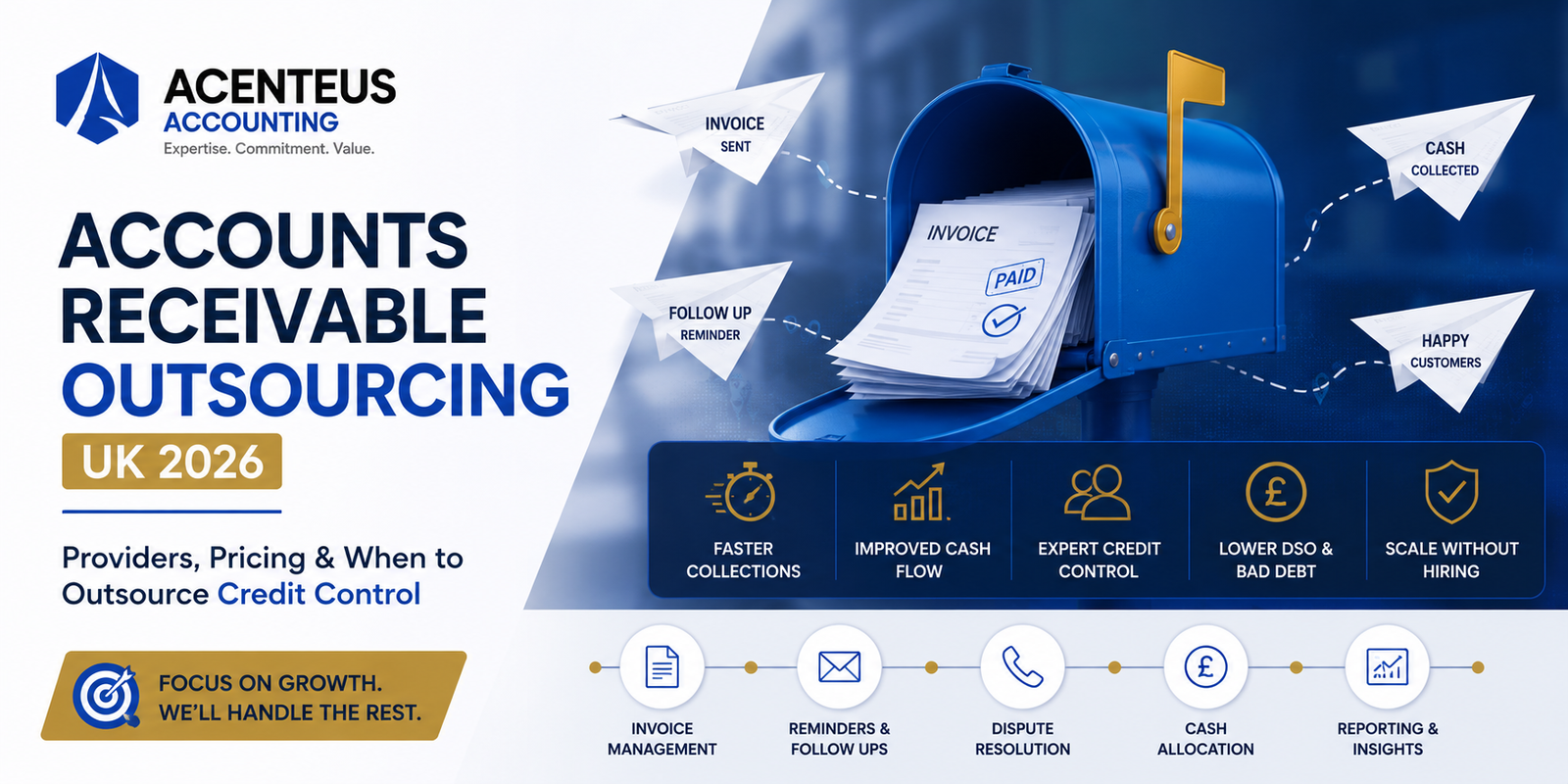
Accounts receivable outsourcing means handing your sales ledger and credit control to an external specialist who chases invoices, manages disputes, allocates cash and reports on your debtors, so you collect faster without hiring. In the UK in 2026 it typically costs from around £200 to £900 a month on a fixed retainer for a small to mid ledger, or a per invoice or per FTE fee for larger volumes, with debt recovery on older accounts often charged as a percentage of what is collected. You should outsource credit control once chasing outgrows the person doing it: when your debtor days sit well above your payment terms, aged debt over 90 days is climbing, or nobody owns collections day to day. This is a buyer’s guide to the providers, the pricing models and the decision itself, not a how to for running receivables in house.
Late payment is the reason this decision matters more in 2026 than it used to. The Small Business Commissioner and the Department for Business and Trade estimate that late payments cost the UK economy almost £11 billion a year, contribute to 14,000 business closures (38 a day), and leave UK businesses owed around £26 billion at any one time, an average of £17,000 per affected business. Owners spend an average of 86 hours a year chasing debt. From April 2026 the government confirmed a package of reforms, including a 60 day cap on payment terms imposed on large firms and mandatory statutory interest in commercial contracts, which tilts the balance back towards suppliers who actually run disciplined credit control. Whether you run that discipline in house or outsource it is a working capital decision, and this guide is built to help you make it. If you would rather keep the function in house, our separate guide to managing accounts receivable internally covers the process, and this article picks up where that choice ends.
Key takeaways
- What it is: accounts receivable outsourcing delegates some or all of the receivables cycle (invoice dispatch, chasing, dispute handling, cash allocation, reporting and escalation) to an external provider. It is not the same as a one off debt collection agency.
- Typical UK cost in 2026: roughly £200 to £900 a month on a fixed retainer for small to mid ledgers, per invoice or per account fees at volume, managed FTE fees for full function cover, and a percentage of collections (often 5 to 15 percent or more) for aged or disputed debt recovery.
- When to outsource: when debtor days run well above your terms, aged debt over 90 days is rising, or no one owns chasing. Ledger size, overdue balance, debtor days, staffing capacity and collection workload are the five signals to read.
- In house is the expensive default: a £30,000 credit controller costs about £34,500 all in once employer National Insurance at 15 percent and pension are added, before software and overheads, and before you ask whether one person can cover holidays and disputes.
- Providers split by model: finance function outsourcers (full receivables inside a wider service), software led managed credit control, and credit management or collections specialists for harder debt. Match the model to your problem.
- Do due diligence: confirm brand voice control, escalation path, system integration, compliance (UK GDPR, ISO 27001, and FCA authorisation where debt collection is involved), reporting cadence, and exit terms before you sign.
What is accounts receivable outsourcing?
Accounts receivable outsourcing is a service in which an external provider runs part or all of your receivables cycle on your behalf, under your brand, using your accounting system. In scope, depending on the engagement, are raising and dispatching invoices, sending reminders and statements, chasing overdue accounts by phone and email, handling queries and disputes, allocating incoming cash against invoices, maintaining the sales ledger, reporting on aged debt and cash collected, and escalating stubborn accounts to formal recovery. You keep ownership of the customer relationship and the credit decisions. The provider supplies the disciplined, daily collection process that most in house teams cannot sustain once volume grows.
It helps to separate three things that get lumped together. Credit control outsourcing is the ongoing, proactive chasing of current and recently overdue invoices, run as a managed service to keep debtor days down. Full accounts receivable outsourcing wraps that into the wider ledger: invoicing, cash allocation, reporting and reconciliation, usually as part of an outsourced finance function. Debt collection or recovery is the recovery of older, disputed or defaulted debt, often by a specialist agency on a percentage of collections. Many businesses need the first, some need the second, and only a minority of accounts need the third. A good provider tells you which is which, rather than pushing everything towards recovery.
The commercial point is that outsourcing does not mean handing over the keys. The best arrangements keep your tone of voice, your escalation rules and your final say on credit limits, while giving you a team that chases every account on a fixed cadence rather than when someone in the office finds time. That cadence is what shortens payment cycles, and it is the thing that is hardest to protect in house when the person who chases is also doing everything else.
When should you outsource credit control?
Outsource credit control when the workload has outgrown the capacity and discipline you can give it in house, and the cost of slow collection is larger than the fee. The signal is rarely a single number. It is a pattern across five factors: ledger size, debtor days, overdue and aged debt, staffing capacity, and collection workload. The table below turns those into practical thresholds. Treat them as rules of thumb calibrated to UK small and mid sized businesses, not hard rules, because a clean ledger with a few large customers behaves very differently from a high volume ledger of small accounts.
| Signal | Keep it in house | Outsource credit control | Full AR outsourcing or recovery |
|---|---|---|---|
| Active debtor accounts | Under about 50 | About 50 to 300 | 300 plus, or multi entity |
| Debtor days versus terms | Within about 10 days of terms | 15 or more days over terms | 30 plus days over, and rising |
| Aged debt over 90 days | Low and stable | Rising month on month | Material and entrenched |
| Staffing capacity | Owner or one person copes | No dedicated resource, or stretched | Need a team, or specialist recovery |
| Collection workload | A few hours a week | Daily chasing and disputes | High volume plus legal escalation |
Two of these deserve a closer look because they drive the decision most often. Debtor days, or Days Sales Outstanding, is the average number of days it takes to collect after a sale, calculated as receivables divided by annual credit sales, multiplied by 365. If your terms are 30 days and your debtor days sit at 55, you are financing your customers for an extra 25 days out of your own working capital. Every day of that gap is cash you have earned but cannot use, and if you bridge it with an overdraft or invoice finance, it becomes a direct interest cost. Aged debt over 90 days is the second signal, because debt gets harder to collect the older it becomes, and a rising 90 plus bucket usually means the current chasing is not keeping up.
The staffing question is where the honest cost sits. A single credit controller is a single point of failure: holidays, illness and turnover all stop collections dead, and disputes pile up while cover is missing. A £30,000 credit controller costs about £34,500 all in once employer National Insurance at 15 percent and auto enrolment pension are added, before you count software, phone lines, training and management time. For that budget, many businesses get one person covering one function with no redundancy, whereas an outsourced team covers the same ledger continuously. That is the comparison to run, not fee against salary alone.
How much does accounts receivable outsourcing cost in the UK?
Accounts receivable outsourcing in the UK is priced on five main models, and most real quotes are a blend. The figures below are market benchmarks compiled from UK providers at the time of writing, not quotes, because the right price depends on ledger size, invoice volume, the age and difficulty of the debt, and how much of the cycle you hand over. Always get an itemised quote and confirm what is and is not included.
| Pricing model | How it works | Typical 2026 UK benchmark | Best suited to |
|---|---|---|---|
| Fixed monthly retainer | A set fee to manage the ledger or chase to an agreed cadence | About £200 to £900 plus a month for small to mid ledgers | Predictable ongoing credit control |
| Per invoice or per account | A fee per invoice chased or per active debtor account | A few pounds per invoice or account, scaling with volume | High volume, fluctuating ledgers |
| Managed FTE or per seat | A dedicated resource or team, often offshore with UK review | From roughly £1,500 to £3,000 plus a month per resource | Full function cover and scale |
| Percentage of collections | A commission on sums recovered, often no collection no fee | Commonly 5 to 15 percent or more, higher on older debt | Aged, disputed or defaulted debt |
| Hourly | Time based billing for ad hoc or project work | About £20 to £45 plus an hour | Catch up work and one off cleanups |
A fixed monthly retainer is the most common model for ongoing managed credit control, because it makes the cost predictable and keeps the provider focused on keeping the whole ledger current rather than cherry picking easy invoices. Percentage of collections is normal for genuine recovery work on older debt, where the risk is higher and the provider only earns if it recovers. Managed FTE pricing is where finance function outsourcers sit, and it is the model to look at if you want receivables run alongside bookkeeping, accounts payable and reporting rather than as a standalone service. For a sense of how these outsourced pricing models compare across the wider finance function, our breakdown of payroll outsourcing costs walks through the same per item, per FTE and retainer logic.
Read every quote against the in house all in cost, not the headline salary. Once you add employer National Insurance, pension, software licences, telephone and management time to a credit controller’s salary, and then factor the risk of a single point of failure, a managed service that covers the ledger continuously often lands at or below the true cost of one hire, while collecting more consistently.
How we compared the providers
We compared providers against nine criteria that decide whether outsourced receivables actually improves your cash position, rather than just moving the work. Each provider profile below is assessed on these, and the comparison table summarises the decision relevant ones. The assessment is editorial and based on each provider’s public positioning and category, so confirm current, specific terms with the provider before you rely on them.
- Credit control capability: the depth and discipline of proactive chasing, from reminders to structured escalation ladders.
- Reporting: aged debt, cash collected, DSO trend and account level visibility, on a set cadence.
- Debtor communication: whether the provider chases under your brand and tone, protecting customer relationships.
- Escalation: a clear path from friendly reminder to formal demand to recovery or legal, without over escalating good customers.
- System integrations: clean two way connection to Xero, QuickBooks, Sage or your ERP, so the ledger stays the single source of truth.
- Compliance: UK GDPR, data security (ISO 27001 is a strong signal), and FCA authorisation where the service includes debt collection.
- Pricing: transparency and fit of the pricing model to your ledger, with no incentive to chase the wrong accounts.
- Scalability: the ability to flex up for volume, seasonality or growth without you rehiring.
- Service model: finance function, software led managed service, or collections specialist, and how much control you keep.
The best accounts receivable outsourcing providers in the UK for 2026
The table gives the shortlist at a glance, then each profile goes deeper. The providers split into three groups, because they solve different problems: finance function outsourcers that run receivables inside a wider service, software led managed credit control, and credit management or collections specialists for harder debt. Match the group to your problem first, then the provider.
| Provider | Best for | Service model | Pricing model | Systems and compliance |
|---|---|---|---|---|
| Acenteus Accounting | Receivables inside a full outsourced finance function | Finance function, onshore review with offshore delivery | Managed FTE or fixed monthly, itemised | Xero, QuickBooks, Sage, UK GDPR, ISO aligned |
| Integra Global Solutions | Practices and businesses wanting flexible AR capacity | Offshore, dedicated accountants | Fixed monthly or hourly | Sage, IRIS, Xero, QuickBooks |
| AdvanceTrack | Accountancy practices wanting white label AR | Outsourcing for practices, ISO certified | Per job or managed resource | Cloud ledgers, ISO 27001, UK GDPR |
| Corient Business Solutions | Practices and SMEs bundling AR with bookkeeping | F&A outsourcing for UK practices | Managed resource or per process | Cloud accounting stack, UK compliance |
| Chaser | SMEs wanting software plus managed chasing | Software led outsourced credit control | Flat monthly fee, not commission | Xero, QuickBooks, Sage, in app CRM |
| Hilton-Baird Collection Services | Outsourced ledger management and recovery | Credit control and collections specialist | Retainer for ledger, percentage for recovery | Ledger systems, FCA regulated recovery |
| Creditreform UK | Audit ready collections with credit data | Credit management and collections | Service fee, percentage on recovery | Case dossiers, credit risk data, audit logs |
Acenteus Accounting
Acenteus Accounting is the strongest fit when you want receivables run as part of a complete finance function rather than as an isolated chasing service. Credit control sits alongside bookkeeping, cash allocation, accounts payable and management reporting, so the same team that chases your invoices also reconciles the cash and reports the aged debt, which removes the handoffs where receivables usually leak. Delivery is a hybrid model, offshore processing with UK qualified onshore review, which keeps cost down without giving up control, and the team works inside your existing ledger. On systems, Acenteus builds around clean integration with Xero and QuickBooks so the ledger stays the single source of truth. Best for: UK businesses that want the whole receivables cycle owned end to end, and accountancy practices that want to offer it to clients under their own brand. Pricing is a managed resource or fixed monthly fee, itemised. The watch out with any full function provider is to agree the credit control cadence and reporting explicitly in the SLA, so chasing does not become the quiet part of a broad engagement.
Integra Global Solutions
Integra Global Solutions lists accounts receivable outsourcing alongside bookkeeping, payroll and tax, and has served UK practices and businesses since 2004. Firms can take dedicated accountants on a fixed monthly fee or hourly billing with no minimum commitment. Best for: practices and businesses building receivables capacity gradually. The watch out is to confirm how chasing stays on your brand and tone, how granular the account level reporting is, and which security certifications apply, before you commit.
AdvanceTrack
AdvanceTrack is a well established outsourcing provider for UK accountancy practices, ISO certified and built around white label delivery. If you are a practice that wants to add accounts receivable and credit control to your client services without hiring, AdvanceTrack is designed for exactly that model, with the work coming back under your brand. Best for: practices, firm to firm. Compliance is a strength, with ISO 27001 and UK GDPR alignment. The watch out is that a practice focused provider is optimised for firm to firm delivery, so a business buying direct should confirm the fit.
Corient Business Solutions
Corient is a UK focused accounting outsourcer that offers accounts receivable within a broader bookkeeping and finance service, suited to practices and SMEs that want to bundle receivables with the rest of the ledger. Best for: buyers who want AR as one line in a wider outsourced service rather than a standalone specialist. Service model is managed resource or per process on cloud accounting systems. As with any bundled service, confirm that credit control is run as an active, measured process and not just ledger maintenance.
Chaser
Chaser pairs accounts receivable automation software with an outsourced credit control service, and it is a strong fit for SMEs that want disciplined chasing without the cost of a hire. The managed service chases on your behalf under your brand, at a flat monthly fee rather than commission, which keeps your spend predictable and the incentive aligned with clearing the whole ledger. It integrates with Xero, QuickBooks and Sage, and gives you an in app view of every chasing action. Best for: SMEs that want software driven, brand consistent chasing at a fixed cost. The watch out is that a software led service is built for proactive chasing of current and recently overdue debt, so genuinely aged or disputed debt may still need a recovery specialist.
Hilton-Baird Collection Services
Hilton-Baird Collection Services is an established UK specialist in outsourced ledger management and debt recovery, and it is the group to look at when the problem is not just cadence but harder, older debt. It offers ongoing outsourced credit control on a retainer as well as recovery of overdue accounts, typically on a percentage of what is collected. Best for: businesses that need both a managed ledger and a credible recovery capability behind it. As a regulated collections provider, it sits on the compliance heavy end of the market. The watch out is to be clear which accounts belong in proactive chasing and which in recovery, so you are not paying recovery rates for debt that only needed disciplined chasing.
Creditreform UK
Creditreform UK combines credit management and collections with credit risk data, and its distinctive strength is audit ready traceability: customer and account dossiers and action logs that tie every collection step to a documented escalation. That makes it a strong fit for finance teams that need defensible, auditable records, for example in regulated sectors. Best for: teams where case traceability and audit grade reporting are the baseline requirement. The watch out is that the quality of the output depends on the quality of the data you hand over, so clean customer and account records matter before you start.
The outsource decision framework
Use this framework to place your ledger, rather than jumping straight to a provider. It moves from cheapest and simplest to most specialist, and most businesses land in the middle two.
- Keep it in house if your debtor accounts are few, debtor days sit within about 10 days of terms, aged debt is low and stable, and one person comfortably covers chasing alongside their other work. Outsourcing here would add cost without moving the number.
- Outsource credit control as a managed service if chasing has become daily work, debtor days run 15 or more days over terms, or you have no dedicated resource and collections stop whenever that person is away. This is the largest group, and a fixed retainer or software led service usually fits.
- Move to full accounts receivable outsourcing if you want the whole cycle, invoicing through cash allocation and reporting, run as part of an outsourced finance function, or you are multi entity and need consistency across ledgers. Managed FTE pricing and a finance function provider fit here.
- Bring in a recovery specialist for the specific accounts that are genuinely aged, disputed or defaulted. This is a targeted, percentage of collections engagement layered on top of, not instead of, disciplined current chasing.
The common mistake is treating the whole ledger as a recovery problem and paying recovery rates for debt that only needed consistent chasing. The opposite mistake is leaving aged debt inside a proactive service that is not built to recover it. Split the ledger, and match each part to the right model.
Due diligence checklist before you sign
Before you appoint a provider, confirm the following. These are the questions that separate a service that improves cash from one that simply moves the admin.
- Brand voice and control: does the provider chase under your name and tone, and do you keep the final say on credit limits, holds and write offs.
- Escalation path: is there a defined ladder from reminder to statement to formal demand to recovery, and who authorises each step.
- System integration: does it connect cleanly and two way to your Xero, QuickBooks, Sage or ERP, so the ledger stays the single source of truth rather than a parallel spreadsheet.
- Reporting cadence: what do you get, how often, aged debt, cash collected, DSO trend and account level notes, and is it genuinely actionable.
- Compliance: UK GDPR and clear data handling, ISO 27001 or equivalent security, and FCA authorisation where the service includes debt collection. Our note on onshore and offshore delivery, data security and compliance sets out what good looks like.
- Pricing transparency: is the model itemised, and does it avoid incentives to chase the wrong accounts, for example commission only structures that neglect current debt.
- Scalability and continuity: can the provider flex for seasonality and growth, and is there cover so collections do not stop when one person is away.
- Data handover and onboarding: how is your sales ledger transferred, how long does onboarding take, and what is expected of your team.
- Exit terms and references: what is the notice period, how is the ledger handed back, and can the provider give reference clients of similar size and sector.
How Acenteus Accounting runs receivables
Acenteus Accounting treats accounts receivable as one connected part of the finance function, not a standalone chasing desk. The same team maintains the sales ledger, chases to an agreed cadence under your brand, allocates cash, reconciles, and reports aged debt and DSO trend, which is what stops receivables leaking at the handoffs between people and systems. Delivery is offshore processing with UK qualified onshore review, so you get the cost of scale with the control of local oversight, and the work happens inside your own accounting system.
The proof point that matters for receivables is operational accuracy and clear reporting, because a collections process is only as reliable as the ledger behind it. In one verified Clutch review, a Cambridge accounting firm that has outsourced its finance work to Acenteus Accounting since November 2024 described the delivery as completed “on time with minimal errors” and supported by “clear and well-structured” reporting. That is the standard that keeps a credit control process defensible: accurate balances, allocated cash, and reporting a client can act on. If you want to see how receivables fit into the wider service, our outsourced finance function page sets out the full scope, and our guide to the leading UK accounting outsourcing firms explains the practice versus business split that decides which kind of provider you actually need.
Frequently Asked Questions (FAQ)
Accounts receivable outsourcing is delegating some or all of your receivables cycle, invoicing, chasing, dispute handling, cash allocation, reporting and escalation, to an external provider who runs it under your brand and inside your accounting system. It differs from a one off debt collection agency, which recovers specific old or defaulted debts, usually on a percentage of what is collected.
Expect roughly £200 to £900 or more a month on a fixed retainer for a small to mid ledger, per invoice or per account fees at higher volume, managed FTE fees from about £1,500 a month for full function cover, and a percentage of collections, commonly 5 to 15 percent or more, for aged or disputed debt recovery. These are 2026 market benchmarks, not quotes, so get an itemised quote for your ledger.
No. Accounts receivable outsourcing, or credit control outsourcing, is the ongoing, proactive management of your current and recently overdue invoices to keep debtor days down. Debt collection or recovery targets older, disputed or defaulted accounts, is often run by a regulated specialist, and is usually charged on a percentage of sums recovered. Many businesses need the first and only occasionally need the second.
Outsource when chasing has outgrown the person doing it: when debtor days run 15 or more days over your terms, aged debt over 90 days is rising, or no one owns collections day to day. Read five signals together, ledger size, debtor days, overdue and aged debt, staffing capacity and collection workload, rather than any single number.
It should not, if the provider chases under your brand and tone and you keep the final say on holds and credit limits. A disciplined, professional cadence usually improves relationships, because customers get consistent, courteous reminders rather than sporadic, escalating ones. Confirm brand voice control in the service agreement before you sign.
The better providers integrate two way with Xero, QuickBooks, Sage or your ERP, so the ledger stays the single source of truth and you avoid parallel spreadsheets. Confirm the integration is genuinely two way and real time, not a periodic export, as part of due diligence.
A fixed monthly fee suits ongoing management of current and recently overdue debt, because it keeps the provider focused on the whole ledger and your cost predictable. A percentage of collections suits genuine recovery of aged or disputed debt, where the provider takes the risk and only earns on success. Splitting the ledger and matching each part to the right model is usually cheaper than putting everything on one structure.
Yes. Engagements range from chasing only, where you keep invoicing and cash allocation, to full receivables outsourcing inside an outsourced finance function. Start with the part that is causing the pain, usually the chasing, and expand if the working capital gain justifies it.
This guide is general commercial information for 2026 and not financial, legal or investment advice. Pricing, provider terms and regulations change, so confirm current figures with each provider and check GOV.UK before deciding. Provider assessments are editorial views based on public positioning, not endorsements.