TL;DR:
- Agentic AI is the defining trend of 2026 for accounting, where AI systems act autonomously to complete multi-step workflows without human intervention, unlike traditional automation that follows fixed rules.
- Autonomous AI agents can already handle invoice processing, bank reconciliation, VAT return preparation and client query handling in accounting practices today.
- The opportunity for UK practices includes 50 to 70 per cent efficiency gains on repetitive tasks, freed-up senior time for advisory work and the ability to scale without proportional headcount increase.
- The risk of using AI without human oversight includes hallucination, compliance risk, data security concerns and reputation damage, making qualified accountant review essential.
- Acenteus Cloud is the platform where Acenteus Accounting combines qualified UK people with agentic AI agents to deliver outsourced accounting and AI-powered automation to UK practices.
- The future belongs to firms that combine people and AI, not firms that replace people with AI, and the human-in-the-loop model where AI handles 80 per cent of work and humans review and approve output is the dominant approach in 2026.
Last reviewed: May 2026. All AI capability, compliance and data protection claims reflect current industry trends and Acenteus Cloud platform features as of 2026. Confirm specific AI capabilities and compliance certifications against current provider documentation before making technology adoption decisions.
Introduction: The 2026 Trend That Is Rewriting What Accounting Automation Means
Agentic AI is the defining trend of 2026 for accounting. It is rewriting what accounting automation means. For years, automation in accounting has meant fixed workflows, rule-based processes and humans doing the exception handling. Agentic AI changes this. AI systems can now act autonomously to complete multi-step tasks without human intervention. They adapt to new situations, make decisions and coordinate with other AI agents to handle entire workflows.
Many UK accounting practice owners and senior partners are curious but unclear on what agentic AI means in practice. They have heard the term but are not sure how it differs from the automation they already use. They are wondering whether AI will replace accountants or augment them. They are evaluating whether to adopt agentic AI now or wait until the technology matures.
This article explains agentic AI in accounting clearly without simplifying it into meaningless buzzwords. It covers what agentic AI is and how it differs from traditional automation, what autonomous AI agents can do in accounting today, where agentic AI is headed in 2026 and beyond, the opportunity for UK practices, the risk of using AI without human oversight and how Acenteus combines qualified people with agentic AI on Acenteus Cloud.
For the practical AI foundation, the AI transforming UK accounting firms SME guide 2026 and the how to automate your UK business accounting save time in 2026 guide provide complementary reads on practical AI tools and automation implementation.
What Is Agentic AI and How Is It Different From Traditional Automation?
What is agentic AI in accounting?
Agentic AI refers to AI systems that can act autonomously to complete multi-step tasks without human intervention. These systems adapt to new situations, make decisions and coordinate with other AI agents to handle entire workflows.
How is agentic AI different from traditional automation?
Traditional automation follows fixed rules. It executes predefined steps in a predefined order. If the workflow changes or an exception occurs, traditional automation breaks and requires human intervention. Agentic AI adapts and makes decisions. It can handle exceptions, learn from patterns and adjust its approach based on the context.
What is agentic AI and how is it different from regular AI in accounting. Regular AI in accounting typically means generative AI or predictive AI. Generative AI creates content such as text, images or code. Predictive AI forecasts future outcomes based on historical data. Agentic AI completes workflows. It takes action, not just creates content or makes predictions.
The key differences are:
| Aspect | Traditional Automation | Generative AI | Agentic AI |
|---|---|---|---|
| What it does | Follows fixed rules | Creates content | Completes workflows |
| Adaptability | None | Limited | High |
| Decision-making | None | None | Autonomous |
| Human intervention | Required for exceptions | Required for output | Minimal for routine work |
| Example | Rule-based data entry | AI-written email | Autonomous bookkeeping agent |
Examples in accounting include autonomous bookkeeping agents that reconcile bank feeds, process invoices and post entries without human touch. These agents can handle the full workflow from invoice receipt to payment to reconciliation without human intervention in many cases.
How is agentic AI different from traditional automation in practice?
A traditional automation rule might say “if invoice amount is over £1,000, route to manager for approval”. If the invoice does not match this rule, the automation breaks. An agentic AI agent can read the invoice, understand the context, check historical patterns, flag unusual items and route to the appropriate person based on the situation.
What Autonomous AI Agents Can Do in Accounting Today
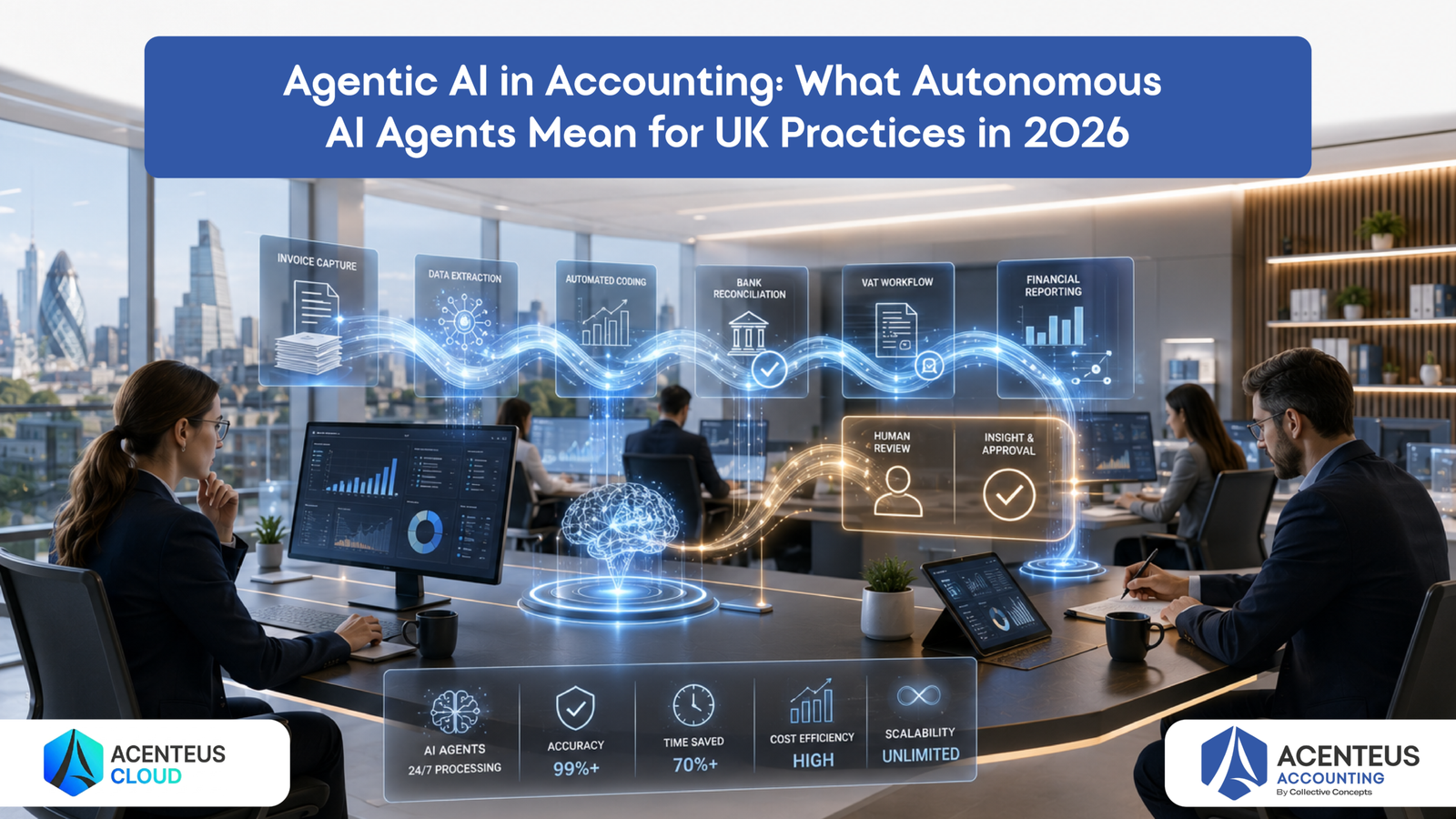
What can autonomous AI agents do in accounting today. Autonomous AI agents can already handle invoice processing, bank reconciliation, VAT return preparation, client query handling and workflow automation in accounting practices.
Automated Invoice Processing
Autonomous AI agents can read supplier invoices, extract line items, code to chart of accounts and post to ledger. This is automated invoice processing at scale. The agent can handle invoices in various formats including PDF, email attachments and scanned images.
The agent extracts key information such as supplier name, invoice date, invoice amount, VAT amount and line item details. It codes each line item to the appropriate account in the chart of accounts based on historical patterns and business rules. It then posts the entry to the ledger and updates the accounts payable.
Bank Reconciliation
AI bookkeeping agent UK 2026 capabilities include bank reconciliation. Autonomous AI agents can match transactions across bank feeds, accounting software and Excel reports without manual intervention. The agent identifies matching transactions, flags unmatched items, suggests reconciliations and posts reconciliation entries.
The agent can handle complex reconciliation scenarios such as multiple bank accounts, currency conversions, transfers between accounts and recurring transactions. It learns from historical reconciliation patterns to improve accuracy over time.
VAT Return Preparation
Autonomous AI agents can extract VAT data from transactions, validate against HMRC rules and prepare returns for review. The agent identifies VAT-eligible transactions, calculates VAT due, validates against current HMRC VAT rules and prepares the VAT return for human review and submission.
The agent can handle different VAT schemes including standard VAT, cash accounting VAT and flat rate VAT. It stays updated on HMRC VAT rule changes and adjusts calculations accordingly.
Client Query Handling
AI agents can answer routine client questions about invoices, payments and deadlines via chat or email. The agent can access client data, answer questions about invoice status, payment due dates, VAT deadlines and accounting file status.
This reduces the time accountants spend on routine client queries and frees them up for higher-value advisory work. The agent can escalate complex queries to human accountants when needed.
Workflow Automation
AI automation accounting 2026 includes workflow automation where agents assign tasks, track deadlines, send reminders and escalate overdue items automatically. The agent monitors workflow progress, identifies bottlenecks, assigns tasks to appropriate team members and sends reminders before deadlines.
The agent can integrate with accounting software such as Xero, QuickBooks and Sage to track workflow status and automate task assignment based on workload and expertise.
Can AI agents handle end-to-end bookkeeping without human intervention. In many routine cases, yes. Autonomous AI agents can handle end-to-end bookkeeping from invoice receipt to payment to reconciliation without human intervention for standard transactions. However, complex transactions, exceptions and unusual items still require human review and approval.
Where Agentic AI Is Heading in 2026 and Beyond
Where is agentic AI heading in 2026 for UK accounting firms. Agentic AI is heading toward end-to-end workflow automation, multi-agent systems, human-in-the-loop models, integration with accounting software and regulatory awareness.
End-to-End Workflow Automation
End-to-end workflow automation means from invoice receipt to payment to reconciliation without human intervention. This is the next step beyond current capabilities where AI agents handle individual tasks. Future AI agents will handle entire workflows from start to finish.
This includes automated invoice processing, automated approval routing, automated payment processing and automated reconciliation, all without human intervention for routine transactions.
Multi-Agent Systems
Multi-agent systems mean different AI agents handling different parts of the workflow and coordinating with each other. One agent handles invoice processing, another handles bank reconciliation, another handles VAT preparation and another handles client queries. These agents coordinate to ensure the workflow is complete and accurate.
Multi-agent systems can handle more complex workflows than single agents. They can distribute work across agents based on workload and expertise, improving efficiency and accuracy.
Human-in-the-Loop Models
What is the human-in-the-loop model for AI in accounting?
The human-in-the-loop model is where AI handles 80 per cent of work and human reviews and approves the final output. This is the dominant approach in 2026 for accounting AI.
The AI agent handles routine transactions, data entry, reconciliation and initial analysis. The human accountant reviews the AI output, approves exceptions, handles complex items and provides advisory input. This model combines AI efficiency with human expertise and judgment.
How will agentic AI change the role of the accountant in 2026?
The role of the accountant will shift from production to review and advisory. Accountants will spend less time on data entry and reconciliation and more time on exception handling, complex analysis and client advisory.
Integration with Accounting Software
Agentic AI systems are integrating with accounting software through native plugins for Xero, QuickBooks, Sage and other platforms. How do agentic AI systems integrate with Xero and QuickBooks. AI agents integrate through API connections, native plugins and workflow automation tools.
The Xero AI in accounting product update shows how Xero is building AI capabilities into its platform. QuickBooks blog on AI accounting covers how QuickBooks is integrating AI for accountants. Sage AI in accounting blog shows how Sage is adding AI capabilities.
Regulatory Awareness
AI agents are being trained on UK GAAP, HMRC rules and compliance requirements. This ensures that AI agents are aware of regulatory requirements and can adjust their output accordingly.
The GOV.UK future of making tax digital publication outlines how HMRC is evolving digital tax requirements, which AI agents need to be aware of.
The Opportunity for UK Practices: Efficiency, Advisory and Scale
What is the opportunity for UK practices with agentic AI. The opportunity includes efficiency gains of 50 to 70 per cent on repetitive tasks, freed-up senior time for client advisory rather than compliance production, scale without hiring and competitive advantage on margin and service quality.
Efficiency Gains
Efficiency gains of 50 to 70 per cent reduction in time spent on repetitive tasks are achievable with agentic AI. Invoice processing that used to take 10 minutes per invoice can now take 2 minutes with AI. Bank reconciliation that used to take 2 hours can now take 30 minutes with AI.
These efficiency gains free up accountant time for higher-value work. Accountants can spend more time on complex analysis, client advisory and business growth activities.
Advisory Capacity
Freed-up senior time for client advisory rather than compliance production is a key opportunity. When AI handles routine compliance work, senior accountants can focus on advisory services such as cash flow forecasting, tax planning, business strategy and financial analysis.
Advisory services typically have higher margins than compliance services. Practices that shift from compliance to advisory can improve their margins and client relationships.
Scale Without Hiring
Handling more clients without proportional headcount increase is another opportunity. With AI handling routine work, practices can take on more clients without hiring proportional additional staff. This improves practice economics and profitability.
This is particularly valuable given the accountancy talent crisis and outsourcing recruitment headaches that UK practices face. AI helps mitigate the talent shortage by augmenting existing staff capacity.
Competitive Advantage
Firms that adopt agentic AI first will outpace competitors on margin and service quality. Early adopters can offer faster turnaround times, lower prices and better service quality than competitors who rely on traditional automation or manual processes.
The outsourcing for accountants UK overview covers how outsourcing combined with AI can provide competitive advantage.
The Risk of Outsourcing AI Without Human Oversight
What are the risks of using AI for accounting in the UK. The risks include AI hallucination, compliance risk, data security concerns and reputation damage. Human oversight remains essential and a qualified accountant must review and approve AI output.
AI Hallucination
AI hallucination means AI can make confident mistakes that look correct but are wrong. An AI agent might reconcile transactions incorrectly, code an invoice to the wrong account or calculate VAT incorrectly. These mistakes look correct but are wrong.
Human review catches these mistakes before they reach clients or HMRC. This is why the human-in-the-loop model is essential.
Compliance Risk
AI may not be aware of the latest HMRC guidance or UK accounting standards. HMRC rules change and AI agents need to be updated accordingly. If AI agents are not updated, they may apply outdated rules and create compliance risk.
The security and GDPR red flags for outsourced accounting providers guide covers compliance considerations for AI and outsourcing.
Data Security
AI systems handling sensitive client data must meet GDPR and ISO 27001 requirements. The GOV.UK data protection guidance outlines GDPR requirements for handling personal data. AI systems must encrypt data, control access and maintain audit trails.
Practices using AI must ensure their AI providers meet these security requirements.
Reputation Risk
AI errors that reach clients can damage firm reputation faster than human errors. Clients expect accuracy from their accountants. AI mistakes that reach clients can erode trust and lead to client churn.
Human review prevents AI mistakes from reaching clients. This is essential for reputation management.
Human Oversight Remains Essential
Qualified accountants must review and approve AI output. This is non-negotiable. AI augments human accountants, it does not replace them. The ultimate guide to outsourcing for UK accountants covers the importance of human oversight in outsourcing and AI.
Will AI replace accountants in the next 5 years?
No. AI will augment accountants, not replace them. The role of the accountant will shift from production to review and advisory, but accountants will remain essential for complex analysis, judgment and client relationships.
How Acenteus Combines Qualified People With Agentic AI on Acenteus Cloud
Acenteus combines qualified UK accountants with agentic AI agents on the Acenteus Cloud platform. AI agents handle repetitive tasks like invoice processing, reconciliation and data entry. Qualified UK accountants review, approve and advise on AI output.
This is the human-in-the-loop model in practice. AI handles 80 per cent of work, humans handle 20 per cent of complex items and review.
Acenteus Accounting is a modern outsourcing partner combining qualified people with automation. The accounting outsourcing for UK accounting firms page covers how Acenteus provides outsourcing support for UK practices.
The tax compliance outsourcing UK page covers how Acenteus handles tax compliance with AI and human oversight. The VAT compliance outsourcing guide covers VAT outsourcing with AI.
Acenteus Cloud Platform Overview: Where AI and Human Expertise Meet
Acenteus Cloud is the platform where Acenteus delivers outsourced accounting and AI-powered automation to UK practices. It is where qualified people and agentic AI meet, not AI replacing people.
What Acenteus Cloud Is
Acenteus Cloud is the platform where Acenteus delivers outsourced accounting and AI-powered automation. The Acenteus Cloud platform page provides details on platform features. The Acenteus Cloud AI automation page covers AI capabilities on the platform.
How AI Is Integrated
Agentic AI agents handle repetitive tasks like invoice processing, reconciliation and data entry on Acenteus Cloud. These agents are integrated into the workflow and work alongside human accountants.
The AI automation accounting capabilities on Acenteus Cloud include automated invoice processing, bank reconciliation, VAT return preparation and workflow automation.
Where Human Expertise Comes In
Qualified UK accountants review, approve and advise on AI output on Acenteus Cloud. This is the human-in-the-loop model. AI handles routine work, humans handle complex items and review.
Human expertise is essential for exception handling, complex analysis and client advisory. Acenteus Cloud ensures that human accountants are involved at the right points in the workflow.
Platform Features
Acenteus Cloud platform features include secure client portal, real-time dashboard, workflow tracking, audit trail and GDPR-compliant data handling. The Acenteus Cloud homepage provides an overview of the platform.
The secure client portal allows clients to access their accounting files, view reports and communicate with the Acenteus team. The real-time dashboard shows workflow status, deadline tracking and KPI metrics. Workflow tracking shows task progress and assignment. Audit trail maintains a record of all actions taken on client files. GDPR-compliant data handling ensures data protection compliance.
Security and Compliance
Acenteus Cloud meets ISO 27001, GDPR compliance, data encryption and access controls. Security and compliance are essential for handling sensitive client data.
The security and GDPR red flags guide covers what to look for in an outsourced accounting provider’s security and compliance.
How Engagement Works
How engagement works on Acenteus Cloud: Acenteus assesses current workflow, identifies highest-cost processes, deploys AI agents and human oversight, reviews and iterates.
The engagement process starts with workflow assessment. Acenteus understands the practice’s current workflow, identifies pain points and highest-cost processes. Then Acenteus deploys AI agents for repetitive tasks and human accountants for complex items and review. The engagement is reviewed regularly and iterated to improve performance.
The first time outsourcing decision framework covers how to evaluate outsourcing for UK practices. The what does accounting outsourcing cost guide covers pricing models for outsourcing.
Can I start with AI automation and scale up over time. Yes. You can start with AI automation for specific processes and scale up over time. Acenteus Cloud supports phased adoption where practices start with pilot processes and expand to broader workflows.
The Xero and QuickBooks integrations outsourcing partner 2025 guide covers how Acenteus integrates with accounting software. The how to solve year-end accounting bottlenecks with outsourcing guide covers how outsourcing helps with year-end pressure.
Acenteus Cloud provides AI powered accounting workflow UK capabilities that combine agentic AI with human expertise. The offshore vs onshore accounting UK 2025 quality security cost guide covers the quality and security considerations for outsourcing.
Conclusion: The Future Belongs to Firms That Combine People and AI
The future belongs to firms that combine people and AI, not firms that replace people with AI. Agentic AI is the defining trend of 2026 for accounting. It is rewriting what accounting automation means. Autonomous AI agents can handle invoice processing, bank reconciliation, VAT return preparation and client query handling today.
The opportunity for UK practices includes 50 to 70 per cent efficiency gains on repetitive tasks, freed-up senior time for advisory work and the ability to scale without proportional headcount increase. The risk of using AI without human oversight includes hallucination, compliance risk, data security concerns and reputation damage, making qualified accountant review essential.
Acenteus Cloud is the platform where Acenteus Accounting combines qualified UK people with agentic AI agents to deliver outsourced accounting and AI-powered automation to UK practices. The human-in-the-loop model where AI handles 80 per cent of work and humans review and approve output is the dominant approach in 2026.
How do I know if my practice is ready for agentic AI?
Your practice is ready for agentic AI if you have digital workflows, accounting software integration and willingness to adopt new technology. Start with pilot processes and scale up over time.
If you want to combine qualified people with agentic AI for your practice, Acenteus Accounting provides outsourced accounting and AI-powered automation on Acenteus Cloud that scales with your workload and delivers capacity with human oversight.
Frequently Asked Questions (FAQ)
Agentic AI completes workflows autonomously, while regular AI creates content or makes predictions. Agentic AI acts without human intervention, regular AI requires human input and output review.
In many routine cases yes, but complex transactions and exceptions still require human review. The human-in-the-loop model where AI handles 80 per cent and humans review is essential.
The human-in-the-loop model is where AI handles 80 per cent of work and human reviews and approves the final output. This combines AI efficiency with human expertise and judgment.
Agentic AI integrates through API connections, native plugins and workflow automation tools. Xero and QuickBooks are building AI capabilities into their platforms.
Risks include AI hallucination, compliance risk, data security concerns and reputation damage. Human oversight and qualified accountant review are essential to mitigate these risks.
No. AI will augment accountants, not replace them. The role will shift from production to review and advisory, but accountants remain essential for complex analysis and judgment.
Cost varies by provider and scope. Managed FTE outsourcing with AI typically costs £1,400 to £3,000 per month per FTE. Per job pricing varies by engagement type.
Acenteus Cloud is the platform where Acenteus delivers outsourced accounting and AI-powered automation. Agentic AI agents handle repetitive tasks while qualified accountants review and advise.
Yes. You can start with AI automation for specific processes and scale up over time. Phased adoption is common and reduces implementation risk.
Your practice is ready if you have digital workflows, accounting software integration and willingness to adopt new technology. Start with pilot processes and expand gradually.