TL;DR:
- Tax season capacity can be modelled using a simple formula: available billable hours per staff member multiplied by headcount equals total team capacity, and total team capacity subtracted from peak season workload equals the capacity gap.
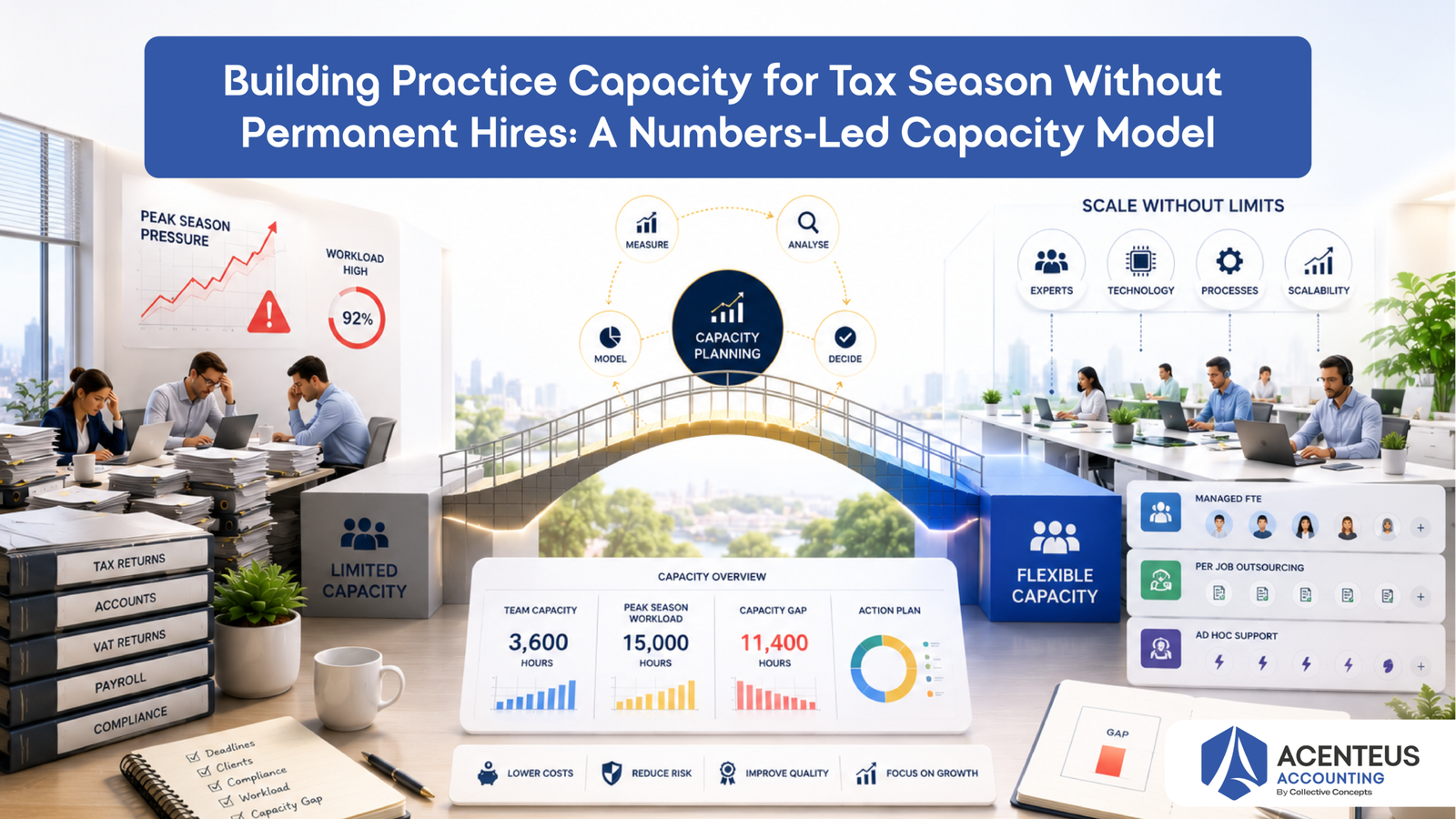
- A typical UK practice with 10 staff at 30 billable hours per week has 3,600 hours of capacity over 12 weeks, which is often insufficient for 15,000 hours of peak season workload, creating an 11,400 hour shortfall.
- Hiring three permanent accountants to cover an 11,400 hour gap costs around £135,000 per year fully loaded, with three months of time-to-productivity and ongoing under-utilisation in non-peak months.
- Using four managed FTE offshore resources at £2,500 per month for four months costs £40,000, delivers full output from month one with documented processes and has no ongoing cost after peak season.
- Per job outsourcing for 1,200 tax returns at £35 each, 500 sets of accounts at £80 each and 200 VAT returns at £60 each costs £94,000 for the peak season and offers high flexibility but no dedicated capacity.
- The break-even point between hiring and outsourcing occurs when the fully loaded cost of permanent hires exceeds the cost of flexible resources, which typically happens when the capacity gap can be covered by two or fewer FTEs for four months or less.
Last reviewed: May 2026. All salary, productivity and cost figures reflect typical UK accounting practice benchmarks as of 2026. Confirm specific figures against your own practice data and current market rates before making hiring or outsourcing decisions.
Introduction: The Capacity Problem That Triggers Outsourcing Enquiries
The capacity problem that triggers outsourcing enquiries is simple and repeatable. Peak season workload arrives in November and December. Self-Assessment deadlines approach in January and March. Corporation Tax deadlines stack up throughout the year. VAT returns are due every quarter. The existing team is already at full capacity. The practice owner faces a choice. Hire permanent staff and carry the cost year round. Or find a flexible resource model that scales up for peak season and scales down afterwards.
How do I scale accounting practice capacity without permanent hires. The answer is to model the capacity gap, compare the cost of permanent hires against flexible resources and choose the model that delivers the required capacity at the lowest total cost with the least risk.
This guide is a numbers-led capacity model with a worked example. Every section includes a calculation, table or formula. The reader can plug their own numbers into this model and derive a decision. This is not a narrative or general advice piece. It is a practical capacity model that you can apply to your own practice.
For the broader strategic context on scaling and peak season planning, the most effective way to scale accounting practice capacity and the peak season playbook for tax season provide complementary reads.
Worked Example: Practice Size, Current Capacity, Peak Season Workload Gap
The worked example below is designed to be adapted to your own practice. Use realistic figures for your headcount, billable hours per week, peak season workload and cost structure.
Practice Profile:
- 10 staff including 2 partners
- Current capacity: 30 hours per week per staff member
- Peak season workload: 15,000 hours needed over 12 weeks (November to February)
Current team capacity over 12 weeks:
10 staff × 30 hours × 12 weeks = 3,600 hours
Workload gap:
15,000 hours – 3,600 hours = 11,400 hours shortfall
This 11,400 hour shortfall is the capacity gap that needs to be filled. The question is how to fill it most cost-effectively.
Option A: Hire Permanent Staff
- 3 new accountants to cover the gap
- Fully loaded cost per accountant: £45,000 per year (salary, NI, pension, overhead)
- Total cost: 3 × £45,000 = £135,000 per year
- Time-to-productivity: 3 months training before full output
- Ongoing cost in non-peak months when capacity is under-utilised
Option B: Managed FTE Outsourcing
- 4 offshore FTEs at £2,500 per month per FTE
- 4 months of peak season support (November to February)
- Total cost: 4 FTEs × £2,500 per month × 4 months = £40,000
- Full output from month one with documented processes
- No ongoing cost after peak season
Option C: Per Job Outsourcing
- 1,200 tax returns at £35 per return = £42,000
- 500 sets of accounts at £80 per set = £40,000
- 200 VAT returns at £60 per return = £12,000
- Total cost: £42,000 + £40,000 + £12,000 = £94,000 for peak season work
Comparison Table:
| Metric | Permanent Hire | Managed FTE | Per Job |
|---|---|---|---|
| Upfront cost | £135,000 | £40,000 | £94,000 |
| Time-to-productivity | 3 months | 2 weeks | 4 weeks |
| Ongoing cost | Yes | No | No |
| Flexibility | Low | Medium | High |
| Risk | High | Low | Medium |
This worked example shows the scale of the cost difference. Permanent hiring costs £135,000 per year. Managed FTE outsourcing costs £40,000 for four months. Per job outsourcing costs £94,000 for the peak season work. The managed FTE option is the cheapest in this scenario and delivers capacity quickly with low risk.
The Workload Capacity Formula: How Many Hours Can Your Team Handle?
How do I calculate practice capacity for tax season in the UK. The answer is to use a workload capacity formula that calculates available billable hours per staff member, multiplies by headcount and subtracts from peak season workload to find the capacity gap.
Available Hours per Staff Member
The starting point is the standard full-time working week in the UK.
- Hours per week: 37.5 standard full-time
- Non-billable time: 20 per cent (meetings, admin, training, client calls)
- Billable hours per week: 30 hours (37.5 × 0.8)
- Billable hours per month: 130 hours (30 × 4.33)
- Billable hours per year: 1,560 hours (30 × 52)
This formula assumes 20 per cent non-billable time. Some practices may have higher or lower non-billable time depending on their workflow, client mix and practice culture. Adjust the non-billable percentage to reflect your practice.
The billable hours per staff member is the foundation of the capacity model. Multiply this by headcount to get total team capacity.
Total team capacity formula:
Total team capacity = Billable hours per staff member × Headcount × Number of weeks
For a 10 staff practice over 12 weeks:
Total team capacity = 30 hours × 10 staff × 12 weeks = 3,600 hours
This is the capacity available to handle peak season workload.
Peak Season Workload by Task Type
Peak season workload varies by task type. The average hours per task are:
- Self-Assessment returns: 1.5 hours per return (average)
- Corporation Tax returns: 2.5 hours per return (average)
- VAT returns: 1 hour per return (average)
- Year-end accounts: 6 hours per set (average, bookkeeping excluded)
How many hours does a tax return take in a UK accounting practice. The average is 1.5 hours for a Self-Assessment return and 2.5 hours for a Corporation Tax return. These are industry benchmarks that vary by complexity and client sophistication.
Peak season workload formula:
Peak season workload = (Self-Assessment returns × 1.5) + (Corporation Tax returns × 2.5) + (VAT returns × 1) + (Year-end accounts × 6)
For a practice with 1,200 Self-Assessment returns, 300 Corporation Tax returns, 200 VAT returns and 500 sets of year-end accounts:
Peak season workload = (1,200 × 1.5) + (300 × 2.5) + (200 × 1) + (500 × 6)
Peak season workload = 1,800 + 750 + 200 + 3,000
Peak season workload = 5,750 hours
This is the total peak season workload in hours. Compare this to total team capacity to find the capacity gap.
Capacity Gap Formula
How do I calculate my practice’s capacity gap for tax season. The answer is to subtract total team capacity from peak season workload.
Capacity gap formula:
Capacity gap = Peak season workload – Total team capacity
For the worked example:
Capacity gap = 15,000 hours – 3,600 hours = 11,400 hours
This 11,400 hour gap is what needs to be filled through hiring or outsourcing.
Number of FTEs Needed
How many tax returns can one accountant handle in peak season. The answer depends on the accountant’s billable hours per week and the complexity of the returns. A typical accountant at 30 billable hours per week can handle around 20 Self-Assessment returns per week (30 hours ÷ 1.5 hours per return).
To calculate the number of FTEs needed:
Number of FTEs needed formula:
Number of FTEs needed = Capacity gap ÷ (Billable hours per FTE × Number of weeks)
For the worked example with 11,400 hour gap over 12 weeks:
Number of FTEs needed = 11,400 ÷ (30 × 12)
Number of FTEs needed = 11,400 ÷ 360
Number of FTEs needed = 31.67 FTEs
This calculation shows that 32 FTEs would be needed to cover the gap if using internal staff. This is clearly not feasible for a 10 staff practice, which is why outsourcing becomes necessary.
For outsourcing, the number of FTEs needed is calculated differently. If using managed FTE outsourcing at full output from month one:
Number of outsourced FTEs needed = Capacity gap ÷ (Outsourced FTE hours per week × Number of weeks)
Assuming outsourced FTEs work 35 hours per week:
Number of outsourced FTEs needed = 11,400 ÷ (35 × 12)
Number of outsourced FTEs needed = 11,400 ÷ 420
Number of outsourced FTEs needed = 27.14 FTEs
This still seems high because the worked example uses a 15,000 hour peak season workload, which is substantial for a 10 staff practice. In practice, most practices would not have such a large gap and would use a combination of internal capacity and outsourcing to fill the gap.
A more realistic scenario for a 10 staff practice:
- Peak season workload: 6,000 hours over 12 weeks
- Current team capacity: 3,600 hours over 12 weeks
- Capacity gap: 6,000 – 3,600 = 2,400 hours
Number of outsourced FTEs needed = 2,400 ÷ (35 × 12)
Number of outsourced FTEs needed = 2,400 ÷ 420
Number of outsourced FTEs needed = 5.71 FTEs
This suggests around 6 outsourced FTEs would be needed to cover a 2,400 hour gap over 12 weeks.
Mapping Peak Season Workload: Self-Assessment, Corporation Tax and VAT Deadlines
How do I plan workload for self-assessment season in the UK. The answer is to map the deadlines, calculate the workload by task type and build a timeline that shows when the workload peaks.
Self-Assessment Deadlines
The Self-Assessment deadlines for 2026/27 are:
- Paper tax return submission: 31 October 2026
- Online tax return submission: 31 January 2027
- Balancing payment: 31 January 2027
- First payment on account: 31 January 2027
- Second payment on account: 31 July 2027
The peak workload for Self-Assessment is in January when the online submission deadline and payment deadline coincide. This is when most practices experience the highest capacity pressure.
GOV.UK’s Self-Assessment tax return deadlines confirms these dates.
Corporation Tax Deadlines
Corporation Tax deadlines depend on the company’s accounting period. For most small companies:
- Corporation tax payment: 9 months and 1 day after period end
- CT600 filing deadline: 12 months after period end
Corporation Tax deadlines are spread throughout the year depending on accounting period ends. This creates a more even workload distribution compared to Self-Assessment.
VAT Deadlines
VAT deadlines are quarterly for most businesses:
- VAT return submission: One month and seven days after quarter end
- VAT payment: Same as return submission deadline
VAT deadlines create a predictable quarterly workload pattern. The workload is less intense than Self-Assessment but more frequent.
What Is the Typical Peak Season Workload for a UK SME Accounting Firm?
The typical peak season workload for a UK SME accounting firm varies by practice size and client mix. For a 10 staff practice:
- Self-Assessment returns: 800 to 1,200 returns
- Corporation Tax returns: 200 to 400 returns
- VAT returns: 300 to 500 returns
- Year-end accounts: 400 to 600 sets
Using the average hours per task:
- Self-Assessment workload: 1,000 × 1.5 = 1,500 hours
- Corporation Tax workload: 300 × 2.5 = 750 hours
- VAT workload: 400 × 1 = 400 hours
- Year-end accounts workload: 500 × 6 = 3,000 hours
Total peak season workload = 1,500 + 750 + 400 + 3,000 = 5,650 hours
This is over a 12 week period from November to February. The weekly workload is 5,650 ÷ 12 = 471 hours per week.
For a 10 staff team at 30 billable hours per week, total capacity is 300 hours per week. The capacity gap is 471 – 300 = 171 hours per week.
Over 12 weeks, the capacity gap is 171 × 12 = 2,052 hours.
This is a more realistic capacity gap for a 10 staff practice than the 11,400 hour gap in the initial worked example.
The Permanent Hire Option: Fully Loaded Cost and Time-to-Productivity
How much does it cost to hire a permanent accountant in the UK. The fully loaded cost includes salary, employer NI, pension, overhead and recruitment cost.
Fully Loaded Cost per Accountant
Typical salary ranges for accountants in UK practices:
- Junior accountant: £28,000 to £35,000 per year
- Qualified accountant: £40,000 to £55,000 per year
- Senior accountant: £50,000 to £65,000 per year
For this model, use a fully loaded cost of £45,000 per year for a qualified accountant. This includes:
- Salary: £38,000
- Employer NI: £4,500 (approximately 13.8 per cent of salary above threshold)
- Pension: £1,700 (3 per cent of salary)
- Overhead: £800 (office space, equipment, software)
- Total: £45,000 per year
This figure is consistent with ICAEW practice benchmarks and industry data.
Time-to-Productivity
What is the time-to-productivity for a new accountant in a UK practice. The typical time-to-productivity is 3 months for a qualified accountant. This includes:
- Month 1: Recruitment, onboarding, training on practice systems
- Month 2: Supervised work, gradual increase in workload
- Month 3: Full output with minimal supervision
During the first 3 months, the new accountant is not at full productivity. Assume 50 per cent productivity in month 1, 75 per cent in month 2 and 100 per cent in month 3.
This means the new accountant delivers only 75 per cent of full output over the first 3 months (50 + 75 + 100 = 225 per cent over 3 months, averaged to 75 per cent per month).
For peak season capacity planning, this time-to-productivity is critical. If peak season starts in November and the new accountant starts in September, the accountant will be at full productivity by December. If the accountant starts in October, they will not be at full productivity until January, which is when peak season is at its highest.
Ongoing Cost in Non-Peak Months
The ongoing cost in non-peak months when capacity is under-utilised is a key drawback of permanent hiring. If the practice hires 3 accountants to cover peak season capacity, those accountants are paid year round even when workload is lower.
For 3 accountants at £45,000 per year:
- Annual cost: 3 × £45,000 = £135,000
- Peak season cost (4 months): £135,000 × (4 ÷ 12) = £45,000
- Non-peak season cost (8 months): £135,000 × (8 ÷ 12) = £90,000
The non-peak season cost of £90,000 is the cost of under-utilised capacity. This is a significant ongoing cost that permanent hiring carries year round.
How Many Tax Returns Can One Accountant Handle During Peak Season in the UK?
How many tax returns can one accountant handle during peak season in the UK. A qualified accountant at 30 billable hours per week can handle around 20 Self-Assessment returns per week (30 hours ÷ 1.5 hours per return).
Over 12 weeks, one accountant can handle:
20 returns per week × 12 weeks = 240 Self-Assessment returns
For Corporation Tax returns at 2.5 hours per return:
30 hours per week ÷ 2.5 hours per return = 12 Corporation Tax returns per week
Over 12 weeks, one accountant can handle:
12 returns per week × 12 weeks = 144 Corporation Tax returns
For year-end accounts at 6 hours per set:
30 hours per week ÷ 6 hours per set = 5 sets of accounts per week
Over 12 weeks, one accountant can handle:
5 sets per week × 12 weeks = 60 sets of accounts
These figures assume the accountant is working at full capacity on these tasks. In practice, the accountant will also handle other work, so the actual number of returns handled will be lower.
The Flexible Resource Option: Managed FTE and Per Job Pricing
How does managed FTE outsourcing work for peak season capacity. Managed FTE outsourcing provides a dedicated offshore resource on a monthly retainer basis. The resource is assigned exclusively to the practice and works on the practice’s clients following the practice’s workflows.
Managed FTE Pricing
Managed FTE pricing for accounting outsourcing in the UK typically ranges from:
- Entry-level bookkeeping FTE: £1,400 to £1,800 per month
- Qualified accountancy-grade FTE: £1,800 to £2,400 per month
- Senior or specialist FTE: £2,400 to £3,000 per month
For this model, use £2,500 per month per FTE for a qualified accountancy-grade FTE. This is consistent with the accounting outsourcing pricing guide.
Managed FTE Capacity
A managed FTE offshore resource typically works 35 hours per week. This is slightly higher than the 30 billable hours per week for in-house staff because offshore resources often have lower non-billable time.
Billable hours per managed FTE per month:
35 hours per week × 4.33 weeks = 151.55 hours per month
Billable hours per managed FTE per 4 months:
151.55 hours × 4 months = 606.2 hours
For 4 managed FTEs over 4 months:
4 FTEs × 606.2 hours = 2,424.8 hours
This 2,424.8 hours of capacity is close to the 2,400 hour capacity gap in the realistic scenario above.
Per Job Pricing
Per job pricing charges a fixed fee per completed engagement. Typical per job prices for accounting outsourcing:
- Self-Assessment tax return: £30 to £40 per return
- Corporation Tax return: £80 to £120 per return
- VAT return: £25 to £60 per return
- Year-end accounts (limited company): £80 to £150 per set
For this model, use:
- Self-Assessment tax return: £35 per return
- Corporation Tax return: £100 per return
- VAT return: £60 per return
- Year-end accounts: £80 per set
Per Job Capacity
Per job pricing does not provide capacity in the same way as managed FTE. Instead, it provides a fixed cost for a fixed volume of work. The practice sends the work and pays per job completed.
For 1,200 Self-Assessment returns at £35 per return:
1,200 × £35 = £42,000
For 500 sets of year-end accounts at £80 per set:
500 × £80 = £40,000
For 200 VAT returns at £60 per return:
200 × £60 = £12,000
Total per job cost: £42,000 + £40,000 + £12,000 = £94,000
This is the cost for the peak season work using per job pricing.
How Do I Decide Between Per Job and Managed FTE for Peak Season?
How do I decide between per job and managed FTE for peak season capacity. The decision depends on volume, predictability and flexibility needs.
Managed FTE is better when:
- Volume is steady and predictable
- Practice wants dedicated capacity that is always available
- Practice wants to build institutional knowledge over time
- Practice has ongoing work beyond peak season
Per job is better when:
- Volume is variable and unpredictable
- Practice wants to pay only for work completed
- Practice needs maximum flexibility to scale up or down
- Practice has one-off or project-based work
For peak season capacity, managed FTE is typically more cost-effective for steady volume, while per job is more cost-effective for variable volume or one-off work.
The Capacity Model Comparison: Side-by-Side Numbers for Your Practice
The capacity model comparison below shows side-by-side numbers for the permanent hire option, managed FTE option and per job option. Use this table to compare the options for your own practice.
Comparison Table for Worked Example
| Metric | Permanent Hire | Managed FTE | Per Job |
|---|---|---|---|
| Capacity gap | 2,400 hours | 2,400 hours | 2,400 hours |
| Number of resources | 3 accountants | 6 FTEs | N/A (per job) |
| Upfront cost | £135,000 per year | £60,000 (4 months) | £94,000 (peak season) |
| Cost per hour | £56.25 | £24.75 | £39.17 |
| Time-to-productivity | 3 months | 2 weeks | 4 weeks |
| Ongoing cost | Yes (£90,000 non-peak) | No | No |
| Flexibility | Low | Medium | High |
| Risk | High | Low | Medium |
| Dedicated capacity | Yes | Yes | No |
| Institutional knowledge | Builds over time | Builds over time | No |
Cost per hour calculation:
- Permanent hire: £135,000 ÷ (3 accountants × 1,560 hours) = £135,000 ÷ 4,680 = £28.85 per hour (annual cost)
- For peak season 4 months only: £45,000 ÷ 2,400 hours = £18.75 per hour (but this ignores non-peak cost)
- Full cost including non-peak: £135,000 ÷ 2,400 hours = £56.25 per hour (annual cost spread over peak hours)
- Managed FTE: £60,000 ÷ 2,424.8 hours = £24.75 per hour
- Per job: £94,000 ÷ 2,400 hours = £39.17 per hour
The managed FTE option has the lowest cost per hour at £24.75 per hour. The permanent hire option has the highest cost per hour at £56.25 per hour when the full annual cost is spread over peak season hours. The per job option is in between at £39.17 per hour.
Comparison Table for Realistic 10 Staff Practice
| Metric | Permanent Hire | Managed FTE | Per Job |
|---|---|---|---|
| Peak season workload | 5,650 hours | 5,650 hours | 5,650 hours |
| Current team capacity | 3,600 hours | 3,600 hours | 3,600 hours |
| Capacity gap | 2,050 hours | 2,050 hours | 2,050 hours |
| Number of resources | 2 accountants | 5 FTEs | N/A (per job) |
| Fully loaded cost per resource | £45,000 | £2,500 per month | Per job rate |
| Total upfront cost | £90,000 per year | £50,000 (4 months) | £80,000 (peak season) |
| Time-to-productivity | 3 months | 2 weeks | 4 weeks |
| Ongoing cost | Yes | No | No |
| Flexibility | Low | Medium | High |
For this realistic scenario, the managed FTE option costs £50,000 for 4 months, the permanent hire option costs £90,000 per year and the per job option costs £80,000 for peak season. The managed FTE option is still the cheapest.
Acenteus Accounting provides outsourced accounting support for UK practices with managed FTE, per job and ad hoc pricing models across bookkeeping, VAT, payroll and year-end accounts.
The Break-Even Point: When Does Outsourcing Become Cheaper Than Hiring?
What is the break-even point between hiring and outsourcing for peak season. The break-even point is when the fully loaded cost of permanent hires equals the cost of flexible resources.
Break-Even Calculation
For permanent hiring:
- Fully loaded cost per accountant: £45,000 per year
- Number of accountants needed: N
Total permanent hire cost = N × £45,000
For managed FTE outsourcing:
- Cost per FTE per month: £2,500
- Number of FTEs needed: M
- Number of months: 4 (peak season)
Total managed FTE cost = M × £2,500 × 4 = M × £10,000
The break-even point is when:
N × £45,000 = M × £10,000
Solving for N:
N = (M × £10,000) ÷ £45,000
N = M × 0.222
This means that for every 1 managed FTE, the break-even point is 0.222 permanent accountants. Or for every 1 permanent accountant, the break-even point is 4.5 managed FTEs.
In practical terms, the break-even point occurs when the capacity gap can be covered by 2 or fewer FTEs for 4 months or less. If the capacity gap requires more than 2 FTEs for more than 4 months, permanent hiring may become more cost-effective.
Break-Even Table
| Capacity Gap (hours) | FTEs Needed | Managed FTE Cost | Permanent Accountants Needed | Permanent Hire Cost | Break-Even |
|---|---|---|---|---|---|
| 1,000 | 2 | £20,000 | 1 | £45,000 | Outsourcing cheaper |
| 2,000 | 4 | £40,000 | 1 | £45,000 | Outsourcing cheaper |
| 3,000 | 6 | £60,000 | 2 | £90,000 | Outsourcing cheaper |
| 5,000 | 10 | £100,000 | 2 | £90,000 | Hiring cheaper |
| 7,000 | 14 | £140,000 | 3 | £135,000 | Hiring cheaper |
The break-even point is between 3,000 and 5,000 hours of capacity gap. Below 3,000 hours, outsourcing is cheaper. Above 5,000 hours, hiring is cheaper.
What Is the Break-Even Point Between Hiring and Outsourcing for Tax Season?
The break-even point between hiring and outsourcing for tax season is when the capacity gap is around 4,000 hours. Below this, outsourcing is cheaper. Above this, hiring may be more cost-effective.
For most UK SME accounting practices, the capacity gap is around 2,000 to 3,000 hours during peak season. This means outsourcing is typically cheaper than hiring for most practices.
Conclusion: The Right Capacity Model Scales With Your Workload
The right capacity model scales with your workload. If your practice has a capacity gap of 2,000 to 3,000 hours during peak season, managed FTE outsourcing is typically the most cost-effective option. If your practice has a capacity gap of more than 5,000 hours, permanent hiring may become more cost-effective.
The capacity model in this guide provides a framework for calculating your practice’s capacity gap, comparing the cost of permanent hires against flexible resources and choosing the model that delivers the required capacity at the lowest total cost with the least risk.
How do I decide between per job and managed FTE for peak season. Use managed FTE for steady, predictable volume and per job for variable, unpredictable volume.
What is the cost of not meeting peak season deadlines in terms of client churn. Missing deadlines can lead to client complaints, client churn and reputational damage. The cost of client churn is typically higher than the cost of outsourcing to meet deadlines.
The outsourcing capacity planning for UK accounting firms guide provides additional context on capacity planning. The tax compliance outsourcing overview and VAT compliance outsourcing guide provide more detail on specific service areas.
If you want to build practice capacity for tax season without permanent hires, Acenteus Accounting provides managed FTE, per job and ad hoc outsourcing models that scale with your workload and deliver capacity quickly with low risk.
Frequently Asked Questions (FAQ)
A qualified accountant at 30 billable hours per week can handle around 20 Self-Assessment returns per week, or 240 returns over 12 weeks. Corporation Tax returns are around 12 per week or 144 over 12 weeks.
The fully loaded cost is around £45,000 per year for a qualified accountant, including salary, employer NI, pension and overhead. Junior accountants cost less, senior accountants cost more.
Time-to-productivity is typically 3 months for a qualified accountant. Month 1 is onboarding and training, month 2 is supervised work, month 3 is full output.
Capacity gap equals peak season workload minus total team capacity. Total team capacity equals billable hours per staff member multiplied by headcount multiplied by number of weeks.
The break-even point is around 4,000 hours of capacity gap. Below this, outsourcing is cheaper. Above this, permanent hiring may be more cost-effective.
A Self-Assessment tax return takes around 1.5 hours on average. Complex returns can take 2 to 3 hours, simple returns can take 1 hour.
Managed FTE is better for steady, predictable volume. Per job is better for variable, unpredictable volume or one-off work. The choice depends on your practice's workload pattern.
Missing deadlines can lead to client complaints, client churn and reputational damage. The cost of losing even 2 to 3 clients can exceed the cost of outsourcing to meet deadlines.
Onboarding an outsourced team typically takes 2 to 4 weeks with documented processes. Managed FTE can deliver full output from month one, per job typically takes 4 weeks.
Yes. You can use managed FTE or per job outsourcing only for tax season and pause the engagement afterwards. This is a common and cost-effective approach for peak season capacity.