Last updated: 3 July 2026
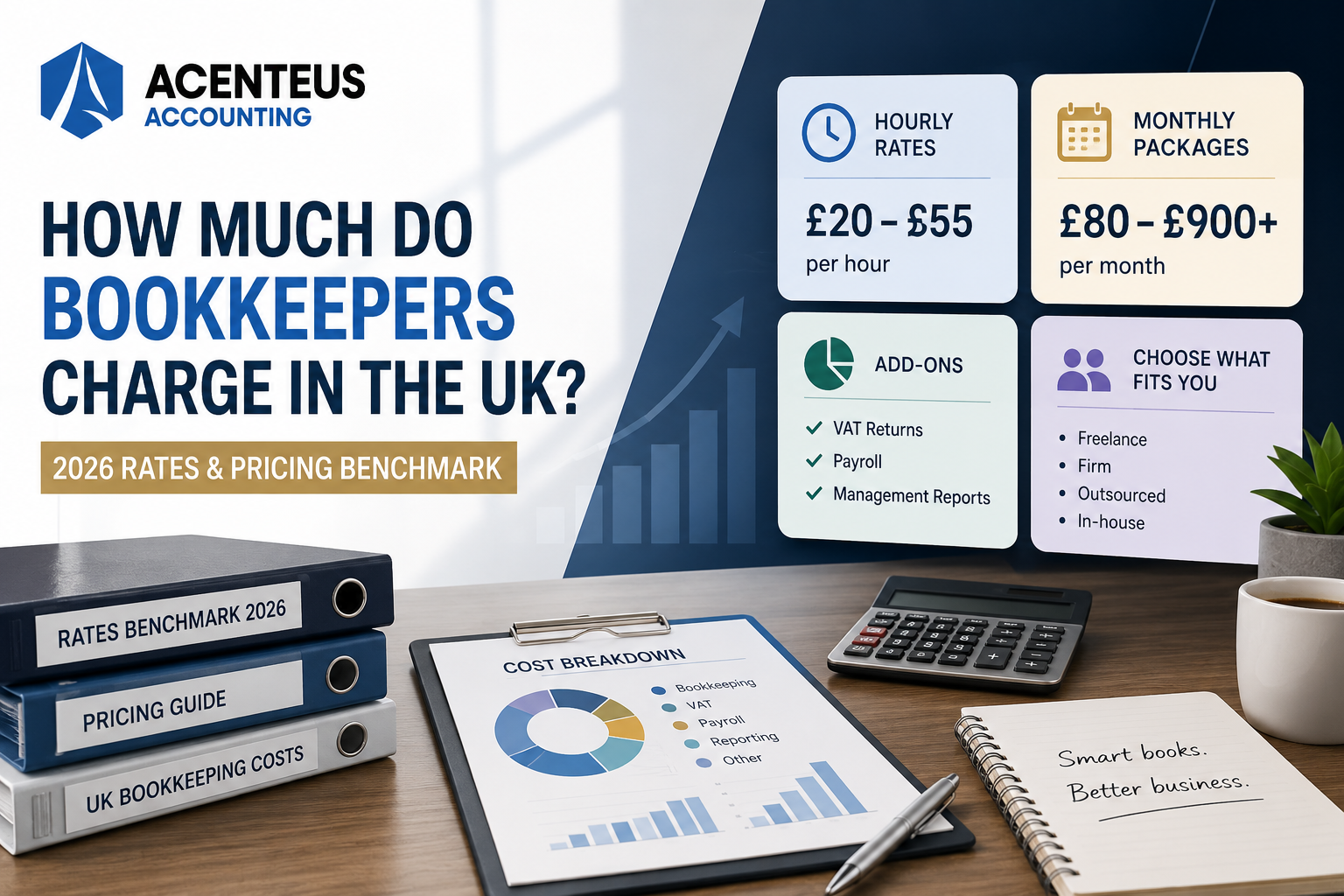
Most UK bookkeepers charge £20 to £55 an hour, or a fixed monthly fee that typically runs from around £80 for a sole trader to £900 or more for a growing VAT-registered company with payroll. Those are realistic 2026 market ranges drawn from multiple industry sources, not fixed prices, because your actual cost depends on transaction volume, VAT and payroll needs, how often your books are done, and whether you use a freelancer, a local firm, an outsourced provider or an in-house hire.
This guide is a pricing benchmark, so every number below is a stated range with its source and assumptions made explicit, and where we give a worked example we spell out what we assumed. We do not present estimates as confirmed quotes, because bookkeeping has no fixed price: the same business in two cities, with different transaction volumes, can see costs differ several times over. What follows breaks down hourly rates, monthly packages, transaction-based pricing and catch-up work; prices the common add-ons of VAT, payroll and management reporting; compares freelance, firm, outsourced, white-label and in-house models; and works through realistic examples so you can estimate your own likely cost and know what a fair quote looks like.
Key takeaways
- Hourly rates: roughly £20 to £55 an hour is the typical UK range in 2026, with freelancers lower (around £18 to £30) and established firms and specialists higher (£35 to £60 plus).
- Monthly packages: commonly £80 to £150 for sole traders, £150 to £350 for small limited companies, and £300 to £900 or more once VAT, payroll and reporting are added.
- Add-ons stack up: VAT returns, payroll and management accounts are usually charged on top of a base fee, and can exceed it, so always get an itemised quote.
- In-house is the most expensive route: a £30,000 bookkeeper costs around £34,463 all-in once employer National Insurance and pension are added, and £34,000 to £61,300 fully loaded.
- Outsourcing typically saves 30 to 60 percent against in-house once salary, on-costs and overheads are counted, which is why it is the common choice for smaller businesses and practices.
How much do bookkeepers charge per hour in the UK?
UK bookkeepers typically charge between £20 and £55 an hour in 2026, with the exact rate driven by experience, qualifications, location and the complexity of the work. Newer or less experienced bookkeepers sit at the lower end, while qualified, specialist or London-based bookkeepers command the higher end. Some industry sources put the everyday standard-work range slightly wider, from about £18 for a junior freelancer to £60 or more for a chartered or highly specialist bookkeeper.
The table below sets out typical 2026 hourly ranges by provider type. Treat these as market benchmarks compiled from multiple UK sources, not quotes.
| Provider type | Typical hourly rate (2026) | Notes |
|---|---|---|
| Freelance or self-employed | £18 to £30 | Lowest cost, but limited cover and capacity |
| Bookkeeping firm or agency | £30 to £45 | Built-in cover and continuity |
| Chartered or specialist | £45 to £60+ | Complex, compliance-heavy or advisory work |
| Offshore or hybrid outsourced | £12 to £20 | UK-supervised models sit at the lower end |
Hourly pricing suits short-term or one-off work, such as a catch-up job or an ad hoc query, where the scope is unclear. Its weakness is unpredictability: as transaction volume rises, an hourly arrangement can become expensive and hard to budget, which is why most ongoing relationships move to a fixed monthly fee. A note on cheap rates: a £20 freelancer without a recognised qualification who misses a VAT or Making Tax Digital requirement can cost far more in errors than a £45 qualified firm that gets it right first time, so price should never be read in isolation from competence.
How much does bookkeeping cost per month in the UK?
Most UK small businesses pay a fixed monthly fee between roughly £100 and £500 for ongoing bookkeeping, with very small or simple businesses closer to £80 and growing companies that need VAT and payroll paying £300 to £900 or more. Monthly fixed-fee pricing has become the most common model for ongoing work, because it makes budgeting predictable and aligns cost with a defined scope. An industry pricing survey of UK bookkeepers found monthly fee pricing was the most common primary method, used by just over half of respondents, with a median monthly fee around £150 and a mean nearer £289, a gap that reflects how much scope and client size vary.
The table below sets out typical 2026 monthly ranges by business profile. These are benchmarks; your quote depends on transactions, VAT status and services included.
| Business profile | Typical monthly fee (2026) | Usually includes |
|---|---|---|
| Sole trader or micro-business | £80 to £150 | Basic transaction recording, reconciliation |
| Small limited company | £150 to £300 | Bookkeeping, often basic VAT |
| Growing VAT-registered SME | £300 to £600 | Bookkeeping, VAT, some reporting |
| Larger or complex SME | £600 to £900+ | Bookkeeping, VAT, payroll, management accounts |
The single biggest reason quotes vary is what is and is not included. A headline £150 a month package can reach £300 or more once VAT returns, payroll and software are added, so the base figure alone can mislead. This is why an itemised quote matters, and why the add-on prices in the next section are as important as the base fee. For a fuller treatment of how outsourced pricing is built up, our outsourced bookkeeping costs guide breaks it down in more detail.
Transaction-based and catch-up pricing
Some bookkeepers price by transaction volume rather than by hour or a flat fee, and this model is increasingly common because transaction count is the single biggest driver of how long bookkeeping takes. Under it, your fee scales with the number of bank transactions, invoices and receipts processed each month, so a low-volume consultancy pays less than a high-volume ecommerce business even at the same revenue. Providers usually band this, for example a price for up to 50 transactions a month, a higher price for up to 150, and so on. It is worth asking any provider how they define a transaction, since definitions vary.
Catch-up and clean-up work is priced differently again, usually hourly or as a fixed project fee, because it is one-off and variable in scope. If your books are months behind, expect to pay for the catch-up separately from ongoing work, commonly at an hourly rate, or as a quoted project once the bookkeeper has seen the state of the records. Historical clean-up before a deadline, a loan application or a switch of provider is a typical trigger. Because scope is genuinely uncertain until someone looks, be wary of a firm quote for catch-up given without sight of the records, and expect a range until the position is clear.
The add-ons: VAT, payroll and management reporting
The services layered on top of core bookkeeping, VAT returns, payroll and management accounts, are where a cheap headline fee often grows, and they are usually charged as extras rather than bundled. Understanding their typical cost lets you read a quote properly and compare providers fairly.
The table below gives typical 2026 add-on ranges compiled from UK sources. As always, these are benchmarks, not quotes, and depend on volume and complexity.
| Add-on | Typical 2026 cost | Notes |
|---|---|---|
| VAT return preparation | £50 to £150 per return | Quarterly for most VAT-registered businesses |
| Payroll | £4 to £12 per employee per month, plus a £25 to £50 minimum | Sometimes bundled at £15 to £40 a month for a small team |
| Auto-enrolment pension admin | Often within the payroll fee | Assessment and pension file handling |
| Management accounts | Varies widely, often £100 to £400+ per month | Monthly or quarterly, adds reporting and analysis |
| Software licence | Passed through or included | Xero, QuickBooks or similar |
The important point for budgeting is that add-ons can exceed the base bookkeeping fee. A small limited company with several staff, VAT registration and quarterly management accounts can easily find the extras cost more than the core bookkeeping, so the only meaningful comparison between providers is total cost for your actual scope, not headline rates. If you also need payroll, our guide to payroll outsourcing costs and providers covers that layer in detail.
What drives the price? The main cost factors
Bookkeeping is priced on a handful of factors, and understanding them explains why two superficially similar businesses get very different quotes. Knowing your own position on each helps you predict your cost and sense-check a quote.
- Transaction volume: the primary driver. More bank transactions, invoices and receipts mean more time, so a high-volume business pays more regardless of revenue.
- VAT registration: VAT-registered businesses need quarterly returns and more careful coding, which adds cost.
- Payroll: running payroll, and the auto-enrolment duties that come with it, is a distinct, priced service.
- Frequency: monthly bookkeeping costs more than quarterly, but catches problems earlier; annual clean-ups are cheapest but riskiest.
- Complexity: multiple income streams, foreign currency, ecommerce channels, projects or stock all add time.
- Software and automation: clean cloud systems with bank feeds and capture tools reduce time; messy or manual records increase it.
- Location and provider type: London and major cities sit higher; freelancers are cheaper than firms; offshore and hybrid models are cheaper still.
- Compliance needs: Making Tax Digital readiness and the shift to quarterly submissions for some sole traders and landlords raise the baseline for affected clients, as covered in our MTD for Income Tax guide.
In-house versus outsourced: the real cost comparison
The most common pricing mistake is comparing an outsourced monthly fee against an in-house bookkeeper’s headline salary, when the fair comparison is against the fully loaded cost of employment. Once you add employer National Insurance, pension, software, training, equipment and management time, an in-house bookkeeper costs far more than the salary suggests.
The numbers are stark. A £30,000 bookkeeper costs around £34,463 a year all-in once employer National Insurance at 15 percent and the 3 percent minimum pension are added, and industry guides put the fully loaded cost, including software, office space and overheads, at £34,000 to £61,300 a year. Set against that, an outsourced package at, say, £300 a month is £3,600 a year, and even a comprehensive package at £900 a month is £10,800 a year. This is why multiple UK sources put the saving from outsourcing at 30 to 60 percent against equivalent in-house output, and why smaller businesses in particular rarely find a full in-house hire justified. In-house still wins on one thing: direct, full-time control and immediate availability. But for most small businesses the maths favours outsourcing, and a lone in-house bookkeeper also creates a single point of failure when they are ill or on leave, which a firm or outsourced provider covers.
| Option | Typical annual cost (2026) | Trade-off |
|---|---|---|
| In-house bookkeeper (£30k salary) | £34,463 all-in, up to £61,300 fully loaded | Maximum control, highest cost, single point of failure |
| Freelance bookkeeper | Varies; roughly £3,000 to £12,000 | Cheapest hourly, limited cover |
| Local firm or agency | Varies with scope; often £3,600 to £11,400 | Continuity and cover, mid-range cost |
| Outsourced or hybrid provider | Often 30 to 60% below in-house | Scalable, cost-efficient, needs a good provider |
Worked examples with stated assumptions
Because averages hide as much as they reveal, here are three worked examples. Each states its assumptions clearly, and each total is an illustrative estimate built from the benchmark ranges above, not a quote. Your own cost could sit outside these if your circumstances differ.
Example 1: sole trader, not VAT registered. Assumptions: around 40 transactions a month, cloud bookkeeping on Xero, quarterly bookkeeping, no payroll, no VAT, no management accounts. On the benchmark ranges, this profile typically fits a monthly fee of roughly £80 to £150, or an equivalent quarterly charge. Illustrative annual cost: about £1,000 to £1,800. The main variable is whether the trader is caught by Making Tax Digital for Income Tax, which for those over the threshold shifts the work to quarterly and raises the fee.
Example 2: small VAT-registered limited company. Assumptions: around 150 transactions a month, VAT registered with quarterly returns, monthly bookkeeping, no payroll, no management accounts. Base bookkeeping at roughly £150 to £300 a month, plus VAT returns at £50 to £150 a quarter (say £200 to £600 a year), gives an illustrative annual total of about £2,200 to £4,200. Adding payroll for two or three staff would add roughly £300 to £900 a year on the benchmark payroll ranges.
Example 3: growing SME with payroll and reporting. Assumptions: around 400 transactions a month, VAT registered, monthly bookkeeping, payroll for eight staff, and quarterly management accounts. Base bookkeeping and VAT might run £400 to £700 a month; payroll at £4 to £12 per employee plus a minimum could add £50 to £150 a month; quarterly management accounts add further cost. Illustrative annual total: roughly £7,000 to £12,000. Against a fully loaded in-house hire at £34,000 to £61,300, the outsourced route is markedly cheaper for this profile, which is the typical tipping point where businesses choose to outsource rather than employ. Our outsourced finance function is designed for exactly this stage.
White-label bookkeeping pricing for accountancy practices
Accountancy practices buy bookkeeping differently from businesses, on a white-label basis, where an outsourcing provider does the work under the practice’s brand, and the pricing model reflects that. Rather than a retail monthly package, practices typically pay per service, per transaction band, or for a dedicated resource, and then apply their own margin when billing the client.
The most transparent benchmark here is the dedicated resource model: a full-time offshore bookkeeper working under UK supervision typically costs a practice in the region of £1,600 to £2,000 a month, against £3,500 to £4,000 for an equivalent UK hire, with the offshore hybrid model running at roughly 50 to 70 percent of pure-UK cost. Practices often apply a 50 to 100 percent markup on outsourced bookkeeping to cover their review, client management and advisory time, which is how white-label bookkeeping supports both competitive client pricing and practice margin. This is the model behind our white-label bookkeeping and payroll service and our broader outsourcing for accountants, and it is why so many practices now treat bookkeeping capacity as something to buy rather than hire. For a fuller comparison of providers, see our guide to the top bookkeeping outsourcing companies.
Is a bookkeeper's fee VAT-deductible?
A bookkeeper’s or bookkeeping firm’s fee is a standard business expense, and where the provider is VAT registered the fee carries VAT at 20 percent, which a VAT-registered client can normally reclaim on its VAT return like any other professional service. For a business that is not VAT registered, the VAT on the fee is simply part of the cost. This is worth factoring into a like-for-like comparison, since a quote may be shown with or without VAT. It is a general point rather than tax advice, and you should confirm your own position with your accountant.
How to get an accurate bookkeeping quote
To get a quote you can rely on, give any prospective bookkeeper the information that actually drives the price, and ask for the total cost of your full scope rather than a headline rate. The more precise your inputs, the more accurate and comparable the quotes you receive.
Tell each provider your monthly transaction volume, your VAT status and return frequency, whether you need payroll and for how many staff, which software you use, how often you want the books done, and whether you need management accounts or other reporting. Then ask each for an itemised quote showing the base fee and every add-on separately, so you can compare like with like. Watch specifically for common extras billed on top of a cheap headline rate: VAT preparation, payroll journals, catch-up work, credit control and software licences. A provider who quotes a clear, itemised total for your real scope is easier to trust than one advertising a low base fee that grows once the add-ons appear.
Case study: predictable bookkeeping cost at scale
For a business or a practice, the value of a bookkeeping partner is not just the rate but the reliability: accurate books, delivered on time, for a cost you can predict. On Clutch, the independent B2B review platform that verifies client feedback, Acenteus Accounting holds 100 percent positive reviews for exactly this kind of dependable delivery.
A Cambridge accounting firm that outsources bookkeeping, VAT and related work to Acenteus reported that the team “completed all tasks on time with minimal errors,” and highlighted “clear and well-structured work description reports, supporting transparency and review.” A separate client described the wider effect: “Acenteus’ accounting outsourcing has transformed how we manage compliance and reporting. Their precision and efficiency free up our time to focus on high-value advisory work and client growth.”
The pricing relevance is direct. Errors and rework are hidden costs that a cheap rate can disguise, so on-time delivery with minimal errors and clear documentation is what makes a bookkeeping cost genuinely predictable rather than a headline that grows. Whether you are a business weighing outsourcing against an in-house hire, or a practice buying white-label capacity, the cost that matters is the total cost of getting the books right, not the lowest advertised rate. That is the standard our accounting and bookkeeping support is built around.
Frequently Asked Questions (FAQ)
UK bookkeepers typically charge £20 to £55 an hour in 2026, with some industry sources citing a wider range of about £18 to £60 depending on experience and complexity. Freelancers and less experienced bookkeepers sit at the lower end, while qualified, specialist or London-based bookkeepers charge more. Offshore or UK-supervised hybrid providers can be lower, often £12 to £20 an hour. These are market benchmarks, not fixed prices, and your rate depends on scope and location.
Most UK small businesses pay £100 to £500 a month for ongoing bookkeeping, with very small or simple businesses closer to £80 and growing companies needing VAT and payroll paying £300 to £900 or more. Monthly fixed-fee pricing is the most common model because it makes budgeting predictable. The exact figure depends on transaction volume, VAT status and which services are included, so always confirm what a package covers before comparing.
Both models are common. Hourly pricing, typically £20 to £55 an hour, suits one-off or ad hoc work like catch-up jobs where scope is unclear. Monthly fixed-fee pricing, the most common model for ongoing work, gives predictable budgeting for a defined scope. Some bookkeepers also price by transaction volume. For a regular relationship, a fixed monthly fee is usually best; for occasional or unpredictable work, hourly can be more economical.
Bookkeeping quotes vary because the price depends on transaction volume, VAT status, payroll, frequency, complexity, software and provider type, and because what is included differs. A headline monthly fee may exclude VAT returns, payroll and software, which are charged on top and can exceed the base fee. The same business in two cities, with different volumes, can see costs differ several times over. Always compare total cost for your full scope, not headline rates.
Catch-up or clean-up bookkeeping is usually priced hourly or as a fixed project fee, separate from ongoing work, because its scope is uncertain until a bookkeeper reviews the records. Expect to pay an hourly rate, commonly £20 to £45, or a quoted project fee once the state of the books is clear. Be cautious of a firm quote given without sight of the records, and expect a range until the position is assessed.
VAT return preparation typically costs £50 to £150 per return, usually quarterly, while payroll is often £4 to £12 per employee per month plus a £25 to £50 minimum, or £15 to £40 a month bundled for a small team, with auto-enrolment usually within that fee. These are charged on top of core bookkeeping and can together exceed the base fee, so a business needing both should budget for the combined total rather than the headline bookkeeping rate.
For most small businesses, outsourcing is cheaper. A £30,000 in-house bookkeeper costs around £34,463 a year all-in once employer National Insurance and pension are added, and £34,000 to £61,300 fully loaded with software and overheads. Outsourced packages often run a few thousand to around £11,000 a year depending on scope, a saving commonly put at 30 to 60 percent. In-house gives more direct control but costs more and creates a single point of failure when the employee is away.
A £30,000 in-house bookkeeper costs approximately £34,463 a year once employer National Insurance at 15 percent and the 3 percent minimum pension are added. Once software, training, equipment, office space and management time are included, the fully loaded cost is commonly £34,000 to £61,300 a year depending on salary and overheads. This is why the fair comparison with outsourcing is against the loaded cost of employment, not the headline salary.
Practices buying white-label bookkeeping typically pay per service, per transaction band, or for a dedicated resource. A full-time offshore bookkeeper under UK supervision commonly costs around £1,600 to £2,000 a month, against £3,500 to £4,000 for a UK hire, with the hybrid model at roughly 50 to 70 percent of pure-UK cost. Practices often add a 50 to 100 percent markup to cover review and client management, which supports both competitive client pricing and margin.
A bookkeeper's fee is a standard allowable business expense. Where the provider is VAT registered, the fee carries VAT at 20 percent, which a VAT-registered client can normally reclaim on its VAT return like any other professional service, while a non-VAT-registered business bears the VAT as part of the cost. Quotes may be shown with or without VAT, so check which when comparing. This is general information, not tax advice; confirm your position with your accountant.
It varies with transaction volume and how automated the systems are, but small businesses commonly report needing a few hours to around eight hours a month for basic bookkeeping. Clean cloud systems with bank feeds and receipt capture reduce the time considerably, while messy or manual records increase it. Because volume drives the hours, and the hours drive the cost, tidying your systems and using automation is one of the most effective ways to reduce your bookkeeping fee.
For affected clients, yes. From 6 April 2026, sole traders and landlords with qualifying income over £50,000 must keep digital records and file quarterly updates, dropping to £30,000 in 2027 and £20,000 in 2028. Moving from an annual clean-up to quarterly digital submissions shifts the work to a proper monthly or quarterly service, which raises the fee. The increase reflects the change in cadence and compliance, and providers with Making Tax Digital expertise price that capability in.