Last updated: 3 July 2026
For UK accountants managing Making Tax Digital for Income Tax across many clients in 2026, the best software is a practice edition of Xero or QuickBooks for cloud-first firms, IRIS or TaxCalc for compliance-suite practices, and TaxCalc’s MTD Quarterly Filer where clients need to stay on spreadsheets via bridging. There is no single winner, because the right choice depends on your client mix, your existing practice stack, and whether you need a full multi-client dashboard or a bridging tool that submits from spreadsheets. What every option must do is connect to your Agent Services Account, handle quarterly updates and the final declaration, and let you process clients in bulk rather than one at a time.
This guide is written strictly for accountants, agents and practices managing multiple clients, not for individual sole traders choosing software for themselves. That focus changes what matters: a practice does not need the prettiest single-client interface, it needs a multi-client dashboard, agent-access filing, batch submission, and onboarding that scales across dozens of clients in the same two-day window each quarter. With MTD for Income Tax now live from 6 April 2026, the pressure is real and recurring. We compare the platforms that genuinely serve practices, verify the MTD rules against current HMRC and GOV.UK guidance, and set out how to choose, get ready, and decide whether to run submissions in-house or outsource the overflow.
Key takeaways
- MTD for Income Tax is live from 6 April 2026 for sole traders and landlords with qualifying income over £50,000, dropping to £30,000 in April 2027 and £20,000 in April 2028.
- Practice software must connect to your Agent Services Account and handle quarterly updates plus the annual final declaration; there is no GOV.UK service to key returns in, so software is mandatory.
- For most practices, a practice edition of Xero or QuickBooks gives the multi-client dashboard and bulk submission that matter at scale; IRIS and TaxCalc suit compliance-suite firms.
- Bridging software (TaxCalc MTD Quarterly Filer) lets clients stay on spreadsheets while you still file digitally, useful for mixed client bases.
- Capacity, not software, is the real constraint. Quarterly filing multiplies the work, which is why many practices pair software with outsourced support.
What MTD for Income Tax means for practices
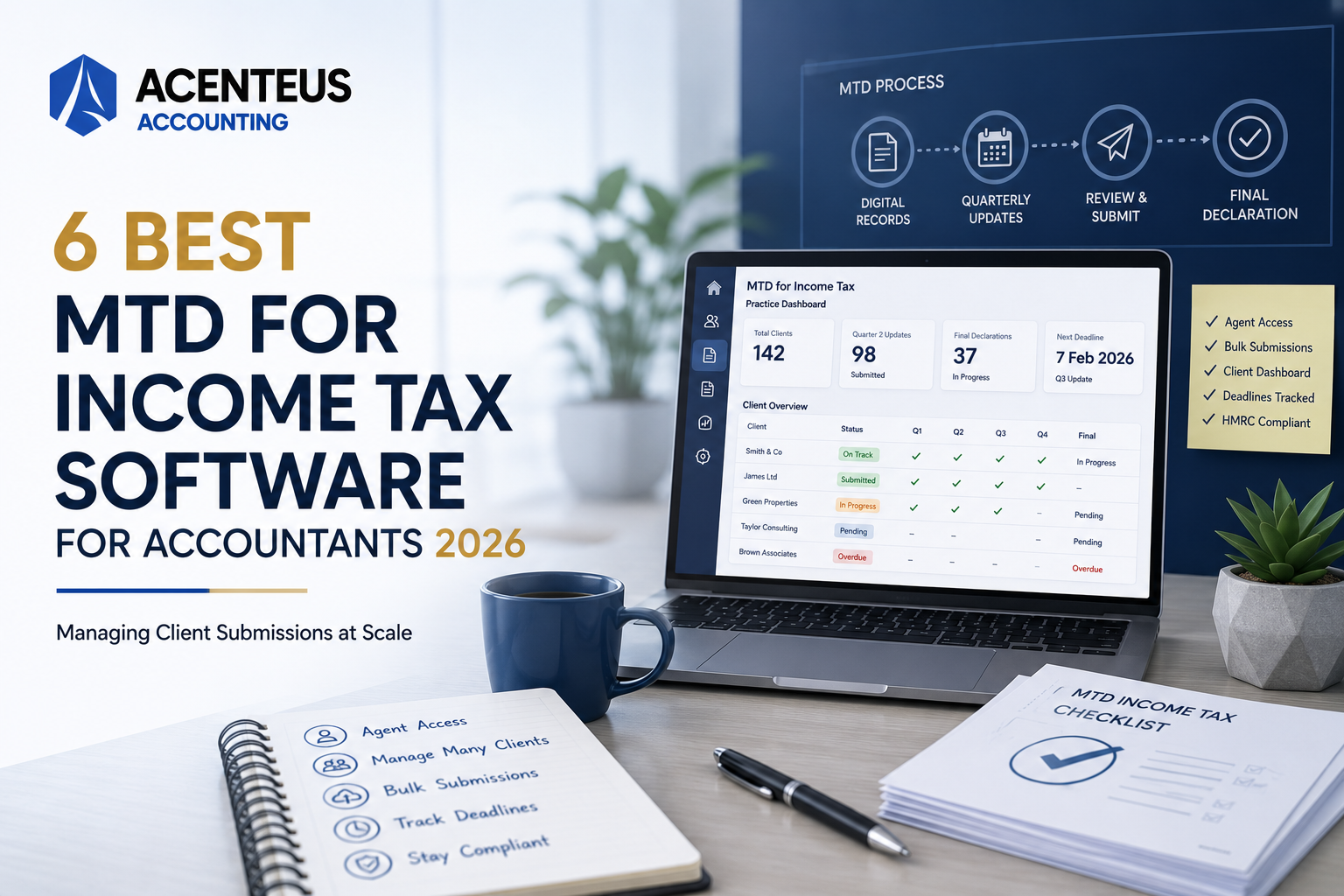
Making Tax Digital for Income Tax replaces the single annual Self Assessment return, for affected clients, with quarterly digital updates and an annual final declaration, all filed through compatible software. For a practice, it turns one filing event per client per year into five, which is the structural change that drives every software and staffing decision.
The rules, confirmed by HMRC and GOV.UK, are specific. From 6 April 2026, sole traders and landlords with qualifying income over £50,000 must keep digital records, send four quarterly updates, and submit a final declaration. The quarterly update deadlines are 7 August, 7 November, 7 February and 7 May, and the final declaration is due by 31 January following the tax year. Clients with both self-employment and property income submit separate updates for each source. Partnerships have been deferred with no confirmed mandation date, so you should not prepare partnership clients yet. Crucially, there is no GOV.UK online form to submit an MTD return: it must go through software, which is why choosing the right platform is not optional. The broader context, including which clients are caught and what has and has not changed, is covered in our income tax rates guide and our explainer on the separate question of Making Tax Digital for Corporation Tax, which HMRC has confirmed it is not introducing in its original form.
Agent access: how practices file MTD for clients
Practices file MTD for Income Tax through their Agent Services Account, and understanding how agent access works is as important as choosing software, because it governs what you can and cannot do for each client. The Agent Services Account is HMRC’s newer account for digital services; it is separate from your old Government Gateway logins, and your firm needs only one, set up by a director, owner or lead partner. If you already have one for MTD for VAT, you use the same account for Income Tax.
Two points matter for practices. First, authorisation: for each client you either transfer an existing Self Assessment authorisation into the Agent Services Account or create a new digital authorisation, where the client approves the connection. Second, and often missed, is the main agent versus supporting agent distinction. HMRC lets a client appoint one main agent and multiple supporting agents. A main agent can do everything, quarterly updates, the final declaration, and viewing penalties. A supporting agent can keep digital records and send quarterly updates, but cannot file the final tax return. If your practice is responsible for finalising a client’s tax position, you must be the main agent, so agree these roles with clients before busy season. Your software then connects to the Agent Services Account and files on each authorised client’s behalf.
How we evaluated MTD software for practices
We evaluated each platform against ten criteria that determine whether software can run MTD across a client base, not just for a single taxpayer. These are the questions a practice should ask before committing.
- Multi-client dashboard: can you see every client’s MTD status, deadlines and outstanding updates in one place?
- Agent access: does it connect to your Agent Services Account and file under your agent authorisation?
- Submission workflow: how smoothly does it prepare, review and submit quarterly updates and the final declaration?
- Bulk actions: can you process or submit updates for multiple clients in a session, rather than one at a time?
- Integrations: does it connect to your accounts production, practice management and bookkeeping tools without rekeying?
- Onboarding: how easily can you send authorisation links and connect new clients at volume?
- Permissions: can you control which staff access which clients, with appropriate roles and audit trails?
- Scalability: does it hold up across dozens or hundreds of clients and the quarterly peak?
- Support: is there responsive support and clear communication when HMRC changes the rules?
- Pricing: is it priced sensibly for a practice, by client or licence, and does it scale predictably?
A note on method. The profiles below are built from each vendor’s published capabilities and HMRC recognition at the time of writing, cross-checked against current GOV.UK and HMRC guidance. Always confirm a product appears on HMRC’s find compatible software for MTD for Income Tax tool, and confirm current pricing with the vendor, before committing. We do not sell any of these products and earn no commission on them.
MTD for Income Tax software compared
This table summarises how the leading practice platforms compare on the features that matter for managing many clients. It reflects publicly stated positioning at the time of writing, and pricing is indicative for 2026.
| Software | Type | Multi-client dashboard | Bridging option | Best for |
|---|---|---|---|---|
| Xero (practice edition) | Cloud accounting | Yes | Via third parties | Cloud-first practices |
| QuickBooks (practice) | Cloud accounting | Yes | Limited | QuickBooks-based practices |
| IRIS | Compliance suite | Yes | Yes | Larger compliance-led firms |
| TaxCalc | Compliance suite plus bridging | Yes | Yes (MTD Quarterly Filer) | Value-focused practices |
| Sage | Cloud accounting | Yes | Yes | Sage-based practices |
| FreeAgent | Cloud accounting | Yes | No | Micro and landlord-heavy books |
The best MTD for Income Tax platforms for practices in 2026
Below is a closer look at each platform, what it does well for a practice, and where it fits, so you can match a tool to your firm rather than to a feature list.
- Xero (practice edition)
Xero is the strongest cloud-first choice for many practices, offering HMRC-recognised MTD for Income Tax alongside a practice dashboard that manages multiple clients from one place. It automates data entry, auto-populates draft returns from clients’ financial records, connects bank feeds, and gives clients a real-time view of tax due after each submission, which supports proactive advisory work. For a practice with a Xero-heavy client base, it keeps quarterly updates and the final declaration in the same system as the bookkeeping, reducing rekeying.
Xero suits practices that are already cloud-first or want to move clients onto cloud records, and that value a modern interface and strong bank-feed automation. Its main consideration is that clients generally need to be on Xero, so it works best where you can standardise a client base onto it rather than support many disparate systems.
- QuickBooks (practice edition)
QuickBooks offers HMRC-recognised MTD for Income Tax with a practice portal for managing clients, strong bank feeds and a familiar interface, and is a natural fit for practices with a QuickBooks client base. Like Xero, it keeps records and submissions in one cloud system and supports the quarterly workflow across multiple clients. It emphasises freeing up practice time and deepening client relationships through its practice tools.
QuickBooks suits practices already invested in the QuickBooks ecosystem or with many clients on it. The deciding factor, as with Xero, is your client base: if your clients are largely on QuickBooks, its integrated workflow is efficient; if not, moving them purely for MTD may not be worth it.
- IRIS
IRIS has been a fixture in UK practice compliance for decades, and its MTD for Income Tax solutions sit within a full compliance suite spanning personal tax, business tax, accounts production, practice management and payroll. For larger, compliance-led firms already running IRIS, it offers depth, tight integration across modules, and the ability to handle a wide range of client types and income sources within one ecosystem, plus MTD outsourcing services for firms that want help.
IRIS suits established, larger practices that value comprehensive functionality and are already invested in the IRIS ecosystem, and can absorb a steeper learning curve and higher cost in exchange for depth. Smaller practices often find it more than they need, and a cloud platform or TaxCalc a better fit for their size.
- TaxCalc
TaxCalc is the value-focused choice for many practices, and it is distinctive for offering both compliance-suite tools and a dedicated bridging solution, MTD Quarterly Filer. MTD Quarterly Filer is an HMRC-recognised bridging tool that lets firms and clients keep using spreadsheets while still submitting quarterly updates digitally, and it is built to manage multiple clients. That makes TaxCalc especially useful for a mixed client base, where some clients will move to full digital records and others need to stay on spreadsheets for now.
TaxCalc suits cost-conscious practices and those with clients who are not ready to leave spreadsheets, giving a compliant route without forcing every client onto cloud accounting. Firms wanting a single, fully cloud, real-time system may prefer Xero or QuickBooks, but for flexibility and value across a varied client base, TaxCalc’s bridging option is a genuine advantage.
- Sage
Sage provides HMRC-recognised MTD for Income Tax within its cloud accounting platform and practice tools, and integrates naturally with the wider Sage ecosystem, which matters if your practice and clients run on Sage. It supports the quarterly workflow and multi-client management, and offers bridging routes for spreadsheet-based clients. For Sage-committed firms, it keeps everything in one familiar environment.
Sage suits practices already built around Sage products. As with the other accounting platforms, the decision follows your existing stack: strong if you are a Sage practice, less compelling if you would be adopting it solely for MTD.
- FreeAgent
FreeAgent is award-winning UK cloud accounting used by many small businesses, landlords and their accountants, with MTD-compatible filing, an easy client-facing app, bank feeds and expense tracking. Its simplicity makes it a strong fit for landlord-heavy and micro-client bases where clients will do some of the work themselves, and it is often available free with certain business bank accounts, which can reduce client cost.
FreeAgent suits practices with many small, simple clients, particularly landlords and sole traders with straightforward affairs. Practices with complex clients or wanting a full compliance suite will need something more comprehensive, but for high volumes of simple MTD clients it is efficient and client-friendly.
Recommendations by practice type
The best MTD software depends on your practice’s size, client mix and existing systems, so here is how the options map to different firms. Use it as a starting shortlist, then trial before committing.
| Your practice | Software to shortlist |
|---|---|
| Cloud-first practice | Xero, QuickBooks |
| QuickBooks-based practice | QuickBooks |
| Sage-based practice | Sage |
| Larger compliance-led firm | IRIS, TaxCalc |
| Value-focused or mixed client base | TaxCalc (incl. bridging) |
| Many landlord or micro clients | FreeAgent, Xero |
| Clients not ready to leave spreadsheets | TaxCalc MTD Quarterly Filer |
A decision tree for choosing MTD software
If you want a quick route to a shortlist, work through these questions in order. First, are most of your clients already on a cloud accounting platform? If yes, use that platform’s practice edition, Xero, QuickBooks or Sage, because keeping records and submissions in one system is the least work. If no, ask the second question: do your clients need to stay on spreadsheets? If yes, choose a bridging solution like TaxCalc MTD Quarterly Filer, which files digitally from spreadsheets. If no, ask the third question: do you run a full compliance suite already? If yes, use its MTD module, IRIS or TaxCalc, so MTD sits alongside your other compliance work. If none of these applies, default to a cloud practice edition and standardise your clients onto it over time. In every path, confirm the product is on HMRC’s compatible-software list and that it supports every income type your clients have.
The real challenge: capacity, not software
The hardest part of MTD for Income Tax is not choosing software; it is finding the capacity to file four quarterly updates plus a final declaration for every affected client, in fixed windows, on top of your existing work. Software makes each submission efficient, but it does not create the hours. A practice with 50 affected clients now has 250 filing events a year instead of 50, concentrated around four quarterly deadlines that fall in months, such as August and November, that used to be relatively quiet.
This is why the Association of Taxation Technicians and others have flagged staffing as the central MTD risk: the work lands in bursts, and recruiting seasonal tax staff is difficult and expensive. Practices have three realistic responses. They can hire, which is slow and costly. They can push more of the record-keeping onto clients through client-friendly software, which helps but has limits. Or they can outsource the overflow, keeping the client relationship and the final review while a partner handles the routine quarterly preparation. Many practices use a blend, and the outsourcing element is exactly what turns a capacity crunch into a managed process. This is where tax outsourcing and broader outsourcing for accountants become part of the MTD answer, not a separate topic. The software runs the submissions; trained people, in-house or outsourced, run the volume.
Case study: adding tax capacity without hiring
The measure of any MTD setup is whether the quarterly work gets done accurately and on time, every quarter, without breaking your team, which is a capacity question as much as a software one. On Clutch, the independent B2B review platform that verifies client feedback, Acenteus Accounting holds 100 percent positive reviews for exactly this kind of reliable, capacity-adding delivery.
One verified client described the value of fast, reliable capacity under pressure: “We urgently needed a payroll staff member with UK experience, and Acenteus was our go-to partner. They promptly onboarded a skilled professional, ensuring seamless payroll processing without any disruption. Their quick response and reliability make them a trusted outsourcing partner.” A Cambridge accounting firm that outsources Self Assessment and related work reported that the team “completed all tasks on time with minimal errors,” with “clear and well-structured work description reports.”
The relevance to MTD is direct. Quarterly updates are, in effect, four times the Self Assessment preparation work, spread across the year, and the practices that will cope are the ones that can add trained capacity quickly without a permanent hire. On time and minimal errors, with clear documentation that makes the practice’s review fast, is precisely what quarterly MTD filing at scale requires. Whether that capacity sits in your own team on Xero or TaxCalc, or in an outsourced tax function using the same tools, the standard is identical, and it is what keeps MTD from overwhelming the practice.
Your MTD readiness checklist
Work through this checklist to get your practice ready for MTD for Income Tax at scale, whether you file in-house or with support.
- Identify affected clients. List every sole trader and landlord with qualifying income over £50,000, and flag those approaching the £30,000 and £20,000 thresholds for 2027 and 2028.
- Set up or confirm your Agent Services Account. Ensure your firm has one, set up by a director or partner, and that the right staff can access it.
- Sort out authorisations. Transfer existing Self Assessment authorisations or create new digital ones, and agree main versus supporting agent roles with each client.
- Choose compatible software. Confirm your chosen platform is on HMRC’s compatible-software list and supports every income type your clients have.
- Segment your client base. Decide who moves to cloud records, who stays on spreadsheets via bridging, and who will do their own bookkeeping.
- Map the quarterly calendar. Diarise the 7 August, 7 November, 7 February and 7 May update deadlines and block review time before each.
- Plan capacity. Estimate the extra quarterly workload, decide what you handle in-house, and arrange outsourced support for the overflow before the first deadline, not after.
- Brief clients early. Tell affected clients what is changing, what you need from them and when, so the quarterly rhythm does not surprise them.
- Run a pilot quarter. Where possible, file for a subset of clients early to test your workflow before the full volume hits.
- Review and refine. After the first quarter, check what took longest and where errors arose, and adjust your process and capacity plan.
Frequently Asked Questions (FAQ)
There is no single best tool, because it depends on your client mix and existing systems. For cloud-first practices, a practice edition of Xero or QuickBooks gives the best multi-client dashboard and bulk workflow. For larger compliance-led firms, IRIS or TaxCalc suit. For value and mixed client bases, TaxCalc, including its MTD Quarterly Filer bridging tool, is strong. Always confirm the product is on HMRC's compatible-software list and supports your clients' income types.
Yes, for some clients. From 6 April 2026, sole traders and landlords with qualifying income over £50,000 must keep digital records, send quarterly updates and submit a final declaration through compatible software. The threshold drops to £30,000 in April 2027 and £20,000 in April 2028. Clients below these thresholds are not yet mandated, and partnerships have been deferred with no confirmed date, so should not be prepared for MTD yet.
Accountants submit through an Agent Services Account using HMRC-recognised software. You need one Agent Services Account for your firm, an authorisation in place for each client, and compatible software connected to it. There is no GOV.UK online form for MTD returns, so submission must go through software. Your software files the quarterly updates and, if you are the main agent, the final declaration on each authorised client's behalf.
A client can appoint one main agent and multiple supporting agents. A main agent can do everything, submit quarterly updates, file the final tax return and view penalties. A supporting agent can keep digital records and send quarterly updates but cannot file the final return. If your practice finalises a client's tax position, you must be their main agent. Agree these roles with clients before you begin, as it determines what your software lets you do.
It depends on the software. Practice editions of the main platforms provide a multi-client dashboard, and some support batch or bulk submission of quarterly updates, which is a key selection criterion for a busy practice. Bridging tools like TaxCalc's MTD Quarterly Filer are also built to manage multiple clients. Confirm exactly how a tool handles bulk submission before committing, because filing dozens of updates individually is a significant time cost.
HMRC maintains an official list of compatible software, and the main practice options include Xero, QuickBooks, IRIS, TaxCalc, Sage and FreeAgent, alongside bridging tools and some free products. You should only use software on HMRC's recognised list, because submissions from unrecognised software may be rejected. Always check the official find-compatible-software tool on GOV.UK before purchasing, and confirm the product supports every income type your clients have.
Clients can stay on spreadsheets, provided bridging software is used to extract the data and submit the quarterly updates digitally. Full cloud accounting is not legally required; digital records and digital submission are. Bridging tools like TaxCalc's MTD Quarterly Filer are designed for exactly this, letting spreadsheet-based clients comply. For a practice, offering both cloud and bridging routes lets you meet clients where they are rather than forcing everyone onto one system.
Costs vary, but expect additional software cost per MTD client, often in the region of £15 a month, plus additional accountancy time for the extra quarterly work, commonly estimated at a few hundred pounds a year per client. The larger cost for a practice is capacity: four quarterly submissions plus a final declaration per client is far more work than one annual return, which is why many practices factor outsourcing into their MTD pricing and planning.
The quarterly update deadlines are 7 August, 7 November, 7 February and 7 May, covering the standard quarters from 6 April. The final declaration, which replaces the old Self Assessment return and confirms the year's figures, is due by 31 January following the end of the tax year. Clients with both self-employment and property income submit separate quarterly updates for each source within these deadlines.
It depends on capacity. Handle it in-house if you have the staff to absorb four quarterly filing peaks plus the final declaration for every affected client. Outsource the overflow if the quarterly volume would overwhelm your team or force expensive seasonal hiring. Because outsourcing partners use the same MTD software, you keep the client relationship and final review while a partner handles routine quarterly preparation. Many practices use a hybrid, which is often the most cost-effective route.
Not yet. MTD for Income Tax for general partnerships has been deferred, and HMRC has not confirmed a mandation date. You should not prepare partnership clients for MTD until HMRC confirms a timeline. Individual partners with other qualifying income, such as a separate sole trade or property income over the threshold, may be caught for that income, but the partnership itself is outside MTD for now.
MTD for Income Tax uses a points-based penalty system for late quarterly updates and the final declaration, with financial penalties once a threshold of points is reached, plus interest on late-paid tax. For a practice filing for many clients, this makes reliable quarterly processing important, since a missed deadline affects the client directly. Building review time before each deadline, and having capacity to cope with the peak, is the best protection against penalties.