TL;DR: Your SME clients don’t want a live data feed. They want a monthly pack within seven working days that tells them if they’re on track, where cash is going, and what decisions they need to make in the next 30 days. This guide covers the three-part dashboard structure (financials, KPIs, commentary), the tools that deliver it without manual re-entry, and how offshore prep makes the service profitable for your practice.
Management Accounts Are No Longer a Premium Service
There was a time when management accounts were something a growing business graduated into. You reached a certain revenue level, hired a finance director or engaged a more senior accountant, and started receiving monthly or quarterly reports that told you more than your annual statutory filing ever could. That model is becoming obsolete. In 2026, a meaningful proportion of UK SME owners expect financial visibility as a baseline feature of their accountancy relationship, not a tier they need to pay extra to reach.
The shift has been driven by two things running in parallel. Cloud accounting software has made real-time transaction data accessible to businesses that previously had to wait for their accountant to close off a period before they could see where they stood. And the SME owner profile has changed. The founders and directors running growth-stage businesses today are accustomed to data-driven decision-making across every other part of their operation. They run live dashboards for their marketing, their operations, and their sales pipeline. They find it genuinely puzzling that their financial picture arrives four to six weeks after the month has ended, or not at all between annual accounts.
The practices that will retain and attract growth-stage SME clients over the next few years are not the ones that can produce the most technically accurate statutory accounts. They are the ones that can deliver timely, readable, decision-relevant financial data on a monthly basis and then help clients act on it. This article sets out what that looks like in practice, how to build the delivery model that makes it sustainable, and how to turn the dashboard conversation into something more valuable than a monthly reporting exercise.
What UK SMEs Actually Mean When They Ask for Real-Time Data
When an SME owner says they want real-time financial data, they are rarely asking for a live feed of every transaction as it hits the ledger. What they mean is that they want to know, at any point during the month, whether their business is performing in line with expectations, whether cash is behaving as forecast, and whether there are any emerging issues they need to act on before they become bigger problems. They want the financial picture to be current enough to be useful, rather than historical enough to be purely retrospective.
The distinction matters because it changes what an accounting firm actually needs to deliver. True real-time reporting, where every invoice, payment, and journal entry is immediately reflected in a live dashboard, is technically achievable with the right software configuration but not always necessary for the decision-making conversations SME clients want to have. What most clients genuinely need is a management accounts pack that arrives within five to seven working days of the month end, presented in a format they can read without an accounting qualification, and supported by a brief commentary from their accountant explaining what the numbers mean for the next thirty days.
The ICAEW guidance on management accounts describes management accounts as financial information prepared for internal use rather than statutory filing, typically including a profit and loss statement, a balance sheet, and a cash flow statement, with supporting narrative. That is the technical definition. The commercial expectation in 2026 extends well beyond it, into KPI tracking, variance analysis, and forward-looking commentary that connects the historical numbers to the decisions the client is facing right now.
Why SME clients want this and why they are right to
UK SME owners who have experienced the difference between an accountant who delivers timely management accounts and one who does not will tell you, consistently, that the value is not in the report itself. It is in the conversations the report enables. A business owner who knows their gross margin has contracted by three percentage points in the last quarter has something concrete to discuss with their accountant, their operations manager, and their suppliers. A business owner who only knows that last year’s profit was lower than the year before has already missed the window to do anything about it.
The arrival of Making Tax Digital requirements has accelerated this expectation further. The government’s MTD programme is pushing businesses towards quarterly digital reporting as a compliance baseline, which means the infrastructure for more frequent financial visibility is already being built into most accounting relationships. Practices that frame management accounts as a natural extension of that infrastructure, rather than a separate premium service, will find the conversation with clients considerably easier to have.
The Gap Between Compliance Reporting and What SMEs Need in 2026
Statutory accounts exist to satisfy legal and regulatory requirements. They are prepared to a defined standard, filed with Companies House and HMRC, and tell the story of a business’s financial position at a specific point in time after an auditable process of verification and adjustment. That process takes time by design, and the resulting document is structured for regulatory audiences, not for the business owner who needs to decide next week whether to hire another member of staff or push back the equipment purchase until Q3.
The gap between what statutory accounts deliver and what SME clients actually need for operational decision-making is not a gap that better compliance work will close. It is a structural gap that only management accounts can address. The Xero guide to management accounts makes this distinction clearly: statutory accounts look back over a completed financial year, while management accounts look at the most recent period with the explicit purpose of informing what happens next. Both are necessary. They serve entirely different purposes.
The practices that struggle to articulate the value of management accounts to their SME clients are often those that still present them as a more detailed version of annual compliance work. They are not. They are a different type of financial service entirely, one that requires a different skill set, a different delivery cadence, and a different kind of client conversation. Recognising that distinction is the starting point for building a management accounts offer that SME clients will actually value and pay for.
What the compliance-focused practice gets wrong
Practices that have built their service model around annual compliance work frequently underestimate two things when they try to add management accounts to their offering. First, the turnaround expectation. Clients who wait nine months for their annual accounts have already calibrated their expectation of how long accountancy work takes. When those same clients are told their monthly management accounts will be ready within ten working days of month end, and they consistently arrive two or three weeks late, the service does not just underperform. It actively damages the trust that makes the advisory relationship work.
Second, the format expectation. Management accounts that arrive as a multi-tab spreadsheet or a lengthy PDF with no narrative are technically adequate but commercially useless for the average SME client. The business owner who opens a forty-page PDF every month and has to find the profit and loss themselves, interpret the numbers without context, and work out the variance from budget without a commentary is not going to attribute much value to the service. And they will not renew it.
What a Management Accounts Dashboard Should Contain
A management accounts dashboard for a UK SME does not need to be complicated. It needs to be complete for the decisions the client is making, readable without a financial background, and updated on a rhythm the client can rely on. The specific contents will vary by business type, but there is a core structure that works for the overwhelming majority of owner-managed businesses operating at growth stage.
The core financial statements
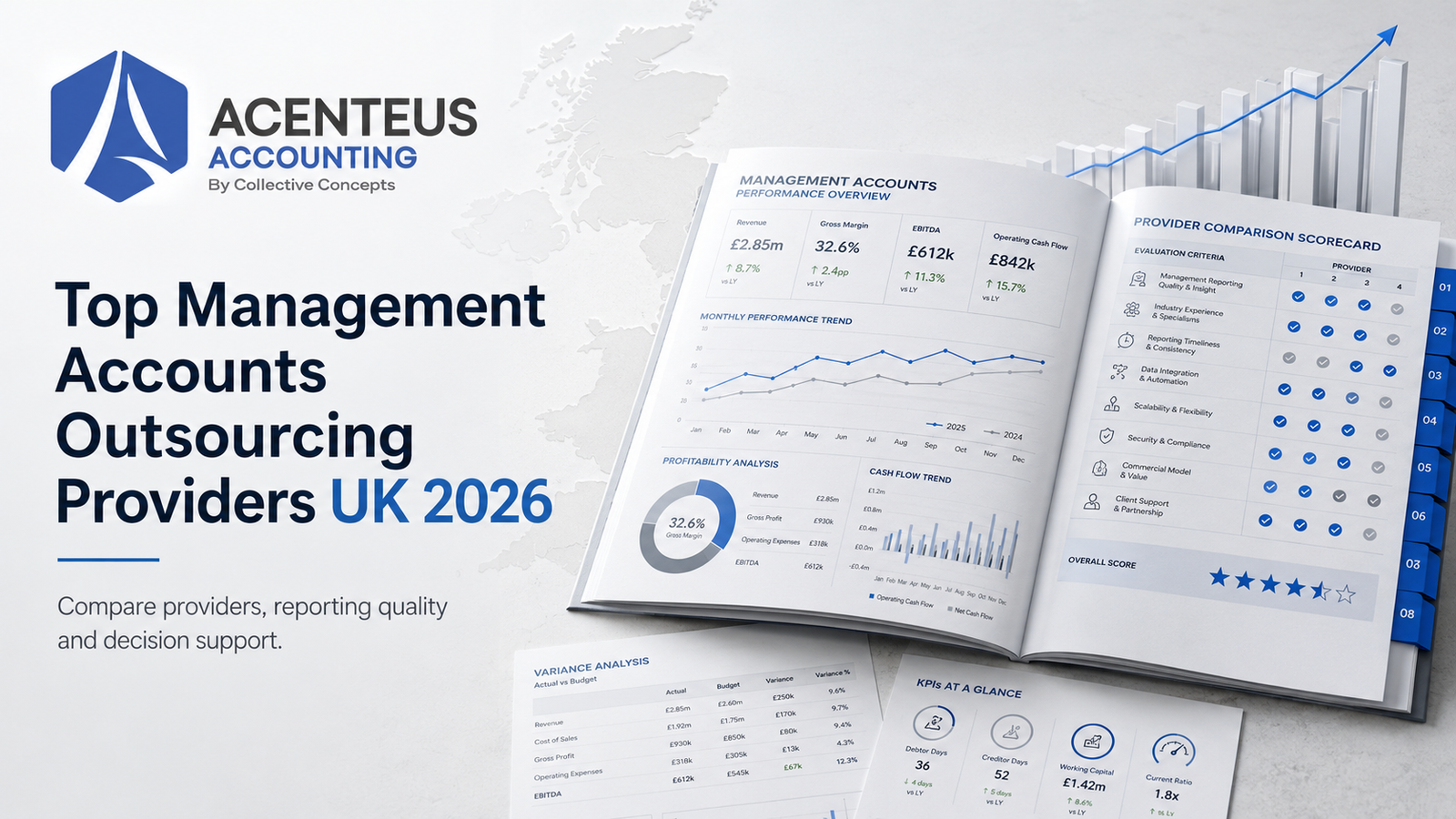
The foundation of any management accounts pack is a profit and loss statement for the period, a balance sheet as at the period end, and a cash flow statement showing actual cash movement versus forecast. These three statements, presented cleanly with prior period comparatives and budget variances where a budget exists, give the client the financial picture in full. They are not optional elements. A management accounts service that omits the balance sheet or the cash flow statement in favour of a simplified P&L is not delivering management accounts. It is delivering a partial view that will eventually mislead rather than inform.
KPI tracking
Alongside the core statements, a well-structured dashboard tracks the KPIs that are most relevant to how that specific business creates and sustains value. For most UK SMEs, the standard set includes:
- Gross margin percentage, tracked monthly against the prior year and against budget
- Debtor days and creditor days, which together reveal the working capital position more clearly than the balance sheet alone
- Monthly recurring revenue or pipeline conversion rate for service and subscription businesses
- Payroll as a percentage of revenue, particularly relevant for businesses where staff costs are the primary variable cost
- Cash runway in weeks, calculated from the current bank balance and the average monthly cash burn
- Revenue by service line or product category where the business has meaningful diversity
The KPIs on any given dashboard should be chosen with the client rather than imposed on them. The QuickBooks guide to management accounts notes that management accounts are most effective when they are tailored to the specific decisions a business is facing, rather than built around a generic template. That principle applies equally to the KPI selection. A construction business needs to track job profitability and WIP. A professional services firm needs to track utilisation and realisation. A retailer needs to track stock turn and margin by category. The dashboard that serves all three equally well does not exist.
The narrative commentary
Numbers without context are information. Numbers with context are insight. A management accounts pack that arrives without a written commentary from the accountant has delivered the former and withheld the latter. The commentary does not need to be long. Three to five concise paragraphs that explain the most significant variances, flag anything the client should pay attention to, and connect the current period’s numbers to the decisions the client is facing in the next thirty days will consistently receive more client engagement than a two-hundred-line spreadsheet without a single sentence of explanation.
The Tools UK Accounting Firms Are Using to Deliver Real-Time Dashboards
The technology landscape for management accounts delivery in 2026 is considerably more accessible than it was five years ago. Cloud accounting platforms have built native reporting and dashboard functionality that was previously only available through expensive standalone business intelligence tools. The barrier to entry for delivering a credible real-time dashboard to an SME client has dropped substantially, which also means the expectation that a practice will offer one has risen accordingly.
Cloud accounting platforms
Xero and QuickBooks Online both provide native reporting tools that allow practices to produce management accounts packs directly from the client’s live accounting data. The advantage of using the native tools is that the data is current to the moment the report is generated, provided the bookkeeping is up to date. The limitation is that the native tools have finite flexibility in terms of visual presentation and multi-entity consolidation. For most SME clients operating a single entity with straightforward reporting requirements, the native tools are entirely adequate. For clients with group structures or complex P&L segmentation needs, additional tooling is usually required.
The quality of cloud platform integration is a significant enabler of timely management accounts delivery. Practices that have built robust Xero and QuickBooks integrations into their offshore delivery workflow can pull current client data into a reporting template without manual data re-entry, which removes one of the most time-consuming elements of the monthly management accounts process and reduces the risk of transcription errors in the output.
Dedicated reporting and dashboard tools
Beyond the native platform tools, a growing number of UK practices are using dedicated reporting tools such as Fathom, Spotlight Reporting, and Futrli to build client-facing dashboards that offer more visual flexibility, budget comparison functionality, and forecasting capability than the cloud platforms provide natively. The AccountingWEB analysis of cloud financial insights platforms notes that the market for standalone financial reporting tools aimed at accountancy practices has grown significantly as practices look to differentiate their management accounts offering beyond what the accounting software alone provides.
These tools typically connect directly to the client’s Xero or QuickBooks data via API, which means the dashboard reflects the current state of the bookkeeping without manual intervention from the practice. For clients who want live access to their dashboard between monthly review calls, this live-feed model provides the real-time visibility they are asking for without requiring the practice to produce a new report every time the client wants to check in.
Choosing the right tool for each client
The AccountingWEB review of UK finance software options highlights that there is no single tool that works best for every practice or every client type. The right combination depends on the client’s accounting software, the complexity of their reporting requirements, whether they want self-service access to their dashboard between accountant-led reviews, and the practice’s own workflow. What matters more than the specific tools chosen is that the practice has made a deliberate choice and built a consistent workflow around it, rather than producing management accounts in a different format for every client based on whatever is easiest that month.
How Outsourced Delivery Makes Monthly Management Accounts Viable at Scale
The most common reason UK accounting practices do not offer management accounts to their SME client base is not that they lack the capability. It is that they lack the capacity. Producing a management accounts pack every month for twenty or thirty SME clients, each with a different accounting platform configuration, a different set of KPIs, and a different turnaround expectation, is a substantial volume of structured work that most practices cannot absorb from their existing team without displacing something else.
The talent pressures facing UK accounting practices make this capacity constraint a persistent rather than temporary challenge. Hiring additional onshore staff to support management accounts delivery is expensive and slow, and the recurring deadline-driven nature of monthly management accounts work is exactly the profile of engagement where the cost of onshore resource is hardest to justify against the fee income generated.
An offshore delivery model for management accounts solves this by separating the preparation work, which is structured, repeatable, and deadline-driven, from the review and advisory work, which requires the onshore accountant’s client knowledge and judgement. The offshore team handles the bookkeeping close, the data pull, the variance calculations, and the production of the draft pack to a defined template. The onshore accountant reviews the draft, writes or approves the narrative commentary, and delivers the final pack to the client. The onshore accountant’s time is focused on the elements of the service that require their direct involvement, rather than on preparation work that does not.
Practices that have built this model consistently report that the monthly management accounts engagement, which previously felt too labour-intensive to price profitably, becomes one of the higher-margin service lines in the practice once the offshore preparation workflow is running to a consistent standard. The key is building the offshore workflow to a template that is detailed enough to produce a consistent output regardless of which team member executes it, rather than relying on individual initiative to fill in the gaps each month.
For practices looking to extend this model to their accounting services for small businesses, the offshore-onshore split also makes it commercially viable to offer management accounts to clients whose fee level would not support the full cost of onshore preparation. The offshore cost base means the service can be priced at a point that is accessible to growth-stage SMEs while still generating a margin that makes it worth delivering.
Acenteus CCA provides structured offshore delivery for management accounts preparation specifically designed for UK accounting practices, with defined monthly workflows, template-based output, and onshore review integration built into the delivery model.
Setting Client Expectations Around Data Quality and Turnaround
The single most common source of friction in management accounts delivery is not the quality of the accounting or the accuracy of the numbers. It is the gap between what the client was told to expect and what they actually receive. That gap almost always originates in the onboarding conversation, where turnaround commitments and data quality requirements were either not discussed or were discussed in terms vague enough to mean different things to the practice and the client.
The data quality dependency
Management accounts can only be as timely and accurate as the underlying bookkeeping. A practice that commits to delivering a management accounts pack within five working days of month end is making a commitment that depends on the client having closed their sales invoicing, reconciled their bank, and provided any missing documents by the first working day of the new month. If the client does not know that this is what the turnaround commitment depends on, they will be genuinely surprised when the pack arrives ten days late because their bookkeeping was incomplete.
The engagement documentation for a management accounts service should specify, in plain terms, what the client must provide and by when for the turnaround commitment to hold. That means a named data cut-off date each month, a list of the source data the practice requires, and a clear statement that delays in receiving complete data will result in a corresponding delay to the management accounts delivery. Setting this expectation at onboarding, in writing, removes the awkwardness of the conversation when the deadline is missed because of a data gap rather than a practice failure.
Practices managing the bookkeeping as part of the management accounts engagement, through an outsourced bookkeeping and accounts preparation model, have significantly more control over the data quality dependency because they are not waiting on the client to close their own records. The bookkeeping close is part of the workflow, which means the management accounts preparation can begin immediately rather than waiting for a client submission that may or may not arrive on time.
Turnaround commitments that work in practice
A realistic turnaround commitment for monthly management accounts, assuming the practice has complete and reconciled bookkeeping data from which to work, is five to seven working days for a straightforward single-entity SME. For clients with more complex accounting, multiple cost centres, or significant accruals and prepayments work required at each period end, eight to ten working days is a more defensible commitment. The year-end bottleneck pressures that affect most accounting practices in January and April should also be factored into turnaround commitments, because management accounts clients will notice if their pack is reliably late in those months without explanation.
Turning Dashboard Delivery Into an Advisory Conversation
A management accounts pack delivered without a conversation attached to it is a report. A management accounts pack delivered with a fifteen-minute call, a focused commentary, and two or three specific questions for the client to consider is an advisory engagement. The difference in client-perceived value between the two is significant, and the difference in time required from the accountant is not. The advisory conversation does not need to be long. It needs to be relevant, focused, and forward-looking.
What a good commentary looks like
The written commentary that accompanies a management accounts pack should cover three things: what happened, why it matters, and what the client should be thinking about as a result. A commentary that describes the numbers without explaining them is less valuable than the numbers themselves, because the client can read the numbers. A commentary that explains the most significant movement in the P&L, connects it to a specific operational event the client will recognise, and then points to the decision or question that arises from it is the kind of communication that makes clients feel their accountant understands their business, not just their ledger.
The commentary does not need to be polished prose. Clear, direct sentences that a business owner can read in three minutes are more effective than a formally structured report that takes fifteen minutes to find the relevant points. The tone should be direct without being alarming, and constructive without being evasive. If the cash position has deteriorated, the commentary should say so clearly and explain what has driven it, not soften the message to the point where the client does not register the concern.
Moving from reporting to planning
The management accounts review call is the natural moment to shift from reporting the past to planning for the future. A practice that uses the monthly pack as a launching point for a brief discussion about the next quarter, the key decisions the client is facing, and any areas where additional analysis or planning work would be valuable is delivering something that compliance-only firms cannot replicate.
This advisory layer does not require a separate engagement. It is a natural extension of the management accounts relationship, and it creates the kind of ongoing dialogue that makes clients sticky. An SME owner who has a monthly conversation with their accountant that covers what the numbers are showing and what to do about it will not leave that relationship for a competitor offering a marginally lower compliance fee. The value of the advisory conversation far exceeds the value of the report that enables it.
For practices building out their advisory capacity alongside tax compliance outsourcing, management accounts delivery is one of the clearest pathways from a compliance-led relationship to a genuine advisory one. The monthly cadence creates the touchpoints. The dashboard creates the context. The commentary and review call create the conversation. Together, they create a client relationship that is considerably more resilient than one built on annual compliance alone.
The Practices That Win SME Clients in 2026 Will Be the Ones That Show the Numbers First
The SME clients that practices most want to attract and retain in 2026 are running data-driven businesses. They track everything that matters to their commercial performance in real time, and they expect their financial picture to be as current and as actionable as every other dashboard they rely on. An accounting relationship that delivers a clean set of annual accounts nine months after the year ends and a quarterly call in busy periods does not meet that expectation. It meets the minimum legal requirement, which is a different thing entirely.
Building a management accounts and dashboard delivery service that genuinely serves growth-stage SMEs is achievable for most UK practices, and it is considerably more accessible operationally than it was even three years ago. The cloud accounting infrastructure is already in place for most clients. The reporting tools exist and are affordable. The outsourced delivery models that make monthly preparation viable at scale are well-established. What is required is the decision to build the service properly, the workflow discipline to deliver it consistently, and the confidence to present it to clients as something they should expect rather than something extra they are paying for.
Practices that make that investment now will find it significantly easier to have the advisory conversations that differentiate them from compliance-only competitors. Practices that continue to treat management accounts as a premium service for a small subset of clients will find the gap between what they offer and what their most valuable clients expect continuing to widen. The window to close that gap is open. It will not stay open indefinitely. Get started with outsourcing your accounting services with Acenteus CCA.
Frequently Asked Questions (FAQ)
A profit and loss statement, balance sheet, and cash flow statement for the period, with prior period comparatives, budget variances where a budget exists, a KPI summary relevant to that business, and a written commentary explaining the key movements and what they mean.
Monthly is the standard for most growth-stage SMEs. Quarterly works for very small or early-stage businesses with limited transaction volumes. The frequency should match the pace at which the business makes operational and financial decisions.
A Xero dashboard shows live transaction data in a standard format. Management accounts are a structured, accountant-reviewed financial pack with narrative commentary, KPIs, and variance analysis that provides context and insight rather than raw data.
In most cases, yes. Dedicated reporting tools connect to your existing Xero or QuickBooks data via API and produce a dashboard without requiring you to change your accounting software or re-enter data elsewhere.
Gross margin, debtor days, creditor days, cash runway, payroll as a percentage of revenue, and revenue by service line or product category are the core set for most SMEs. Additional KPIs should reflect the specific drivers of that business's performance.
Five to seven working days is achievable for a straightforward single-entity SME with clean, up-to-date bookkeeping. The turnaround depends on the practice receiving complete data from the client by an agreed cut-off date.
Yes. Xero and QuickBooks provide accurate transaction data, but they do not produce accountant-reviewed analysis, variance commentary, or the forward-looking insight that management accounts deliver. The software is the data source, not the service.
It explains why the significant movements happened, which numbers to pay attention to, and what decisions or questions they raise for the next period. The numbers describe what occurred. The commentary explains what it means for your business.
It makes the monthly preparation cycle sustainable at scale without increasing onshore headcount. The offshore team handles data preparation and draft production to a defined template, freeing the onshore accountant for client-facing review, commentary, and advisory conversation.
Costs vary by business complexity, reporting requirements, and whether bookkeeping is included. For a straightforward SME with clean records, monthly management accounts typically range from £150 to £500 per month depending on the scope and the practice's pricing model.