TL;DR: The 2025/26 payroll year end carries more change than usual. Key obligations: issue P60s to all employees still employed on 5 April by 31 May 2026; maintain and reconcile the P32 monthly; file the P11D(b) by 6 July and pay Class 1A by 19 July. From 6 April 2026, most benefits in kind move to mandatory payrolling through the payroll rather than the annual P11D. The Earlier Year Update has been abolished and prior-year corrections now require an amended FPS with specific data fields completed correctly.
Most payroll years bring incremental changes: a rate adjustment here, a threshold uplift there. The 2025/26 year end and the start of the 2026/27 tax year are different. For the first time since Real Time Information was introduced in 2013, UK employers face a structural change to how benefits in kind are reported and taxed. Mandatory payrolling of benefits in kind arrives from 6 April 2026, and with it comes the abolition of processes that have been part of the compliance landscape for decades. At the same time, HMRC has removed the Earlier Year Update as a valid submission route, replacing it with an amended Full Payment Submission that operates on a different logic and a different timeline.
For UK accounting practices managing payroll on behalf of clients, this year end is not business as usual with a few new numbers. It requires a review of existing payroll configurations, a clear plan for transitioning benefits reporting into the payroll software, and a working understanding of the new submission processes before the year-end cycle begins in earnest. The deadline calendar is unforgiving, penalties for missing it are automatic, and the changes to the reporting framework mean that what worked last April will not be compliant this April.
This article sets out the full year-end deadline calendar, explains the key obligations around the P60 and P32, addresses the mandatory payrolling transition in practical terms, and covers the most common compliance failures that attract HMRC penalties. Whether you manage payroll for a single employer or advise a portfolio of clients through an outsourced accounting model, this is the compliance reference you need before the year-end cycle closes.
The Full 2025/26 Year-End Payroll Deadline Calendar
Getting the deadline calendar into a single place and sharing it with every employer you advise is one of the most practical things a payroll practitioner can do before the year-end rush begins. The dates below cover the complete sequence of obligations from the last FPS of the 2025/26 tax year through to the Class 1A payment in July. The consequences of missing any of them are addressed in detail later in this article.
5 April 2026: Tax year 2025/26 ends
The final day of the 2025/26 tax year. All payroll processing for the year must be complete. Any amendments to employee records, pay, or deductions for the year need to be reflected in the final FPS submitted on or before this date. After 5 April, corrections to 2025/26 data follow a different submission route, which is covered in detail when we look at the abolition of the EYU.
19 April 2026: Final FPS or EPS submission for 2025/26
The final Full Payment Submission or Employer Payment Summary for the 2025/26 tax year must reach HMRC by 19 April 2026. The FPS must be marked as the final submission for the year. For employers paying electronically by BACS, the effective PAYE payment deadline is 22 April 2026. The HMRC employer guide for 2025/26 confirms that the final FPS must carry a flag indicating it is the last submission for the year. Omitting that flag does not prevent acceptance, but it leaves the PAYE record open in HMRC’s systems and creates reconciliation problems downstream.
31 May 2026: P60 deadline
Every employer must issue a P60 to all employees who were on the payroll on 5 April 2026 by 31 May 2026. This is a statutory obligation with no grace period. The P60 must be provided in a format the employee can retain, either on paper or electronically where the employee has agreed to receive it that way.
6 July 2026: P11D and P11D(b) deadline
The P11D for 2025/26 is the last annual return that will operate under the existing process for most benefits. From April 2026, mandatory payrolling means most benefits will be reported through the payroll in real time rather than via the P11D. However, for the 2025/26 tax year, P11Ds are still required for any benefits that were not payrolled during the year, and the P11D(b) remains due by 6 July 2026 to declare Class 1A National Insurance liability on those benefits. The ICAEW February 2026 employer update confirms that employers who registered for voluntary payrolling in 2025/26 are not required to submit P11Ds for the benefits they payrolled, but must still submit the P11D(b) to account for any residual Class 1A liability.
19 July 2026: Class 1A NIC payment due
The Class 1A National Insurance contributions arising from the 2025/26 P11D(b) must be paid to HMRC by 19 July 2026. For electronic payment, the deadline is 22 July 2026. Late payment attracts interest from the due date. Class 1A is calculated at the rate applying in the 2025/26 tax year on the cash equivalent of the benefits reported on the P11D(b), and it is the employer’s cost entirely. There is no employee contribution to Class 1A.
Monthly FPS deadlines throughout 2026/27
From 6 April 2026, the 2026/27 tax year is under way and the RTI obligation continues on a monthly basis. Each Full Payment Submission must be submitted on or before the date each employee is paid. The HMRC employer guide for 2026/27 confirms that the on-or-before rule applies regardless of pay frequency, whether weekly, fortnightly, four-weekly, or monthly. Where no employees have been paid in a tax month, an Employer Payment Summary must be filed by the 19th of the following tax month to notify HMRC. Failing to file either an FPS or an EPS in a month where HMRC expects a submission will generate an automatic penalty notice.
Building the full deadline calendar into your year-end payroll workflow as a set of tracked outputs, rather than a list of dates to remember, is the most reliable way to ensure nothing is missed across a busy client portfolio in April and May.
The P60: What It Is, Who Must Receive One and When
The P60 is the annual summary of an employee’s total pay and deductions for the tax year. It confirms gross earnings, income tax deducted, National Insurance contributions, and student loan or postgraduate loan deductions where applicable. Employees use it to check their tax position, reclaim overpaid tax, complete self-assessment returns, and provide proof of income for mortgage applications and benefits claims. For many employees, the P60 is the only document that certifies their total earnings for an entire year in a single place.
Who must receive a P60
The obligation to issue a P60 applies to every employee who was still employed on 5 April 2026, regardless of whether they were actively working on that date, on sick leave, on maternity or paternity leave, or on a period of unpaid leave. The key test is employment status on the final day of the tax year. An employee who left before 5 April 2026 receives a P45 at the point they leave and does not receive a P60. The GOV.UK guidance on issuing P60s confirms the P60 must cover all employment with the same employer during the tax year, including any periods where an employee moved between PAYE schemes within the same group.
Format and delivery
P60s can be issued on paper or electronically. Electronic issue is permitted where the employee has been informed that their P60 will be provided electronically and has not objected. Most payroll software produces P60s in PDF format, suitable for email delivery or access through an employee self-service portal. Whichever format is used, the P60 must be capable of being retained by the employee and produced if required. A P60 that is accessible only through a system the employee loses access to after leaving employment does not meet this requirement.
For practices providing accounting services to small businesses, it is worth confirming with clients early in April whether they use an employee self-service portal or issue P60s manually, since manual issuance processes are more likely to miss the 31 May deadline when the employer has not built a reminder step into their payroll routine.
What happens if the P60 deadline is missed
An employer who fails to issue P60s by 31 May 2026 is in breach of their statutory obligation. HMRC can impose a penalty of up to £300 per employee for each failure, with daily penalties of up to £60 per employee if the failure continues after HMRC issues a formal notice. In practice, HMRC tends to pursue employers with a pattern of non-compliance rather than those who miss the deadline by a few days. That does not reduce the obligation, but it does mean that a practice discovering a missed deadline should issue the P60s as quickly as possible and document the remedial steps taken.
The P32: What It Records and Why It Still Matters Under RTI
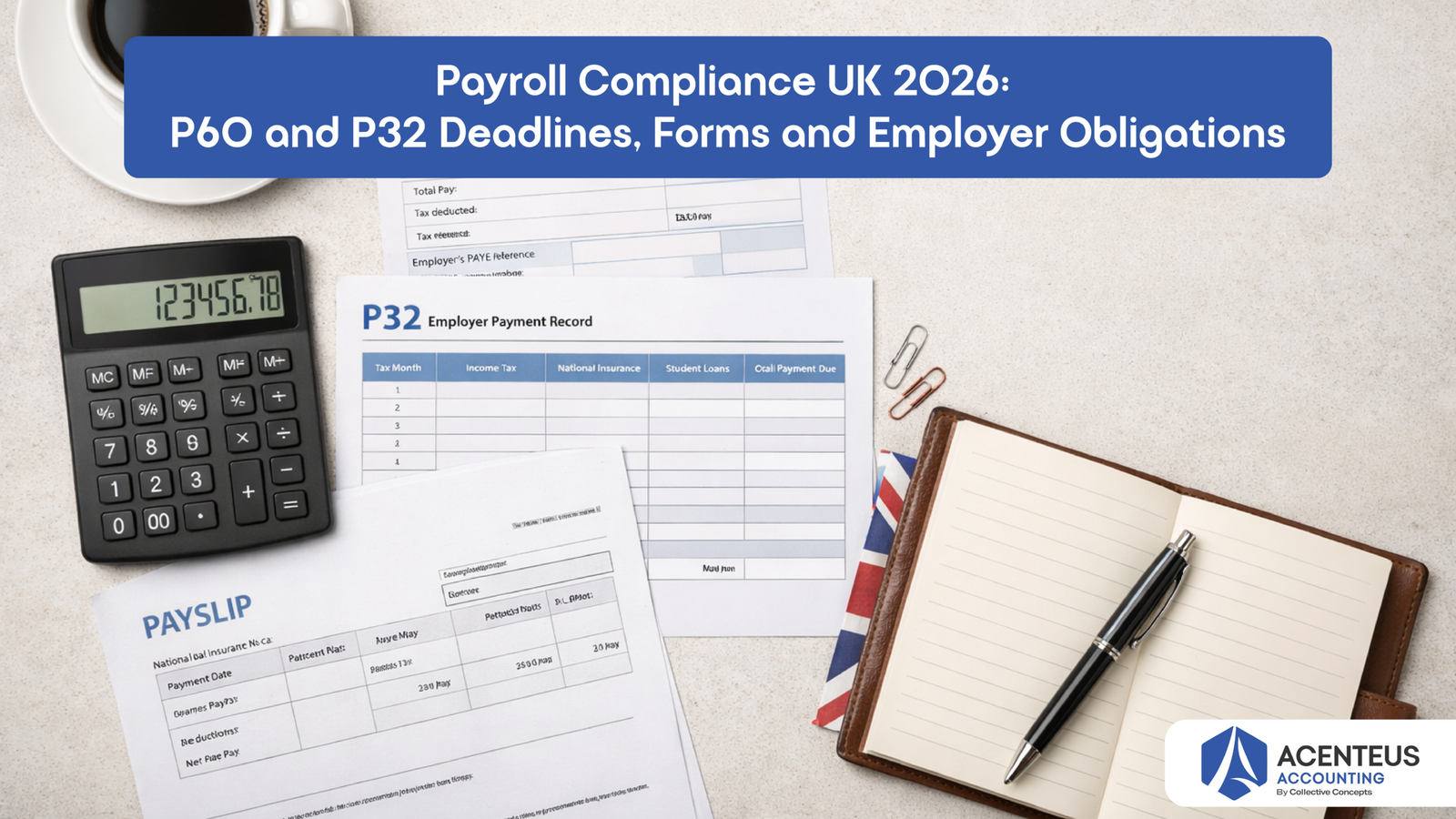
The P32 is the Employer Payment Record. It is not submitted to HMRC. It is a running record the employer maintains throughout the tax year, tracking the PAYE and National Insurance liability for each tax month, the payments made to HMRC, and any statutory payments recovered through the Employer Payment Summary. At year end, the P32 shows the reconciled position for the entire year: what was owed, what was paid, and whether there is a balance outstanding or an overpayment to recover.
Does the P32 still matter under RTI?
A reasonable question. Under Real Time Information, HMRC receives individual payment data through the FPS every time employees are paid, which in theory gives HMRC a live view of each employer’s liability. In practice, the P32 remains essential for a different reason: it is the employer’s own record of what they believed they owed and what they paid, and it is the primary document that enables reconciliation when HMRC’s records and the employer’s records disagree. Reconciliation discrepancies are more common than most practitioners expect. FPS submissions processed incorrectly, EPS reclaims not applied, statutory payment recoveries missing from HMRC’s account: all of these create gaps that the employer cannot resolve without a complete P32 to work from.
Practices that have integrated payroll software with their wider accounting workflow will find the P32 is produced automatically as part of the monthly payroll run. What matters is that the employer or their payroll agent reviews it each month rather than simply accepting the software output without verification, and that the P32 is reconciled against both the bank statement and HMRC’s online employer account before the payment is made.
What the P32 should include
The HMRC employer guide for 2025/26 sets out the full record-keeping requirements for employer payroll records. The P32 should record, for each tax month:
- Total PAYE income tax deducted from employees
- Employee National Insurance contributions deducted
- Employer National Insurance contributions due
- Student loan and postgraduate loan deductions collected
- Statutory Maternity, Paternity, Adoption, Parental Bereavement, and Shared Parental Pay paid to employees
- The recovery amount claimed through the EPS for statutory payments and, where applicable, small employer relief
- The net amount payable to HMRC for that month
- The date and amount of the actual payment made to HMRC
The AccountingWEB analysis of payroll system disconnects identifies the gap between what payroll software calculates and what appears in the employer’s bank records and HMRC payment account as the most consistent source of year-end reconciliation failures. Monthly P32 reconciliation against both sources is the most effective preventive measure available to any employer or practice managing PAYE compliance.
Recovering statutory payments through the P32 and EPS
Statutory payments paid to employees reduce the HMRC liability for that month. Small employers who qualify for small employer relief can recover 103% of statutory payments made. Standard employers recover 92%. These reclaims must be declared on the EPS for the relevant month and will then be reflected as a credit against the liability shown in HMRC’s employer account. If the EPS is not filed or the reclaim is omitted, the employer overpays HMRC and must pursue the recovery separately, which takes considerably longer than preventing the overpayment in the first place.
Record retention requirements
UK employers must retain payroll records, including P32 records, for a minimum of three years after the end of the tax year they relate to. This applies to payslips, FPS submissions, P11D returns, and any HMRC correspondence relating to the PAYE scheme. Practices managing tax compliance outsourcing for multiple employer clients should confirm that their document retention workflow covers payroll records explicitly, since the record-keeping obligation sits with the employer regardless of whether payroll is prepared in-house or by an agent.
Mandatory Payrolling of Benefits in Kind From April 2026
From 6 April 2026, the voluntary payrolling of benefits in kind becomes mandatory for most employers. This is the most significant structural change to employer reporting since RTI was introduced in 2013. The Buzzacott analysis of the mandatory payrolling announcement describes it as a fundamental shift in how employment tax reporting works, and that description is accurate. The P11D process, which has been the standard route for reporting most benefits to HMRC since the 1970s, is being replaced by real-time reporting through the payroll for the majority of benefit types.
What mandatory payrolling means in practice
Under the mandatory payrolling framework, the cash equivalent of taxable benefits provided to employees must be calculated at the start of each pay period and included in the payroll as notional pay. The employee pays income tax on the benefit through their PAYE deductions each time they are paid, rather than through a tax code adjustment the following year. For the employer, the Class 1A NIC liability on most benefits moves to a monthly payment cycle aligned with the payroll, rather than a single annual payment in July.
The HMRC call for evidence summary on real-time benefits reporting confirms that mandatory payrolling applies from 6 April 2026 for all employers who were not already voluntarily payrolling. For those already registered for voluntary payrolling, the change is seamless. For those who were not, the practical preparation required before 6 April 2026 was substantial, and any employer who has not yet transitioned should treat this as an immediate priority.
Which benefits are included and which are excluded
Mandatory payrolling applies to the majority of taxable benefits in kind. The two notable exclusions are employer-provided living accommodation and beneficial loans. These remain outside the mandatory payrolling regime for 2026/27 and will continue to be reported through the P11D process for the time being. For all other benefit types, including company cars, private medical insurance, gym memberships, fuel benefit, and non-business travel costs, mandatory payrolling applies from 6 April 2026.
The AccountingWEB practitioner analysis of mandatory payrolling highlights the practical complexity for employers with large and varied benefit rosters, where the calculation of benefit cash equivalents for inclusion in the monthly payroll requires accurate benefit values to be available before each pay run, rather than in a single annual exercise at year end.
What employers needed to do before 6 April 2026
Employers who were not already voluntarily payrolling benefits needed to take two preparatory steps before 6 April 2026. First, registering with HMRC’s payrolling benefits in kind online service to activate the mandatory payrolling regime for the new tax year. Second, reviewing their payroll software configuration to confirm it could calculate and include benefit values correctly in each pay period. Employers who have not yet completed the transition should speak to their outsourcing partner or payroll adviser as a matter of priority, because operating outside the mandatory payrolling framework from April 2026 will generate compliance failures that carry penalty consequences.
The P11D(b) still applies for Class 1A
Even under mandatory payrolling, the P11D(b) remains in place for the 2026/27 tax year to declare the employer’s total Class 1A liability. What changes is that the Class 1A on payrolled benefits is settled monthly through the payroll process rather than in a single annual payment. Employers should confirm with their payroll software provider how the monthly Class 1A calculation is handled and whether it feeds through the existing EPS framework or requires a separate submission route.
The operational parallel here is worth noting: payrolling benefits requires the same rhythm of monthly preparation and submission discipline that makes VAT compliance outsourcing run well when it is managed through a structured monthly workflow rather than a last-minute quarterly exercise. The employers and practices that will manage mandatory payrolling most comfortably in 2026/27 are those that have built benefit value calculation into the standard monthly payroll run as a defined step, not an afterthought.
EYU Abolished: What Employers Must Use Instead
The Earlier Year Update was the submission route employers used to correct payroll data for a completed tax year after the final FPS had been submitted. From April 2026, HMRC has removed the EYU as a valid submission type. Employers who need to correct data for the 2025/26 tax year or any earlier year must now use an amended Full Payment Submission.
How the amended FPS works for prior year corrections
To correct an error in a prior tax year using an amended FPS, the employer submits an FPS with the corrected year-to-date figures for the affected employee. The submission must include the correct cumulative totals for the tax year being corrected, not just the adjustment to the figure that was wrong. HMRC’s systems process the difference between the previously submitted figures and the amended figures and update the employer’s record accordingly. The HMRC 2026/27 employer guide sets out the technical requirements for amended FPS submissions, including the correct reporting period, the late reporting reason code, and the data fields required to complete a prior year correction accurately.
Why this changes the year-end workflow
The abolition of the EYU changes the year-end workflow for payroll corrections in a way that practices need to communicate clearly to employer clients. Under the previous process, discovering a payroll error after the final FPS had been submitted was straightforward to resolve through the dedicated EYU route. Under the new framework, the same correction requires a correctly constructed amended FPS with specific data fields completed in a particular way. Errors in the correction submission itself can create further discrepancies that are harder to unpick than the original mistake.
The practical implication is that the year-end payroll review should be completed with greater care before the final FPS is submitted. The Xero payroll year-end checklist for 2025/26 recommends completing a full payroll data audit before the year-end submission, checking employee NI categories, student loan start and stop notices actioned during the year, and any in-year PAYE code changes that may not have been applied correctly. Identifying and correcting these within the final FPS is significantly simpler than correcting them afterwards through the amended FPS route.
Current year corrections still use the FPS
For errors discovered in the current tax year, the process has not changed materially. The employer submits an FPS with the corrected figures for the relevant pay period, and the year-to-date figures in HMRC’s system are updated accordingly. The important distinction is between a current year correction, resolved through the normal FPS cycle, and a prior year correction, which now requires a specifically constructed amended FPS in place of the EYU.
The Most Common Payroll Compliance Failures That Trigger HMRC Penalties
The penalty framework for payroll compliance failures is structured and largely automatic. HMRC does not always act immediately on every late filing, but the liability accrues from the day the deadline is missed and HMRC can and does pursue historic penalty debt when its systems identify a pattern of non-compliance. Understanding which failures attract penalties and how those penalties are calculated is essential for any employer or practice managing PAYE.
Late or missing FPS submissions
An FPS submitted after the date employees are paid is a late submission. HMRC allows one late FPS per tax year before penalties begin to apply. After that, monthly penalties are calculated based on the number of employees on the payroll: from £100 per month for employers with one to nine employees, rising to £400 per month for those with 500 or more. These are per-employer penalties, not per-employee, but they accumulate quickly across a practice portfolio where individual client submission slippage goes undetected.
Late PAYE payments
PAYE must reach HMRC by the 19th of each month (22nd for electronic payment). Late payment attracts interest from the day after the due date at the standard HMRC late payment rate. Where payments are late in three or more tax months in a year, HMRC can impose a surcharge penalty of 1% to 4% of the amount paid late, depending on the number of months affected. The AccountingWEB essential employer update for 2026 identifies late payment surcharges as one of the most frequently underestimated payroll compliance costs, particularly for employers who allow monthly payment discipline to slip under cash flow pressure without realising the cumulative penalty consequence.
Incorrect NI category codes
Using the wrong National Insurance category code for an employee is one of the most common payroll errors and one of the most difficult to correct retrospectively, particularly where the error has run for multiple pay periods. The most frequently encountered errors involve employees who are eligible for the reduced married women’s rate (category B), employees over state pension age who should be on category C, and directors subject to the annual earnings period calculation but processed on the standard monthly method. Each produces incorrect NI deductions for both the employee and the employer, and the correction requires a careful reconstruction of the correct NI position for every affected pay period.
Practices comparing the relative compliance risks of offshore versus onshore payroll delivery will find that NI category errors occur at similar rates in both models when the underlying employee data has not been properly verified at onboarding. The risk is in the data quality, not the delivery location.
P11D errors and omissions
For the 2025/26 tax year, the P11D remains the reporting route for non-payrolled benefits. Common errors include failing to report benefits for all relevant employees, using incorrect cash equivalent values for company cars and fuel benefit, omitting minor but taxable benefits, and failing to file a nil P11D(b) where there are no benefits to report but HMRC expects one. The AccountingWEB employer update for 2026 identifies P11D inaccuracies as one of the most frequently flagged issues in HMRC employer compliance reviews, particularly for employers transitioning from the old P11D process to mandatory payrolling where benefit values in the first payrolled year have not been accurately calculated.
Failure to act on tax code notifications
HMRC issues P9 tax code notifications electronically through the PAYE desktop viewer or via the RTI system before the start of each new tax year. Employers are required to apply updated tax codes from 6 April. An employer who continues to use 2025/26 tax codes into the 2026/27 payroll will be applying incorrect deductions from the first pay run of the new year. Where the code change involves a significant underpayment of tax, the employee faces a year-end tax bill that they will attribute to their accountant rather than to a payroll error their employer made in April.
Payroll record-keeping failures
Failure to maintain adequate payroll records is not in itself a directly penalised offence, but it significantly weakens the employer’s position in any HMRC compliance review or dispute, because it removes the primary evidence available to support the employer’s version of events. The HMRC 2025/26 employer guide sets out the specific record-keeping requirements, including the three-year minimum retention period for payroll records after the end of the tax year they relate to.
Statutory sick pay: what changed from April 2026
From 6 April 2026, the three waiting days before Statutory Sick Pay becomes payable were removed, meaning that eligible employees now qualify for SSP from the first day of sickness absence. The SSP weekly rate also increased in line with the annual uplift for 2026/27. Both changes were confirmed in the ICAEW January 2026 tax briefing. Payroll configurations that had the three-day waiting period built in as a standard rule needed to be updated before the first pay run of the 2026/27 tax year. Employers with high levels of short-term absence will notice a direct cash flow impact, since SSP is now payable on absences that would previously have attracted no statutory entitlement.
How Outsourcing Payroll Reduces Compliance Risk for UK Accounting Firms
The volume and precision of payroll compliance work has always made it one of the higher-risk service lines for accounting practices. The year-end cycle is particularly concentrated: multiple deadlines, multiple clients, and a set of obligations that interact with each other in ways that create compounding risk when any one element is missed. In 2026, with mandatory payrolling added to the year-end sequence and the EYU route removed, the operational pressure on practices managing payroll across a diverse client base is higher than it has been in recent years.
The talent constraints that UK accounting practices are managing make the capacity challenge harder to resolve through hiring alone. Payroll is deadline-driven, process-intensive, and requires consistent execution across every client engagement, every month. It is precisely the type of work that an offshore delivery model supports well: structured monthly workflows, defined output formats, and documented checklists that produce consistent results regardless of which team member executes the run.
For practices that have built outsourced payroll delivery into their client service model, the compliance risk reduction comes from the structure of the delivery model rather than from individual competence alone. A defined monthly checklist that covers every FPS submission, P32 reconciliation, EPS reclaim calculation, and tax code update, executed consistently and reviewed before submission, eliminates the majority of compliance failures that attract automatic HMRC penalties.
The transition to mandatory payrolling of benefits in kind adds a further argument for structured delivery. Calculating the monthly benefit cash equivalent for each payrolled benefit, for every relevant employee, before each pay run, is a systematic exercise that benefits from a consistent process and a documented check at each stage. For practices managing this calculation across multiple employer clients with different benefit mixes, the operational overhead without a structured workflow is considerable. With one, it becomes a repeatable monthly task with a predictable time requirement.
The GDPR and data security considerations that apply to payroll outsourcing are particularly important given the sensitivity of the data involved. Payroll records contain employee names, addresses, National Insurance numbers, pay rates, bank account details, and tax codes. Any offshore processing of this data must be governed by a data processing agreement that meets UK GDPR requirements, with specific provisions covering data transfer, storage, and access controls. This is not a reason to avoid outsourcing payroll compliance. It is a reason to set up the data governance framework correctly before work begins.
Practices already managing tax compliance outsourcing for construction sector clients, professional services firms, or retail businesses with large and variable headcounts will find that a structured offshore payroll delivery model significantly reduces the risk of deadline slippage and data errors that generate the most common payroll compliance failures.
Acenteus CCA provides structured offshore payroll support for UK accounting practices, including monthly FPS preparation, P32 reconciliation, benefits payrolling support, and year-end pack production, designed to integrate with the onshore review and sign-off model that UK practice teams operate.
The Deadline Calendar Does Not Move
The year-end payroll cycle operates on fixed statutory dates with automatic penalty consequences for missing them. That has always been true. What is different about April 2026 is the number of structural changes running alongside the standard year-end obligations. Mandatory payrolling of benefits in kind is not a minor administrative adjustment. It changes how benefits are calculated, how they are included in the payroll, how Class 1A is settled, and what happens to the P11D process for the benefit types it covers. Practices that have prepared thoroughly will find the transition manageable. Those that have not will find April and July more pressured than they have experienced in recent years.
The practical priorities between now and 31 May 2026 are clear: issue P60s to all employees on the payroll on 5 April 2026 by the statutory deadline, confirm the final FPS is marked as the last submission for the year, reconcile the P32 against both the employer’s bank records and HMRC’s employer account, and prepare the P11D and P11D(b) for any benefits not payrolled in 2025/26. These four obligations, executed on time and with accurate data, cover the core of the year end.
Looking ahead to 2026/27, the focus shifts to embedding the mandatory payrolling workflow, confirming the amended FPS process is configured correctly in the payroll software, and building the monthly compliance cadence the new reporting framework requires. Practices that treat payroll compliance as a continuous monthly process rather than an annual event will find 2026/27 considerably more straightforward than those still managing it as a year-end rush.
The accounting outsourcing models that support this kind of consistent monthly execution are well established. The practices that use them will be better placed to meet every deadline on the calendar, for every client, without exception.
If you’re looking to outsource your accounting, set up a call with Acenteus Accounting today.
Frequently Asked Questions (FAQ)
P60s must be issued to all employees who were on the payroll on 5 April 2026 by 31 May 2026. The form can be provided on paper or electronically, provided the employee has agreed to electronic receipt. There is no extension to this deadline.
Contact your employer directly and request it in writing. If the employer fails to issue it after 31 May, you can contact HMRC, who can approach the employer on your behalf. HMRC can also confirm your year's earnings for tax purposes if the P60 remains unavailable.
The P32 is the employer's internal payment record, tracking monthly PAYE and NI liability, statutory payment recoveries, and actual payments made to HMRC. RTI does not replace it. The P32 remains essential for reconciling your own records against HMRC's employer account throughout the year.
From 6 April 2026, most taxable benefits must be included in the payroll each pay period rather than reported annually on a P11D. Employees pay income tax on benefits through their monthly PAYE deductions, rather than through a year-end tax code adjustment.
Yes, for any benefits not voluntarily payrolled during 2025/26. P11Ds for the 2025/26 tax year are due by 6 July 2026 alongside the P11D(b). From 2026/27, mandatory payrolling replaces the P11D for most benefit types.
HMRC allows one late FPS per tax year without penalty. After that, monthly penalties apply based on headcount: from £100 per month for employers with fewer than ten employees, rising to £400 per month for those with 500 or more. Penalties accumulate each month the failure continues.
An amended Full Payment Submission is now used to correct prior year payroll errors. The amended FPS must include corrected year-to-date figures for the affected employee and the appropriate late reporting reason code for the tax year being corrected.
A minimum of three years after the end of the tax year the records relate to. This covers payslips, FPS submissions, P32 records, P11D returns, and HMRC correspondence. Longer retention may be appropriate where a compliance dispute is open or anticipated.
The three waiting days before SSP becomes payable were removed from 6 April 2026. Eligible employees now qualify for SSP from the first day of sickness absence. The SSP weekly rate also increased in line with the annual uplift for the 2026/27 tax year.
Structured offshore payroll workflows with defined checklists for each monthly FPS, P32 reconciliation, and year-end obligation reduce the risk of deadline slippage caused by capacity pressure and individual error. Consistent process execution across all client engagements is the primary risk reduction mechanism.