Last updated: 3 July 2026
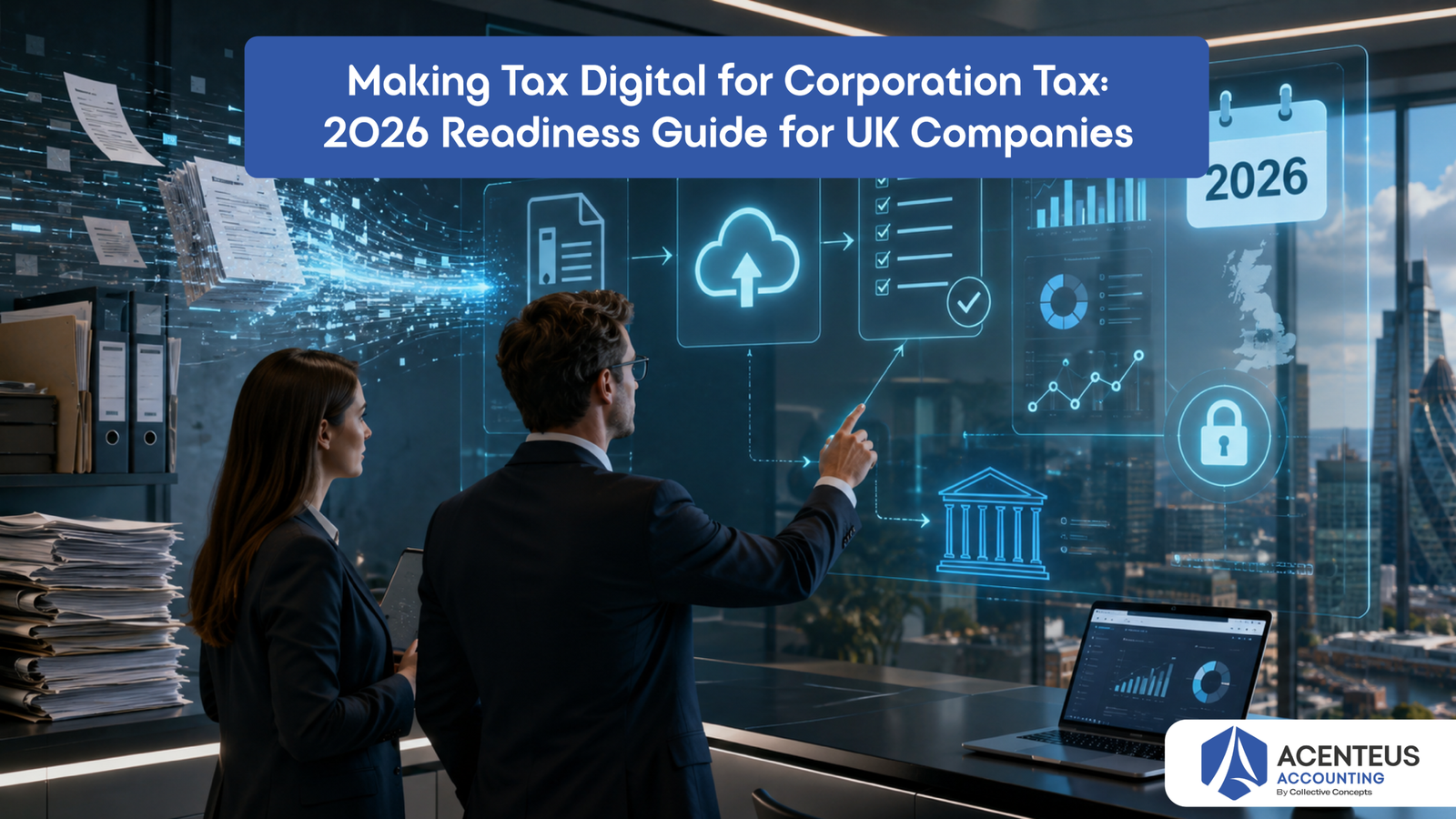
Here is the answer most guides bury: there is no Making Tax Digital for Corporation Tax mandate in 2026. In its Transformation Roadmap published in July 2025, HMRC confirmed that it does not intend to introduce Making Tax Digital (MTD) for Corporation Tax as previously planned, and is instead developing a separate digital approach for companies. So if you run a limited company, your Corporation Tax filing obligations are not changing under MTD, and there is no CT quarterly-update deadline coming for you in 2026.
That is the fact to get straight, because a lot of what is written about “MTD for Corporation Tax 2026” is out of date and quietly implies a mandate that is not happening. But it would be a mistake to read “no mandate” as “nothing to do.” The direction of travel is unmistakably digital: MTD is already compulsory for VAT, it lands for Income Tax in April 2026, and a digital approach for Corporation Tax is being designed. The companies that thrive are the ones that get their records, software and processes ready now, on their own timetable, rather than scrambling later. This guide sets out the real status, what is genuinely changing for companies in 2026, and a practical readiness plan.
Key takeaways (TL;DR)
- There is no MTD for Corporation Tax in 2026. HMRC confirmed in its July 2025 Transformation Roadmap that it does not intend to introduce MTD for Corporation Tax, and is developing a separate approach for companies instead. Your CT filing is unchanged.
- MTD is real for other taxes. It is already mandatory for VAT, and Making Tax Digital for Income Tax begins in April 2026 for sole traders and landlords with income over £50,000, which catches many company directors personally.
- A digital Corporation Tax approach is coming, just not yet, and not on the old timetable. No start date has been set.
- Readiness is still the smart move. Cloud accounting, clean digital records and a solid software stack pay off now, whether or not a CT mandate ever arrives.
- Use 2026 to prepare on your terms. Moving to cloud accounting voluntarily is far less stressful than being forced to under a deadline.
Is Making Tax Digital for Corporation Tax happening in 2026?
No. Making Tax Digital for Corporation Tax is not happening in 2026, and no mandatory start date has been set. HMRC confirmed its position in the Transformation Roadmap it published in July 2025: it does not intend to introduce MTD for Corporation Tax in the form originally consulted on. The House of Commons Library states the position plainly, noting that of the three original MTD strands (VAT, Income Tax and Corporation Tax), only VAT is in full force, Income Tax is rolling out from April 2026, and HMRC has confirmed it does not intend to introduce MTD for Corporation Tax.
This matters because the messaging has changed. When MTD was first announced, Corporation Tax was part of the plan, with an original target of 2020, later pushed to “not before 2026.” That is where a lot of the confusion comes from: older articles still frame 2026 as the CT readiness deadline. The current, correct position is different. Rather than forcing all companies (from a one-person contractor company to a multinational group) into the same quarterly digital regime, the government has accepted that one size does not fit the Corporation Tax population, and is designing a separate approach. For company directors, the practical takeaway is simple: you do not have a new CT filing obligation in 2026, and you do not need to buy CT quarterly-update software.
Here is where each strand of Making Tax Digital actually stands.
| MTD strand | Status | Who it applies to | From when |
|---|---|---|---|
| MTD for VAT | Live and mandatory | All VAT-registered businesses, including companies | Since April 2022 |
| MTD for Income Tax | Rolling out | Sole traders and landlords over the income thresholds | April 2026 (over £50,000), then 2027 and 2028 |
| MTD for Corporation Tax | Not being introduced | No company is mandated | No date; HMRC does not intend to introduce it in its original form |
What was Making Tax Digital for Corporation Tax meant to be?
The original vision for MTD for Corporation Tax, set out in HMRC’s 2020 consultation, would have required companies to keep digital accounting records, send quarterly updates of income and expenditure to HMRC using compatible software, and file an annual Corporation Tax return digitally through that software, replacing the current once-a-year CT600 process. A voluntary pilot was expected first, followed by mandation no earlier than 2026.
Understanding what was proposed helps explain both the delay and the direction. The quarterly-update model works reasonably well for the relatively uniform VAT population, and it is being applied to sole traders and landlords under MTD for Income Tax. But the Corporation Tax population is far more varied. A dormant company, a family trading company, a property investment company and a listed group have almost nothing in common in how they keep records or compute tax, and bolting a single quarterly regime onto all of them raised more problems than it solved. That complexity, combined with the strain of delivering MTD for Income Tax and migrating HMRC’s own legacy systems, is why Corporation Tax kept slipping down the list and has now been set aside for a rethink.
Why has MTD for Corporation Tax been shelved?
MTD for Corporation Tax has been set aside because HMRC concluded that a single digital regime cannot fit the diversity of the Corporation Tax population, and because its capacity is committed to delivering MTD for Income Tax first. Several factors drove the decision.
- The Corporation Tax population is too varied for one model. Companies range from dormant shells to complex groups, with wildly different accounting and tax needs, so a uniform quarterly-update approach was judged unworkable.
- MTD for Income Tax is the priority. Rolling out MTD for millions of sole traders and landlords from April 2026 is a major undertaking, and HMRC has chosen to focus its delivery capacity there.
- The wider programme has a history of delay and cost overruns. Independent reviews, including by the National Audit Office, found the original MTD timetable unrealistic, with unresolved design issues and rising costs, which encouraged a more cautious approach to the hardest strand.
- HMRC is still modernising its own systems. Migrating taxpayer records to a new digital platform has taken longer than planned, and that work has to progress before a CT approach can be built on it.
The result is not that Corporation Tax stays paper-based forever, but that its digital future is being designed more carefully and separately, with no fixed date.
So what is actually changing for companies in 2026?
Even without an MTD for Corporation Tax mandate, 2026 is a significant year for company tax digitisation, because two parts of MTD already affect companies and their directors, and a third is on the horizon. It is worth being clear about each.
Making Tax Digital for VAT (already mandatory)
If your company is VAT-registered, you are already inside MTD. Since April 2022, all VAT-registered businesses, including companies, must keep digital VAT records and submit VAT returns through MTD-compatible software rather than the old HMRC portal. If you are still copying figures into a spreadsheet by hand or filing manually, you are non-compliant now, regardless of Corporation Tax. Our step-by-step guide to submitting a VAT return under MTD covers exactly how this works.
Making Tax Digital for Income Tax (from April 2026)
MTD for Income Tax begins on 6 April 2026 for sole traders and landlords with qualifying income over £50,000, dropping to £30,000 in April 2027 and £20,000 in April 2028. This is not a Corporation Tax obligation, but it catches many company directors personally: if you also run a sole trade or receive rental income above the threshold, you will be mandated into MTD for Income Tax for that income, with quarterly digital updates and a digital final declaration. Directors who assume “my company is fine, so I am fine” can be caught out by their own side income.
The separate digital approach for Corporation Tax (coming, undated)
HMRC has said it will develop a digital approach suited to the Corporation Tax population, rather than force companies into the Income Tax model. No consultation timetable or start date has been published. The sensible planning assumption is that a digital CT regime will arrive eventually, probably built on the same cloud-accounting foundations as MTD for VAT and Income Tax, and that companies already working in clean cloud software will adopt it with minimal disruption whenever it lands.
Why get MTD-ready now even though Corporation Tax is not mandated?
Because digital readiness pays off immediately, regardless of any mandate, and because the parts of MTD that do apply to companies are not optional. There are five concrete reasons to move now rather than wait for a Corporation Tax deadline that may be years away.
First, if you are VAT-registered, digital records are already the law. Second, if you or your fellow directors have side income, MTD for Income Tax may already apply to you personally from April 2026. Third, a digital Corporation Tax approach is being built, and the companies already on cloud software will absorb it effortlessly while paper-based ones face a rushed migration. Fourth, cloud accounting delivers real benefits today: a near real-time view of your numbers, fewer errors, faster year-end, easier collaboration with your accountant, and a running estimate of your Corporation Tax rather than a March surprise. Fifth, moving voluntarily, at your own pace, is far cheaper and calmer than being forced to under a compliance clock. In short, “no mandate” is a reason to prepare on your own terms, not a reason to do nothing.
The company digital readiness checklist
Every UK company should work through a five-step digital readiness check in 2026, whether or not a Corporation Tax mandate ever arrives. Treat it as future-proofing that also improves how you run the business today.
- Confirm your MTD for VAT compliance. If you are VAT-registered, check you are keeping digital records with a genuine digital link and filing through compatible software, not the old portal. Fix this first, because it is already required.
- Check the directors’ personal position. Establish whether any director has sole-trade or property income that brings them into MTD for Income Tax from April 2026, and get that income onto compatible software.
- Move to cloud accounting. Get your company’s bookkeeping into cloud software (Xero, QuickBooks, Sage or similar) so records are digital, current and ready for whatever CT approach eventually arrives.
- Clean up your digital records. Connect bank feeds, categorise transactions properly, stop mixing personal and business spending, and reconcile monthly rather than annually.
- Build a real-time tax view. Use the software (and your accountant) to keep a running estimate of your Corporation Tax and cash position, so filing and payment are never a scramble.
If working through that list sounds like a project you do not have time for, it is precisely the kind of transition a cloud accounting and tax compliance service is built to handle, from migration to ongoing digital record-keeping.
Cloud accounting: the foundation of digital readiness
Cloud accounting is the foundation of any digital-tax readiness plan, because it keeps your records digital, current and connected to HMRC-compatible filing, which is exactly what every strand of Making Tax Digital requires. Instead of a desktop file or a shoebox of receipts, your accounts live in secure online software that updates as money moves.
The practical benefits are the same ones that make companies more resilient in general. Bank feeds pull transactions in automatically, so bookkeeping is close to real time. The software validates entries and calculates VAT, reducing the errors that trigger HMRC queries. You and your accountant see the same live data, so year-end is a review rather than a reconstruction. And because the leading platforms (Xero, QuickBooks and Sage) are already MTD-compatible for VAT and are building for Income Tax, choosing one now means you are ready for a Corporation Tax approach whenever it arrives. Acenteus is a Xero Silver Partner and works across Xero, IRIS and TaxCalc, and our accounting services for businesses and outsourced finance function are built cloud-first for exactly this reason.
Case study: cloud accounting readiness in practice
The value of getting digital-ready shows up in how smoothly compliance runs once the foundations are in place. On Clutch, the independent B2B review platform that verifies client feedback, Acenteus CCA holds 100 percent positive reviews, and the recurring theme is exactly this shift from reactive to real-time.
One verified client described the change directly: “Acenteus’ accounting outsourcing has transformed how we manage compliance and reporting. Their precision and efficiency free up our time to focus on high-value advisory work and client growth.” A separate Cambridge accounting firm, which runs its bookkeeping, VAT and accounts through cloud software with Acenteus, reported that the work was “completed all tasks on time with minimal errors,” with “clear and well-structured work description reports.”
The lesson for digital readiness is that the software is only half the story. Cloud accounting delivers its benefits (real-time numbers, clean records, painless VAT filing, and easy adoption of whatever comes next for Corporation Tax) when it is set up correctly and maintained consistently. That combination of the right platform and disciplined process is what turns a future MTD change from a threat into a non-event.
How Corporation Tax fits into a digital workflow
Even without an MTD mandate, Corporation Tax is far easier to manage inside a clean digital workflow than as an annual paper exercise. When your bookkeeping is in cloud software and kept current, your taxable profit is visible throughout the year, not discovered months after your year-end. That lets you plan for the bill, use reliefs deliberately, and avoid the cash-flow shock of a Corporation Tax liability you did not see coming.
The mechanics of Corporation Tax are unchanged by all of this: you still pay within nine months and one day of your accounting period end and file your CT600 within twelve months, and the rates still run at 19 percent on profits up to £50,000, 25 percent above £250,000, and marginal relief in between. What changes with cloud accounting is your visibility and control. You can sense-check your position at any time with our free UK Corporation Tax calculator, and if a query does arise, our guide to contacting HMRC about Corporation Tax walks through the routes. Good digital records also make any future HMRC enquiry far less painful, because the evidence is already organised.
What UK companies should do in 2026
The right move in 2026 is to treat digital readiness as a business improvement, not a compliance chore, and to do it now while it is voluntary. Start by fixing anything that is already required: confirm your MTD for VAT filing is compliant and check whether any director is caught by MTD for Income Tax. Then get your company onto cloud accounting if it is not already, clean up the records, and set up a real-time view of tax and cash. Finally, keep an eye on HMRC announcements for the separate Corporation Tax approach, but do not wait for them to modernise. The whole point of the current gap, with no CT mandate in force, is that it gives you room to move on your own timetable. Companies that use that room will find the eventual digital CT regime a formality; those that ignore it will face the same rushed, expensive migration that caught out the businesses who left MTD for VAT to the last minute. Our wider guide to accounting outsourcing in the UK sets out how firms and businesses hand this work over entirely, and if you want a straightforward readiness conversation, our team is a message away.
Frequently Asked Questions (FAQ)
No. There is no MTD for Corporation Tax mandate in 2026. HMRC confirmed in its July 2025 Transformation Roadmap that it does not intend to introduce Making Tax Digital for Corporation Tax as originally planned, and is developing a separate digital approach for companies instead. Your company's Corporation Tax filing obligations are not changing under MTD, and no start date has been set.
Probably, but not on the original plan and not soon. HMRC has said it will design a digital approach suited to the diversity of the Corporation Tax population, rather than force companies into the Income Tax model. No consultation timetable or mandatory start date has been published, so any digital CT regime is likely to be years away and will be announced with notice.
It depends on VAT and on the directors' personal income. If your company is VAT-registered, it must already keep digital VAT records and file through compatible software. If a director has sole-trade or property income over £50,000, they are caught by MTD for Income Tax from April 2026. But there is no Corporation Tax MTD obligation for the company itself in 2026.
MTD for VAT is live and mandatory for all VAT-registered businesses since April 2022. MTD for Income Tax starts in April 2026 for sole traders and landlords above income thresholds, replacing the annual Self Assessment with quarterly digital updates and a digital final declaration. MTD for Corporation Tax was planned but has not been introduced; HMRC does not intend to roll it out in its original form and is designing a separate approach.
HMRC concluded that a single quarterly digital regime could not fit the huge variety of companies, from dormant shells to multinational groups, and chose to prioritise delivering MTD for Income Tax first. The wider programme's history of delays and cost overruns, plus the need to modernise HMRC's own systems, also pushed Corporation Tax down the list and led to a rethink.
Possibly. MTD for Income Tax applies to individuals with sole-trade or property income above the thresholds, not to company salaries or dividends. If a director only takes salary and dividends from their company, MTD for Income Tax does not apply to that income. But a director who also has self-employment or rental income over £50,000 will be mandated for that income from April 2026.
For MTD for VAT and to prepare for anything that follows, use cloud accounting software that HMRC recognises, such as Xero, QuickBooks or Sage. These keep digital records, calculate VAT, file directly to HMRC, and are building support for MTD for Income Tax. Choosing a mainstream cloud platform now means you are ready for a future Corporation Tax approach with minimal change.
Cloud accounting itself is not legally mandatory, but digital record-keeping is already required for VAT if your company is VAT-registered, and cloud software is the simplest way to meet that. Given the clear digital direction of UK tax, moving to cloud accounting voluntarily is strongly advisable even where it is not strictly required.
No deadline changes have been announced, because there is no digital Corporation Tax regime yet. Under the current rules, you pay Corporation Tax within nine months and one day of your accounting period end and file your CT600 within twelve months. If a digital approach is introduced in future, HMRC will confirm any changes to reporting with advance notice.
Corporation Tax is charged at 19 percent on profits up to £50,000 and 25 percent on profits above £250,000, with marginal relief tapering the effective rate in between. These rates are unchanged for 2026/27. Cloud accounting helps by showing your taxable profit throughout the year, so the bill is predictable rather than a year-end surprise.
If your company is VAT-registered and you are not keeping digital VAT records or filing through compatible software, you are already non-compliant and exposed to penalties. Ignoring MTD for VAT is the real risk, not Corporation Tax. For a future CT regime, ignoring the digital direction simply means a harder, costlier migration when it eventually arrives.
Move now. There is no benefit to waiting, because cloud accounting improves your finances today and prepares you for every strand of MTD. Moving voluntarily, at your own pace, is far less stressful and less expensive than being forced to migrate under a compliance deadline, which is exactly what happened to businesses that left MTD for VAT to the last minute.
Yes. An accountant or outsourced finance provider can set up your cloud accounting, keep your digital records, file your MTD for VAT returns, manage any MTD for Income Tax obligations for directors with side income, and prepare your Corporation Tax, so digital compliance becomes something that simply happens rather than something you manage.
The most reliable sources are GOV.UK and the House of Commons Library, which track the programme's status and timetable. Because dates and scope have changed repeatedly, always check the current official position rather than relying on older articles, many of which still describe a Corporation Tax mandate that HMRC has since confirmed it will not introduce in that form.
There is no Corporation Tax MTD obligation for any company in 2026, dormant or otherwise. A dormant company with no trading and no VAT registration has nothing to do for MTD. A small trading company that is VAT-registered must already meet MTD for VAT. The general advice still holds: any active company benefits from cloud accounting, and getting ready early is easier than a forced migration later.
No. Making Tax Digital is about how you report to HMRC for tax, and it is separate from your duty to file annual accounts and a confirmation statement at Companies House. Those Companies House obligations continue unchanged. Cloud accounting helps with both, because clean digital records make company accounts, the confirmation statement and any tax filing quicker and more accurate.