Last updated: 3 July 2026
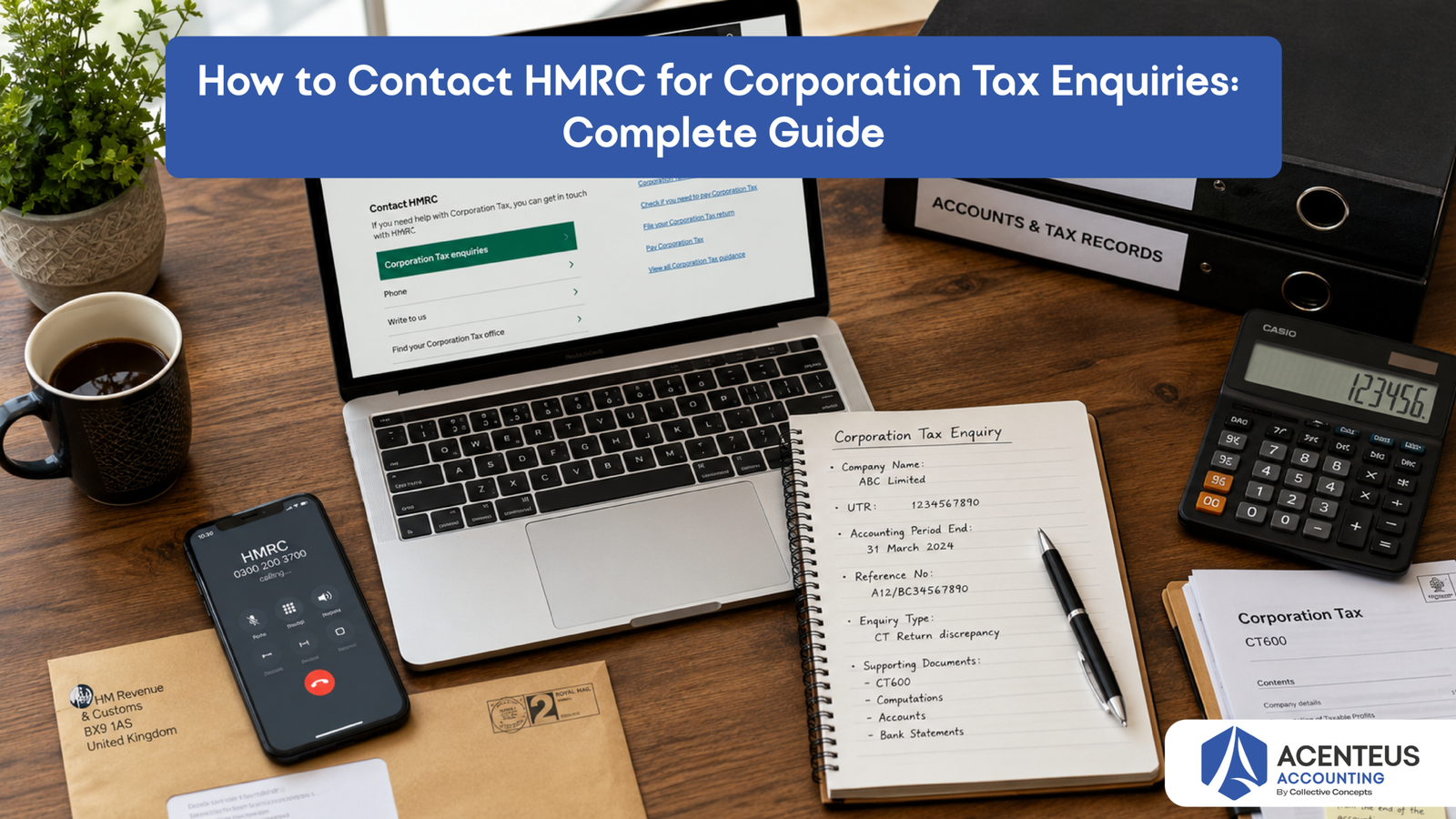
To contact UK HMRC about Corporation Tax, call the Corporation Tax helpline on 0300 200 3410 (Monday to Friday, 8am to 6pm), sign in to your company’s business tax account online, or write to Corporation Tax Services, HM Revenue and Customs, BX9 1AX. Whichever route you pick, have your 10-digit Corporation Tax Unique Taxpayer Reference (UTR) ready, because HMRC will not discuss your company’s affairs without it.
That is the short version. The useful version depends on why you are getting in touch, because “a Corporation Tax enquiry” means two very different things. Most of the time it means a question you want to ask HMRC: a missing UTR, a payment you cannot make, a penalty you want to challenge. Sometimes it means the other thing, a formal enquiry, where HMRC contacts you to open a compliance check into your company tax return. The right channel, and the right approach, is different for each. This guide covers both, with every number and address verified against GOV.UK, plus the scenarios where picking the wrong line just wastes an afternoon on hold.
Key takeaways (TL;DR)
- General Corporation Tax helpline: 0300 200 3410, Monday to Friday, 8am to 6pm, closed bank holidays. From outside the UK, call +44 151 268 0571. Lines are quietest between 8:30am and 11am.
- You must have your 10-digit Corporation Tax UTR. HMRC advisers cannot give it to you over the phone; if it is lost, request a copy online and HMRC posts it to your registered office.
- Cannot pay? Call a different line. The Business Payment Support Service on 0300 200 3835 is the only line that can agree a Time to Pay arrangement.
- Online is fastest for most tasks. Your business tax account lets you file, check balances, view deadlines and message HMRC without queuing.
- If HMRC opens a formal enquiry into your return, do not handle it alone. Respond through your accountant or agent, keep everything in writing, and check the contact is genuine first.
How do you contact HMRC about Corporation Tax? The channels at a glance
There are four ways to reach HMRC about Corporation Tax: phone, your online tax account, post, or through an authorised agent such as your accountant. Each suits a different type of query, and using the right one is the difference between a five-minute job and a long wait. Here is the full picture in one place.
| Channel | Details | Best for |
|---|---|---|
| Phone (general) | 0300 200 3410 (UK), +44 151 268 0571 (abroad), textphone 0300 200 3411 | Questions that need a conversation: penalties, disputes, chasing progress |
| Phone (cannot pay) | Business Payment Support Service, 0300 200 3835 | Setting up a Time to Pay arrangement before or after the deadline |
| Online | Business tax account at tax.service.gov.uk, plus webchat and the digital assistant | Filing, checking balances and deadlines, sending secure messages, paying |
| Post (general) | Corporation Tax Services, HM Revenue and Customs, BX9 1AX | Signed documents, formal paper trails, replying to an HMRC letter |
| Through an agent | Your accountant contacts HMRC on your behalf once authorised | Anything you would rather not handle yourself, especially enquiries |
All HMRC Corporation Tax phone lines run Monday to Friday, 8am to 6pm, and are closed on weekends and bank holidays. If you handle Corporation Tax as part of running a limited company, it is worth reading our free UK Corporation Tax calculator and guide first, because a lot of “I need to call HMRC” moments disappear once you can see what you actually owe and when.
What do you need before you contact HMRC about Corporation Tax?
Before you call or write, have your company’s Corporation Tax UTR, company name, company registration number and registered office address to hand. For anything involving a payment, you also need your 17-character Corporation Tax payment reference. HMRC uses these to find your record, and without the UTR in particular, an adviser cannot take your query any further.
Here is the short checklist to gather first:
- Your 10-digit Corporation Tax UTR (the single most important reference).
- Your company name exactly as registered.
- Your company registration number (CRN) from Companies House.
- Your registered office address.
- For payments, your 17-character Corporation Tax payment reference for the specific accounting period.
- Any reference number printed on the HMRC letter you are responding to.
What is a Corporation Tax UTR and where do I find it?
A Corporation Tax UTR is a 10-digit Unique Taxpayer Reference that HMRC issues to your company shortly after it is incorporated, and it is the number HMRC uses to identify your company for everything Corporation Tax related. It is not the same as your Companies House registration number, your VAT number, or your personal Self Assessment UTR, and mixing them up is a common cause of misapplied payments.
You will find your company UTR on the “Notice to deliver a Company Tax Return” (the welcome letter HMRC posts to your registered office within about 15 working days of incorporation), on any later HMRC letter such as a payment reminder or statement, on a previously filed CT600, and inside your business tax account once the company is enrolled for online services. If you are still not sure which number is which, GOV.UK has a plain guide to finding your UTR.
How do I get a lost Corporation Tax UTR?
If you cannot find your company UTR anywhere, use HMRC’s online service to ask for a copy of your Corporation Tax UTR. You enter your company number and name exactly as they appear on the Companies House register, and HMRC posts the UTR to your company’s registered office address. It is sent by post on purpose, for security: an adviser will not read your UTR out over the phone, and HMRC will not email it. Allow up to 15 working days, and note the service only works for companies registered with Companies House for more than seven days.
One practical warning: HMRC sends the letter to the registered office held at Companies House. If that address is out of date, update Companies House first, or the UTR will land somewhere you cannot reach. A good outsourced finance function keeps these references organised so a lost UTR never stalls a filing or a payment in the first place.
How to contact HMRC about Corporation Tax by phone
Call the Corporation Tax helpline on 0300 200 3410 for general enquiries, from outside the UK on +44 151 268 0571, or via textphone on 0300 200 3411. The lines are open Monday to Friday, 8am to 6pm, and are closed on weekends and bank holidays. According to HMRC, they are least busy between 8:30am and 11am, so a mid-morning midweek call usually beats a Monday afternoon.
A few things make the call go faster. The helpline uses speech recognition when you first connect, so say the reason for your call in a few plain words (“Corporation Tax, payment”) rather than pressing through menus. Have your UTR ready before you dial, since the adviser will ask for it early. If you cannot use a standard phone, Relay UK works by dialling 18001 followed by the helpline number. And take notes while you are on the call: the date and time, the number you rang, the adviser’s name, and what was agreed. If a query is ever disputed later, that contemporaneous note is the record you will be glad you kept.
Phone is the right choice when a query genuinely needs a conversation, for example querying a penalty, disputing a figure, or chasing something that has stalled. For routine tasks, the phone is usually the slowest option, not the fastest.
How to contact HMRC about Corporation Tax online
For most Corporation Tax tasks, your online business tax account is the quickest route and avoids the phone queue entirely. Signing in at tax.service.gov.uk with your Government Gateway details lets you file your company tax return, check your balance and payment deadlines, view your account history, send HMRC a secure message, and make a payment, all in one place.
Two supporting tools help with quick questions. HMRC’s webchat connects you to an adviser for straightforward queries, and the digital assistant can answer basic Corporation Tax questions and point you to the right guidance at any time of day. If you have already sent HMRC a query or a form and just want to know when to expect a reply, use HMRC’s “Where’s My Reply” tool and service dashboard before you chase, since they give the current expected response date and save you a call. For a limited company managing its own books, pairing the online account with solid accounting services for businesses removes most of the reasons you would ever need to contact HMRC by hand.
How to contact HMRC about Corporation Tax by post
Write to Corporation Tax Services, HM Revenue and Customs, BX9 1AX, United Kingdom for general Corporation Tax correspondence when you have not been given a specific address. You do not need to add a street name, city or PO box: BX9 1AX is a central mail-handling code, not a physical office. Put your UTR in the letter and on the first page of every document you send, so HMRC can match your post to your company record.
Two important caveats. First, if you are replying to a letter from HMRC, use the address printed on that letter rather than the generic BX9 1AX, because different teams handle different issues and your reply needs to reach the right one. Second, post is the slowest channel: HMRC scans incoming mail and processing takes time, so it is best reserved for signed forms, formal paper trails, or times when HMRC has specifically asked you to write. If you send anything by courier rather than Royal Mail, BX9 addresses need the separate delivery address at HM Revenue and Customs, BP8002, Benton Park View, Newcastle upon Tyne, NE98 1ZZ.
Which HMRC route do I need? Contact by reason
The fastest way to reach the right HMRC team is to match your reason for contact to the correct channel before you start. Calling the general helpline about a debt, or writing a letter when a webchat would do, is where most wasted time goes. This table maps the common Corporation Tax reasons to the right route and what to have ready.
| Reason for contact | Best route | What you need |
|---|---|---|
| Register a new company for Corporation Tax | Online, business tax account | CRN, company details, incorporation date |
| Lost or never received your UTR | Online "ask for a copy" service | Company number and name from Companies House |
| Cannot pay by the deadline | Phone: 0300 200 3835 (Payment Support) | UTR, amount owed, income and expenses, a realistic proposal |
| Missed a deadline or received a penalty | Phone: 0300 200 3410, or write | UTR, the penalty reference, your grounds |
| Change your accounting period or company details | Online or phone | UTR, the new details |
| Chase a Corporation Tax refund or repayment | Check online first, then phone | UTR, the return or claim details |
| Company is dormant | Online or phone | UTR, date trading stopped |
| HMRC has opened a formal enquiry | Through your accountant or agent | The HMRC letter, your records, professional advice |
If your reason is that you cannot pay, do not use the general helpline. The Business Payment Support Service on 0300 200 3835 is the only line with authority to agree a Time to Pay arrangement, which spreads a Corporation Tax bill over (typically) 6 to 12 months. Call early, before the deadline if you can, and have a realistic monthly figure ready rather than a hopeful one. Interest still accrues on the balance, but a Time to Pay arrangement freezes most penalties and pauses enforcement while it runs. Note that HMRC will not agree an arrangement until your outstanding returns are filed, so file first even if you cannot pay, then call.
What happens if HMRC opens a formal Corporation Tax enquiry?
A formal Corporation Tax enquiry, also called a compliance check, is when HMRC writes to your company to examine your tax return in detail. This is the second meaning of “enquiry,” and it is the one to take seriously. HMRC normally has a window of around 12 months from the date it receives your Company Tax Return to open an enquiry into it, and it can look back considerably further where it suspects a careless or deliberate error. The letter will say what HMRC is checking, which can range from a single figure to the whole return.
What matters is how you respond. Do not ignore it, and do not fire back a quick answer to make it go away. HMRC officers who run compliance checks are trained in investigation, and an offhand remark or an incomplete answer can widen the check rather than close it. The safer approach is to respond in writing, provide exactly what is asked for and no more, keep copies of everything, and, above all, route the correspondence through your accountant or a tax adviser rather than handling it directly.
This is precisely where having a professional manage HMRC correspondence earns its fee. Our tax compliance outsourcing service is built to handle exactly this: acting as your authorised agent, dealing with HMRC directly, framing responses carefully, and protecting you from the inadvertent admissions that turn a routine check into a longer investigation. If you have received an enquiry letter and are not sure what it means, it is worth a conversation with a tax advisory specialist before you reply.
How do I check an HMRC letter or call is genuine?
Before you send any details or make a payment, confirm the contact is really from HMRC. Corporation Tax is a favourite target for scams, and the safest habit is to verify first. HMRC publishes a list of genuine letters and messages it has recently sent, so you can compare yours against it. Remember that HMRC will never ask for your UTR or bank details by email or text, and an adviser will never read your UTR out over the phone. If a letter directs you to a payment account or an address that does not match HMRC’s published details, stop and check before acting. When in doubt, sign in to your business tax account directly (type the address yourself rather than following a link) and see whether the same message appears there.
What if you cannot get through to HMRC?
If the phone line is jammed, you have several alternatives before giving up your morning. Try the webchat or digital assistant for anything routine. If you have already contacted HMRC, use the “Where’s My Reply” tool and the service dashboard to check the expected response date rather than calling to chase. If you work with an accountant, ask them to use the agent dedicated line, which gives authorised agents priority access and shorter waits than the public helpline. And if HMRC has genuinely got something wrong or a query has gone unanswered for far too long, you can make a formal complaint: complaints about Customer Compliance go to Customer Compliance Complaints, HM Revenue and Customs, BX9 2AB. The professional body ICAEW maintains a detailed directory of HMRC contacts that agents use to find the right team quickly.
When do you actually need to contact HMRC about Corporation Tax?
Most Corporation Tax contact is triggered by a deadline, so knowing the key dates tells you when a call or message is genuinely needed. There are three that matter for a limited company: you must register for Corporation Tax within three months of starting to trade, you must pay your Corporation Tax bill within nine months and one day of the end of your accounting period, and you must file your Company Tax Return (CT600) within twelve months of the end of your accounting period. The pay deadline falls before the filing deadline, which surprises a lot of directors.
If any of those dates is at risk, that is your cue to act early rather than wait. Cannot pay by the nine-month deadline? Call the Payment Support line before it passes. Cannot file in time? File as soon as you can to limit penalties, and message HMRC if there are genuine reasons for the delay. You can sense-check the numbers behind all of this with our Corporation Tax calculator, and if the deadlines keep catching you out, that is usually a sign the underlying compliance work needs a firmer hand. Our wider accounting outsourcing guide for UK firms and businesses explains how outsourcing that work removes the last-minute scramble.
Can my accountant contact HMRC for me?
Yes. Once you authorise an accountant as your agent, they can contact HMRC about your Corporation Tax on your behalf, and for most companies this is the least stressful option. Authorisation is done through HMRC’s online agent authorisation service or a paper 64-8 form, after which your agent can speak to HMRC, file your returns, handle correspondence, chase refunds, appeal penalties and set up payment plans without you sitting in the queue.
There are real advantages beyond convenience. Agents use the dedicated agent line, which is faster than the public helpline. They know which team handles what, so post and calls reach the right place first time. And when something sensitive arrives, such as a compliance check, a professional handles the wording so nothing is said that HMRC could take the wrong way. This is the core of what we do: Acenteus acts as the authorised agent for UK companies and practices, managing HMRC correspondence end to end so directors and firms can get on with running the business. If HMRC contact has become a recurring drain, get in touch and we will handle it for you.
Frequently Asked Questions (FAQ)
The general Corporation Tax helpline is 0300 200 3410 for UK callers, +44 151 268 0571 from outside the UK, and 0300 200 3411 for textphone users. Lines are open Monday to Friday, 8am to 6pm, and closed on weekends and bank holidays. If your query is that you cannot pay, call the Business Payment Support Service on 0300 200 3835 instead.
HMRC's Corporation Tax phone lines are open Monday to Friday from 8am to 6pm and are closed on weekends and bank holidays. According to HMRC, the lines are least busy between 8:30am and 11am, so calling mid-morning in the middle of the week usually means a shorter wait.
For general Corporation Tax correspondence, write to Corporation Tax Services, HM Revenue and Customs, BX9 1AX, United Kingdom. You do not need to add a street, city or PO box. Include your UTR in the letter and on the first page of any documents. If you are replying to a specific HMRC letter, use the address printed on that letter instead.
Your 10-digit Corporation Tax UTR appears on the welcome letter HMRC posts after incorporation, on later HMRC letters and payment reminders, on any previously filed CT600, and in your business tax account once the company is enrolled online. If you cannot find it, use HMRC's "ask for a copy of your Corporation Tax UTR" service and it will be posted to your registered office.
No. For security, HMRC advisers cannot read your UTR out over the phone and will not send it by email. If your UTR is lost, request a copy through the online service and HMRC will post it to your company's registered office address, usually within 15 working days. Make sure that address is up to date at Companies House first.
Call the Business Payment Support Service on 0300 200 3835, which is the only HMRC line that can agree a Time to Pay arrangement. Call as early as you can, ideally before the deadline, with your UTR, the amount owed, a breakdown of your income and expenses, and a realistic monthly figure. File any outstanding returns first, because HMRC will not agree an arrangement while returns are missing.
Yes, and for most tasks it is the quickest route. Sign in to your business tax account at tax.service.gov.uk to file returns, check deadlines and balances, send secure messages and pay. HMRC's webchat and digital assistant handle quick questions, and the "Where's My Reply" tool tells you when to expect a response to something you have already submitted.
Your Corporation Tax UTR is a 10-digit number issued by HMRC to identify your company for tax. Your company registration number (CRN) is issued by Companies House when the company is incorporated. They are different references from different bodies, and Corporation Tax filings and payments need the UTR, not the CRN.
It is a 17-character reference used when you pay Corporation Tax by bank transfer or similar. It is based on your UTR but changes every accounting period, so the reference for this year is not the same as last year's. You will find the correct one on your notice to deliver a return, on reminder letters, or in your online account under "View Corporation Tax statement."
Postal replies can take several weeks, as HMRC scans incoming mail and different teams process different issues. Before chasing, use HMRC's "Where's My Reply" tool and service dashboard, which show the current expected response date. For anything urgent, online or phone is faster than post.
A compliance check, or formal enquiry, is when HMRC writes to examine your company tax return in detail. HMRC normally has around 12 months from receiving your return to open one, and longer where it suspects an error. The letter states what is being checked. Respond carefully, in writing, and ideally through your accountant or tax adviser rather than directly.
For a formal enquiry, it is safer to respond through an accountant or tax adviser. HMRC compliance officers are trained in investigation, and a casual or incomplete answer can widen the check. An authorised agent frames responses carefully, provides only what is asked, and manages the correspondence so a routine check does not escalate.
Compare it against HMRC's published list of genuine letters and messages. HMRC will never ask for your UTR or bank details by email or text, and will not read your UTR over the phone. If a letter points to an unfamiliar payment account or address, verify it before acting, and sign in to your business tax account directly to see whether the same message appears there.
Yes. Once you authorise them as your agent, through the online agent authorisation service or a 64-8 form, your accountant can contact HMRC about your Corporation Tax, file returns, handle correspondence, chase refunds, appeal penalties and arrange payment plans on your behalf, using the faster agent dedicated line.