Last updated: 3 July 2026
Accounting outsourcing in the UK is the practice of handing some or all of your accounting work to an external specialist team instead of doing it in-house. It splits into two very different markets that almost every guide lumps together: outsourcing for accountancy practices (a firm delegates client work, usually white-label) and outsourcing for businesses (a company hands over its own finance function). Choose a partner built for the wrong one and you inherit the wrong pricing, the wrong compliance cover, and the wrong people on your account.
That split is the thing to get right, and it is the reason most “top 10” lists are close to useless. They put a white-label partner for practices in the same ranking as a Big-4-adjacent firm serving £50m businesses, then leave you to work out which is which. This guide keeps the two apart, shows you what each actually costs in 2026, gives you a six-point test for vetting any provider, and compares the notable UK firms by who they genuinely suit.
Key takeaways (TL; DR)
- Two markets, not one. “Accounting outsourcing UK” covers white-label support for accounting firms and full finance-function support for businesses. Shortlist providers built for your side only.
- Cost in 2026 runs roughly £150 to £10,000+ per month depending on scope, and typically lands 30 to 50 percent below the cost of equivalent in-house UK staff once salary, pension, software and cover are counted.
- Compliance is the dealbreaker. Your partner must handle Making Tax Digital for Income Tax (live from April 2026), UK corporation tax and marginal relief, Companies House identity verification, and UK GDPR for any offshore processing.
- Use the Six C Test below (Compliance, Capability, Confidentiality, Cost model, Continuity, Control) before signing anything.
- The hybrid model won. Offshore delivery with UK-qualified onshore review now gives most firms the best mix of cost and control.
What this looks like in practice
The clearest signal of an outsourcing partner’s quality is independent, verified review, not self-description. On Clutch, the B2B review platform that verifies client feedback, Acenteus CCA holds 100 percent positive reviews and is ranked among the top finance and accounting outsourcing firms in the UK.
One verified Clutch review, from a Cambridge accounting firm (1 to 10 staff) that has outsourced payroll, bookkeeping, VAT returns, accounts preparation and self-assessment work to Acenteus on an ongoing engagement since November 2024, reads: “Acenteus CCA has completed all tasks on time with minimal errors,” providing “clear and well-structured work description reports, supporting transparency and review.”
That phrase, “minimal errors,” is the one that matters commercially. When outsourced work comes back clean, the practice spends far less time on review, and Acenteus estimates that its verified “on time with minimal errors” delivery translates to roughly 30 to 40 percent less review time for the partner signing the work off. Review time is the hidden cost that makes a cheap offshore rate expensive, so it is the number to interrogate with any provider, not just the day rate. The rest of this guide is built around choosing a partner that produces that outcome rather than the opposite.
What is accounting outsourcing in the UK?
Accounting outsourcing in the UK is a delivery model where an external firm performs accounting tasks (bookkeeping, VAT, payroll, accounts preparation, tax, audit support) that would otherwise sit with an in-house team. The provider can be UK-based, fully offshore, or hybrid, and the engagement can be a single service or an end-to-end finance function.
The word “outsourcing” hides two audiences with opposite needs. Getting clear on which one you are is the first real decision.
Outsourcing for accountancy practices (white-label, firm-to-firm)
If you run an accounting or audit firm, outsourcing means delegating client compliance work to a behind-the-scenes partner so your team can take on more clients without hiring. The work comes back under your brand, your client never sees the supplier, and you keep the relationship. This is the model that fits sole practitioners through to multi-partner firms with 1 to 20 staff, and it is the one Acenteus is built around through its outsourcing services for accountants. Providers here include Acenteus CCA, QX Accounting Services, Corient, AdvanceTrack, Outbooks and AcoBloom.
Outsourcing for businesses (an outsourced finance function)
If you run a business rather than a practice, outsourcing means replacing or supplementing an internal finance department. You get bookkeeping, management accounts, payroll, VAT and often part-time CFO input from one provider, so you never build a full in-house team. Acenteus serves this market too through its accounting services for businesses and outsourced finance function lines. Providers oriented this way include Aone, Forvis Mazars, Crowe UK, Menzies, BDO and Azets.
The tell is simple. If you already are the accountant and just need capacity, you want a white-label partner. If you need someone to be your accountant, you want an outsourced finance function. The rest of this guide flags which side each point applies to.
Why are UK firms and businesses outsourcing accounting in 2026?
They are outsourcing because the maths of hiring in-house stopped working. Three forces are squeezing both practices and businesses at once: a genuine talent shortage, a wall of new compliance, and margins that no longer absorb rising salary costs.
The talent gap is the loudest driver. In its UK Salary and Recruiting Trends 2026, Hays reported that 93 percent of employers had hit skills shortages in the previous year, and that those shortages dented productivity at 55 percent of firms. UK practices have spent three years struggling to fill junior and mid-level roles, and the ones that cope best have quietly replaced “hire more people” with “build outsourced capacity you can flex up and down.” Demand for advisory work is climbing at the same time, so partners want their qualified staff on client conversations, not on reconciliations.
Compliance is the second driver, and 2026 is a heavy year for it (see the compliance section below). The third is plain economics. A qualified UK accountant now carries salary, employer National Insurance, pension, software licences and training before they produce a single set of accounts, and you can model the true loaded cost using an employer National Insurance calculator. Outsourcing converts that fixed cost into a variable one you only pay when you use it.
The market reflects the shift. The UK accounting and auditing sector is worth around £40.2 billion in 2026 (IBISWorld), and the finance-and-accounting outsourcing slice is growing faster than the sector as a whole: Mordor Intelligence sizes the global market at roughly 59 billion US dollars in 2026, growing near 8 percent a year. On cost, Acenteus’s own hybrid delivery runs 30 to 50 percent below equivalent pure-UK cost, and Mordor cites a mid-size manufacturer that saved 25 to 45 percent after moving end-to-end accounting to an offshore provider. Treat exact percentages as directional, but the direction is not in doubt.
How much does accounting outsourcing cost in the UK?
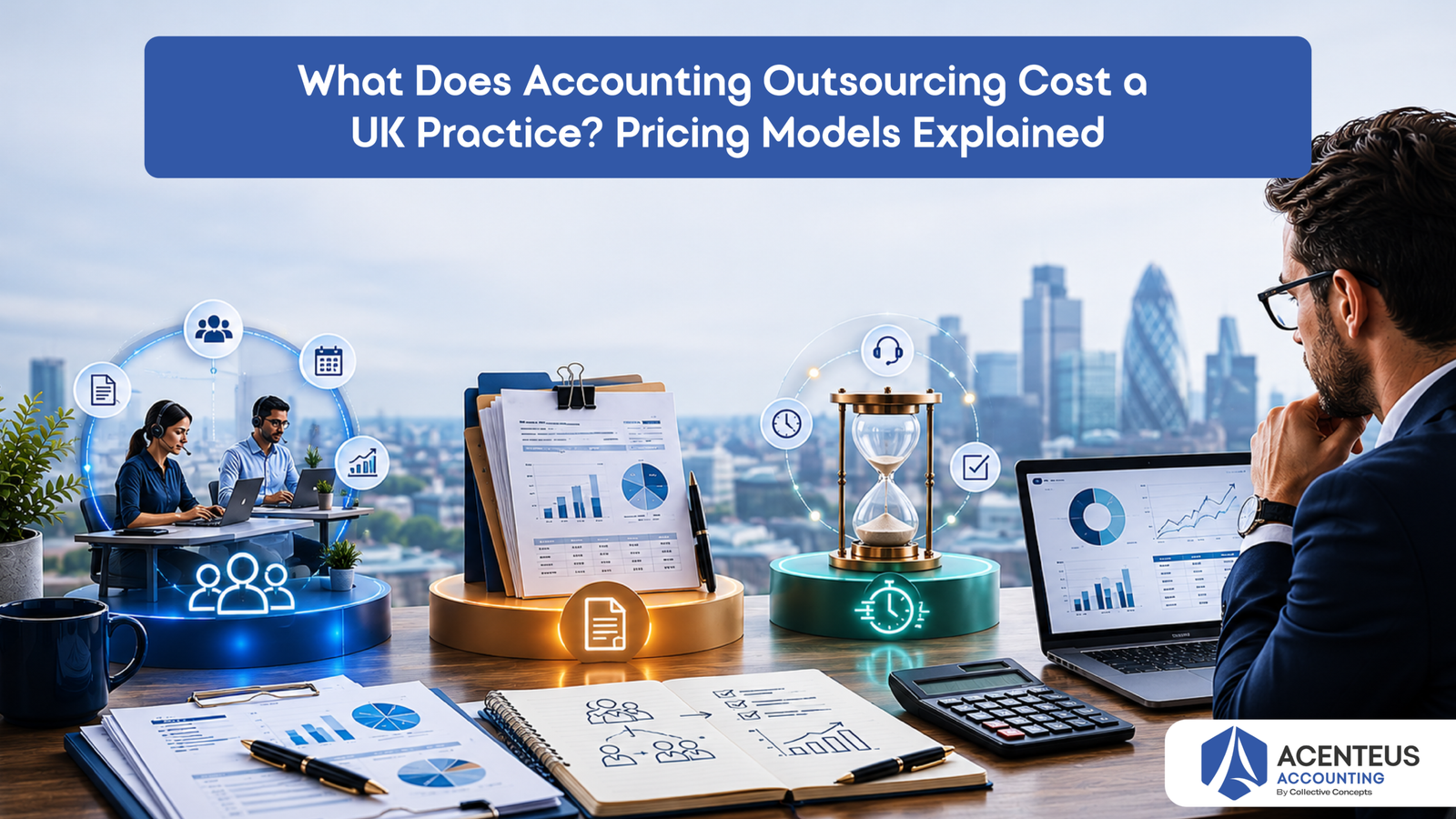
Accounting outsourcing in the UK costs roughly £150 to £10,000+ per month, set by scope and complexity rather than a single rate card. As a rule of thumb it lands 30 to 50 percent below the equivalent in-house UK cost once you count salary, employer NI, pension, software and holiday cover. There is no flat price because “outsourcing” ranges from a few hours of bookkeeping to a full finance function with CFO input.
Two things shape what you pay: the engagement model and the size of the work. Here are the engagement models you will be quoted.
| Engagement model | How it works | Best for | Typical use |
|---|---|---|---|
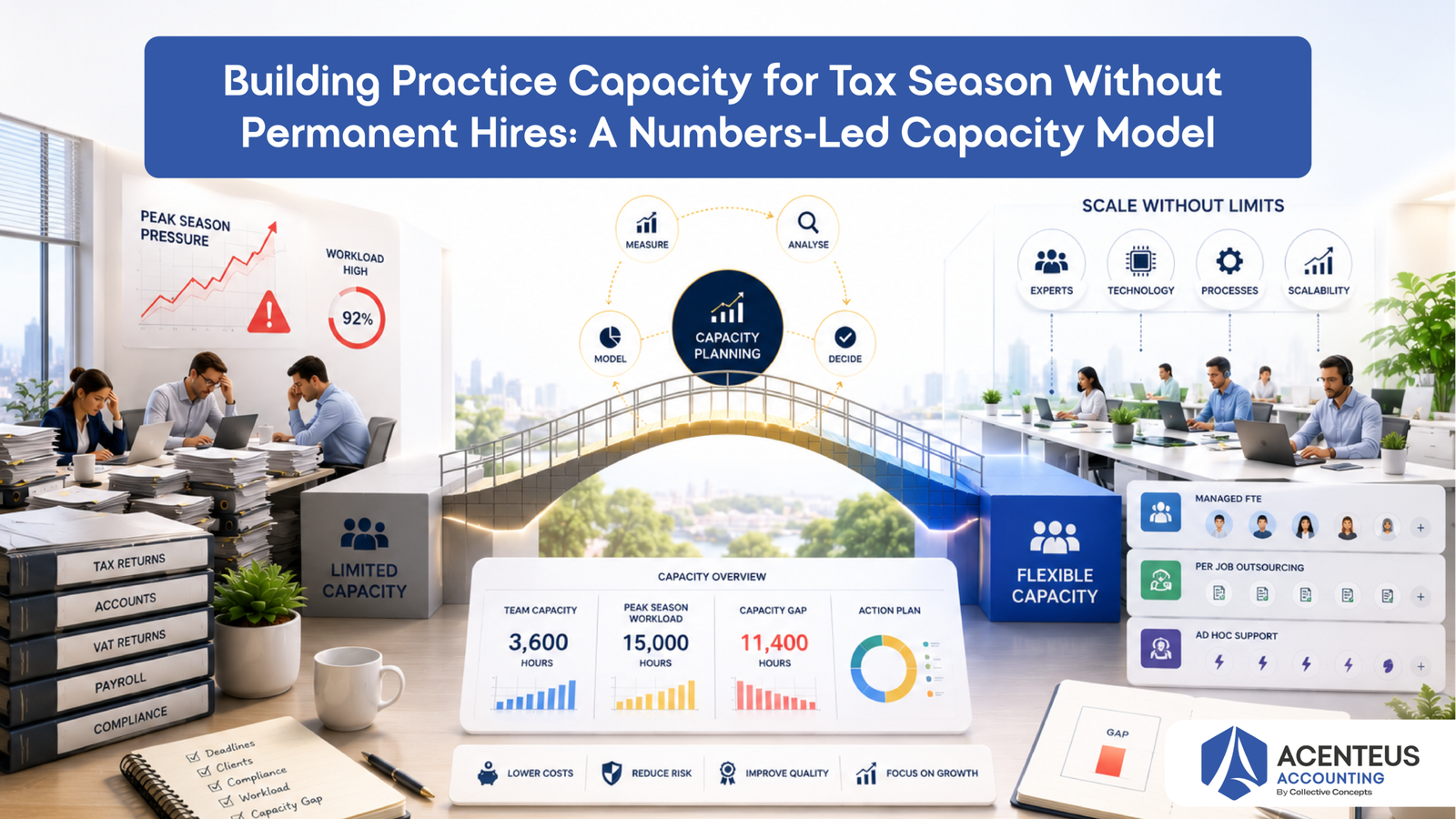
| Managed FTE (dedicated) | A named full-time resource or team works only on your files | Practices with steady, predictable volume | Ongoing bookkeeping, accounts, tax prep |
| Per job / per return | You pay a fixed fee per set of accounts, return or task | Practices with variable or seasonal volume | Year-end accounts, self-assessment season |
| Ad hoc / overflow | Work sent as needed, priced per task or per hour | Firms testing outsourcing or covering peaks | Busy-season overflow, one-off backlogs |
| Shared / pooled team | A share of a team, usually with a named lead | Cost-sensitive firms with lighter volume | Bookkeeping and VAT for smaller portfolios |
For a fuller breakdown of how these models price out, Acenteus has a dedicated guide to outsourced bookkeeping costs in the UK. As a benchmark by size:
| Buyer profile | Typical monthly cost |
|---|---|
| Micro business or sole trader (under £500k revenue) | £150 to £400 |
| Small business (£500k to £5m revenue) | £400 to £1,500 |
| Growing SME (£5m to £25m revenue) | £1,500 to £5,000 |
| Mid-market (£25m+ revenue) | £5,000 to £15,000+ |
| Practice, per-return outsourcing | From roughly £15 to £40 per job, volume dependent |
A word of caution on the cheapest quote. Hourly offshore rates can look unbeatable, but if the work comes back needing heavy review, your real cost is the offshore fee plus your own senior’s rework time. Predictable per-job or dedicated pricing is usually cheaper once you count review hours, which is why transparent, fixed pricing matters more than the headline rate.
The Six C Test: how to choose an accounting outsourcing partner
The best way to choose an accounting outsourcing partner is to score every candidate against six factors before you look at price: Compliance, Capability, Confidentiality, Cost model, Continuity and Control. Call it the Six C Test. It works whether you are a practice buying white-label support or a business buying a finance function, and it surfaces the weaknesses a sales call is designed to hide.
| The Six Cs | What you are checking | What to ask |
|---|---|---|
| Compliance | Genuine UK regulatory knowledge, not US or generic | "How do you handle MTD for ITSA, corporation tax marginal relief and Companies House ID verification?" |
| Capability | Qualified people and a real review layer | "Who is ACCA, ACA or AAT qualified, and who reviews the work before it reaches me?" |
| Confidentiality | Data security and, for practices, white-label discretion | "Where is my data processed, what are your UK GDPR safeguards, and how do you stay invisible to my clients?" |
| Cost model | Predictable pricing you can build a margin on | "Is this fixed per job or per FTE, and what triggers an extra charge?" |
| Continuity | No single point of failure, cover during absence | "What happens when my named person is off, and how do you protect against knowledge loss?" |
| Control | You keep the client and the final sign-off | "Do I retain the client relationship and final review, and how do handovers work?" |
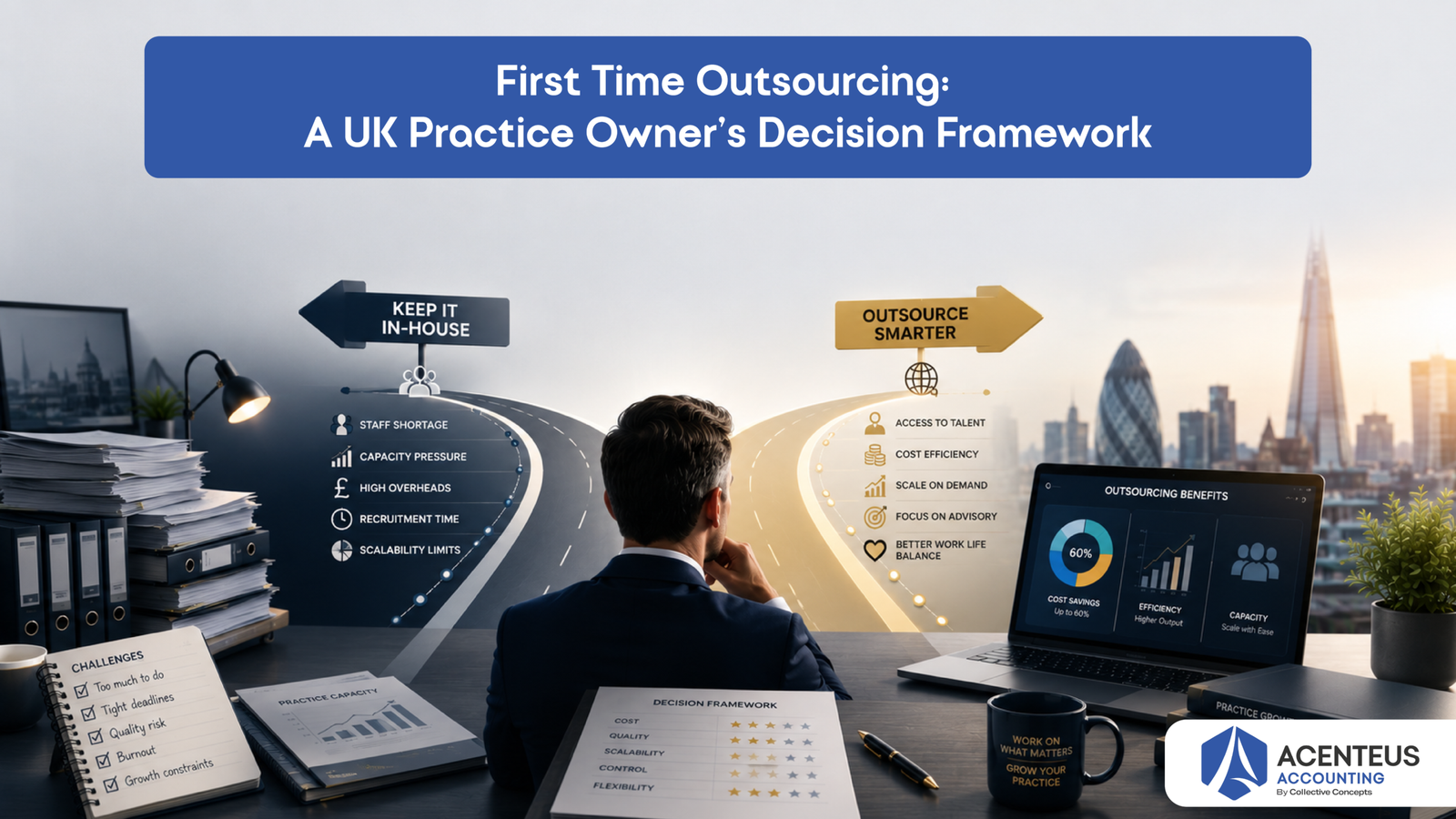
The two Cs that separate a good partner from a risky one are Compliance and Confidentiality. A provider strong on US bookkeeping but shaky on UK rules will leave gaps that cost far more to fix than you saved. And for a practice, a partner that cannot stay genuinely white-label, or cannot tell you exactly where client data sits, is a reputational risk you are handing to a third party. Acenteus’s own take on making the first outsourcing decision safely sits in its first-time outsourcing decision framework, which pairs well with this test.
The 2026 UK compliance your outsourcing partner must handle
A UK accounting outsourcing partner in 2026 must be fluent in Making Tax Digital for Income Tax, corporation tax and marginal relief, Companies House identity verification, audit quality standards, and UK GDPR for offshore data. This is the section where “we do UK work” gets tested, because 2026 changed several of the rules.
Making Tax Digital for Income Tax (MTD for ITSA) is live. From 6 April 2026, sole traders and landlords with qualifying income over £50,000 must keep digital records and file quarterly updates. The threshold drops to £30,000 from April 2027 and to £20,000 from April 2028, per HMRC’s own guidance on the mandation thresholds. There is a soft-landing on late-submission penalties for the first cohort in 2026/27, but as ICAS notes in its MTD briefing, that grace does not extend to later cohorts. A partner not already running MTD for ITSA clients is behind.
Corporation tax and marginal relief. The tiered system introduced in April 2023 continues unchanged for 2026/27: 19 percent on profits up to £50,000, 25 percent above £250,000, and marginal relief tapering the effective rate in between, as set out on GOV.UK’s corporation tax rates page. The catch is the marginal band: each extra pound of profit between £50,000 and £250,000 is effectively taxed at around 26.5 percent, and the thresholds shrink when there are associated companies. This is not junior-bookkeeper territory. You can pressure-test any provider’s grasp of it with Acenteus’s free UK corporation tax calculator.
Companies House and the Economic Crime and Corporate Transparency Act. New identity verification duties for directors and people with significant control are being phased in, and your provider needs to build them into filing workflows on your behalf.
Audit quality (ISQM1). If audit support is in scope, the provider should work to current UK audit quality management standards. Acenteus, for example, delivers audit outsourcing aligned to the Mercia methodology that many UK firms already use.
UK GDPR and offshore data. For any partner processing data outside the UK, confirm exactly where data sits and that valid transfer safeguards are in place. Ask for the data security policy in writing. This is non-negotiable whether you are a practice or a business, and it is covered in Acenteus’s tax compliance outsourcing approach.
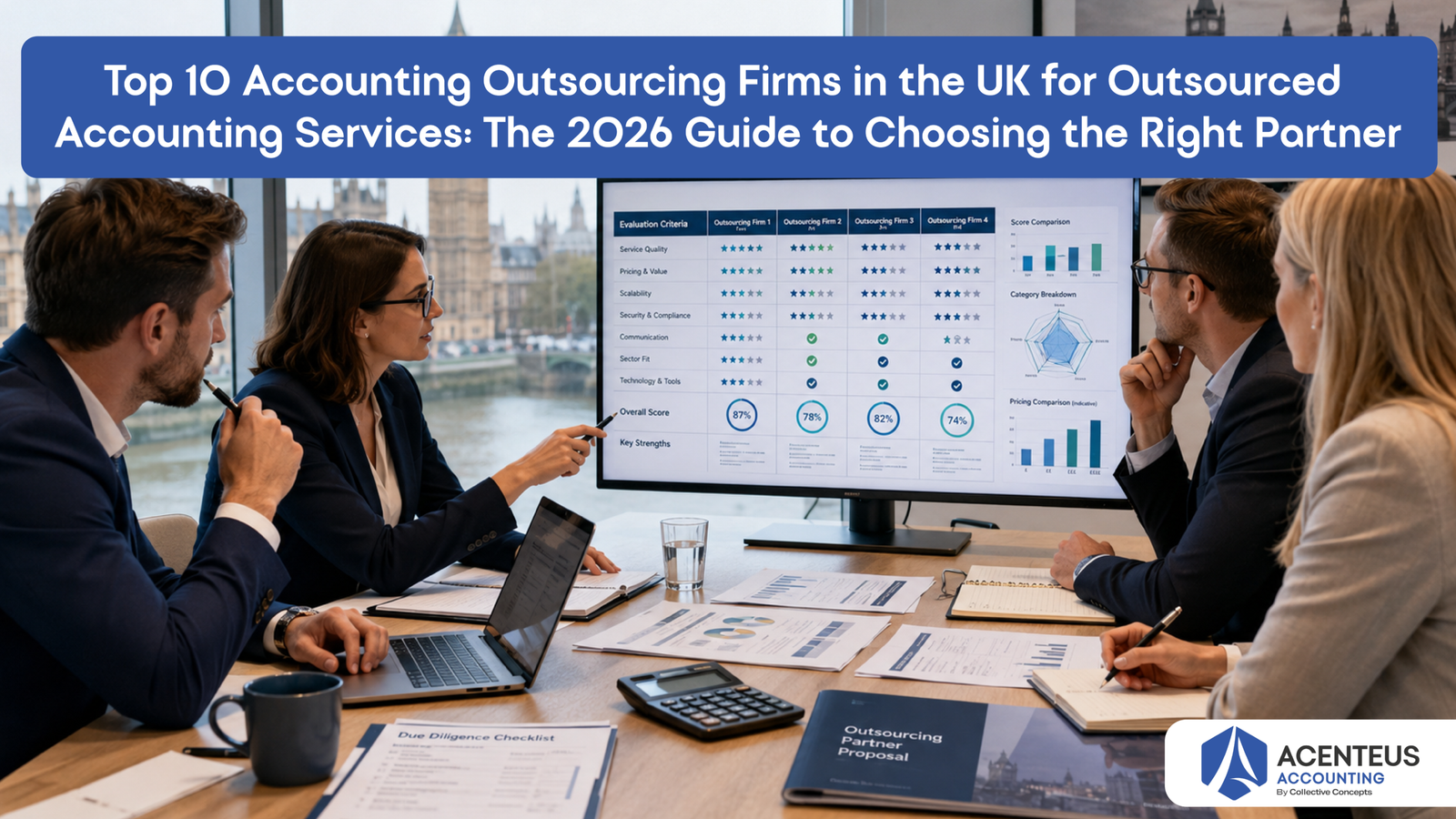
Top accounting outsourcing firms in the UK for 2026, by who they suit
There is no single “best” accounting outsourcing firm in the UK, because the right choice depends entirely on whether you are a practice or a business and how big you are. Ranking them in one list is what makes most guides misleading. Below they are grouped by fit, so you can shortlist from the right column instead of the whole market.
| Firm | Best for | Model | Side |
|---|---|---|---|
| Acenteus CCA | Small to mid UK practices and growing businesses wanting UK oversight | Offshore + UK account management & Resource Placed on your current team | Both |
| QX Accounting Services | High-volume practices needing scale and enterprise tooling | Offshore + UK account management | Practices |
| Corient | Practices wanting a discreet white-label extension | Offshore, white-label | Practices |
| AdvanceTrack | Practices prioritising process and compliance rigour | Outsourcing and offshoring | Practices |
| Outbooks / AcoBloom | Practices wanting UK-focused offshore delivery | Offshore delivery centres | Practices |
| Aone Outsourcing | SMEs wanting a full finance function with senior input | Onshore-led finance function | Businesses |
| Forvis Mazars / BDO | Mid-market and PE-backed businesses (£10m+) | Structured, advisory-led | Businesses |
| Crowe UK / Menzies | Owner-managed businesses wanting FD or sector depth | Firm-embedded outsourcing | Businesses |
| Azets / Gravita | Regional SMEs and tech or PE-backed growth businesses | Advisory-led | Businesses |
| TaxAssist / Meru | Sole traders, micro businesses, e-commerce startups | Local network or fixed-fee | Businesses |
For practices wanting white-label support with UK oversight. This is the fastest-growing corner of the market. Acenteus CCA is a UK-registered, ACCA-affiliated firm in Brighton (Companies House 16059910) built specifically for practices with 1 to 20 staff, pairing offshore delivery with senior UK review and transparent per-service pricing, which is why it sits in both columns above. QX Accounting Services is the scale option, supporting 350+ firms with strong tooling and certifications, better suited to high-volume practices than to a boutique. Corient, AdvanceTrack, Outbooks and AcoBloom round out this group, each leaning white-label and UK-focused. If you are weighing the larger providers specifically, Acenteus publishes direct comparisons such as Acenteus vs QX and Acenteus vs Grant Thornton.
For businesses wanting a finance function. Aone suits SMEs that want senior-led delivery and CFO-level thinking without the CFO salary. Forvis Mazars and BDO bring institutional credibility for mid-market and PE-backed companies above roughly £10m to £25m. Crowe and Menzies fit owner-managed businesses that want sector depth or part-time finance-director support. Azets covers regional SMEs, Gravita leans into tech and PE-backed growth, and TaxAssist and Meru serve sole traders, micro businesses and e-commerce startups.
One honest caveat: several firms above serve both sides, and a few “top 10” lists place a practice-only provider next to a business-only one without saying so. Always confirm which market a provider is actually built for before the demo, not after.
Onshore, offshore or hybrid: which model wins?
For most UK firms in 2026 the hybrid model wins, because it captures offshore cost savings while keeping UK-qualified review and accountability. Pure onshore is the most expensive and the easiest to trust. Pure offshore is the cheapest and the riskiest on quality and compliance. Hybrid sits in between and, done properly, gives you the price of offshore with the control of onshore.
| Model | Cost | Control and quality | Best when |
|---|---|---|---|
| Onshore (UK only) | Highest | Highest, easiest communication | Compliance-sensitive work, low volume |
| Offshore (fully overseas) | Lowest | Variable, review burden on you | High volume, strong internal QC |
| Hybrid (offshore + UK review) | Middle | High, UK sign-off retained | Most practices and growing businesses |
The reason hybrid has become the default is the review layer. Offshore delivery only saves money if the output does not bounce back for rework, so a UK-qualified review step is what turns a cheap rate into a genuine saving. Acenteus runs this hybrid structure deliberately, aiming to deliver UK-standard output at a fraction of pure-UK cost while keeping a senior onshore sign-off, and it is the same logic behind building practice capacity for tax season without permanent hires.
Red flags: how accounting outsourcing goes wrong
Most failed outsourcing relationships fail for predictable reasons: weak UK compliance knowledge, no review layer, unclear data handling, hourly pricing that balloons, and over-dependence on a single unnamed person. Spotting these early is worth more than any feature list.
Watch for a provider that talks fluently about US or generic bookkeeping but goes vague on MTD, marginal relief or Companies House duties. Watch for “we are cheap” with no mention of who reviews the work, because unreviewed offshore output is where quality problems and compliance gaps live. Be wary of pricing that cannot be pinned down: if the final bill depends on how long a file “takes,” you cannot forecast cost or protect your margin. And be cautious of any setup that leans on one individual with no documented cover, since a single holiday or resignation can stall your delivery. If a provider cannot answer the Six C questions above cleanly, that is your answer.
How to start outsourcing without disrupting your firm
The safe way to start outsourcing is to pilot a small, well-defined batch of work, verify quality against your own standards, then scale, rather than moving everything at once. Start with 5 to 10 files or a single service line, agree a written scope, and treat the first month as a test of both the output and the working relationship.
Document your process before you hand it over, because a partner can only match a standard you have actually written down. Keep your review step in place for the first few cycles so nothing reaches a client unchecked, then relax it as trust builds. If you are a practice, protect the client relationship throughout: the point of white-label is that you keep the client and the credit. Acenteus Accounting lays out the full decision and rollout in its first-time outsourcing framework, and if you want to talk through a pilot for your firm, its team is reachable via the contact page.
Frequently Asked Questions (FAQ)
Accounting outsourcing in the UK means giving accounting work to an external specialist firm instead of an in-house team. It covers bookkeeping, VAT, payroll, accounts preparation, tax and audit support, delivered UK-based, offshore, or on a hybrid model. It splits into two markets: white-label support for accountancy practices, and full finance-function support for businesses.
Accounting outsourcing in the UK typically costs between £150 and £10,000+ per month depending on scope and business size, and usually works out 30 to 50 percent cheaper than equivalent in-house UK staff once salary, employer National Insurance, pension, software and cover are included. Practices buying per-return work often pay a fixed fee per job instead of a monthly retainer.
Outsourcing means giving work to an external firm, which may be UK-based or overseas. Offshoring is a type of outsourcing where the work is delivered from another country, usually for cost reasons. Many UK providers run a hybrid model: UK-based relationship and review, with some offshore delivery. What matters for UK compliance is that a UK-qualified person owns the review, wherever the processing happens.
White-label accounting outsourcing is a model built for accountancy practices, where an external partner does client work behind the scenes and it is delivered under the practice's own brand. The end client never sees the supplier, and the practice keeps the relationship and final sign-off. It lets a firm add capacity without hiring.
Score every candidate on the Six C Test: Compliance (real UK regulatory knowledge), Capability (qualified people and a review layer), Confidentiality (data security and white-label discretion), Cost model (predictable pricing), Continuity (cover and no single point of failure), and Control (you keep the client and sign-off). Shortlist only providers built for your side of the market, practice or business, then compare on price last.
Yes, with a regulated, UK GDPR-compliant provider. Check that the firm is regulated by a recognised body such as ACCA, ACA or AAT, uses encrypted cloud systems, and can give you a written data security policy. For any offshore processing, confirm exactly where data is stored and that valid UK data-transfer safeguards are in place before you sign.
Most UK outsourcing firms work in Xero, QuickBooks and Sage, and practice-facing providers often also use IRIS, CCH, TaxCalc, Digita and Capium. Look for a provider that is certified on the platform you already run, so onboarding is a plug-in rather than a migration. A partner should slot into your existing tech stack, not force you onto theirs.
Yes. For many small businesses, outsourcing is the most cost-effective option, giving professional bookkeeping, VAT and management accounts for £300 to £600 a month, well below the cost of hiring. The key is matching the service level to your actual needs so you are not paying for a full finance function you do not use yet.
A UK outsourcing partner in 2026 must handle Making Tax Digital for Income Tax (live from April 2026 for income over £50,000), corporation tax and marginal relief, Companies House identity verification under the Economic Crime and Corporate Transparency Act, UK GAAP reporting, and UK GDPR for any offshore data. If audit support is in scope, they should also work to current UK audit quality management standards.
Yes. Making Tax Digital for Income Tax started on 6 April 2026 for sole traders and landlords with qualifying income over £50,000, dropping to £30,000 in April 2027 and £20,000 in April 2028. Your outsourcing partner must keep digital records and file quarterly updates using compatible software, and must be authorised to act for affected clients. A provider not already running MTD for ITSA is behind schedule.
For most UK firms, hybrid is the strongest choice: offshore delivery for cost, with a UK-qualified review step for control and compliance. Pure onshore is the most expensive but the easiest to trust; pure offshore is the cheapest but puts the whole review burden on you. The review layer is what turns a low offshore rate into a real saving rather than a rework problem.
No, not with a partner built correctly. White-label providers for practices are designed so you keep the client relationship, the branding and the final sign-off. For businesses, a good provider gives you real-time visibility of your numbers rather than taking them away. Control comes down to the Confidentiality and Control points in the Six C Test, so confirm both in writing before you start.
Onboarding usually takes two to six weeks, depending on scope and how well documented your processes are. A sensible start is a pilot of 5 to 10 files or one service line, with your review step kept in place, before scaling. Providers with clean onboarding, clear scoping and defined workflows tend to be live faster and with fewer surprises.
Yes. Overflow and per-job outsourcing exist specifically to absorb self-assessment, year-end and VAT peaks without adding permanent headcount. You send work as volume spikes and pay per task, then scale back down afterwards. This is one of the main reasons practices outsource: it converts a hiring problem into a capacity dial you can turn up and down.
Ask five things: who manages my account day-to-day and how are they qualified; how do you handle HMRC deadlines and what happens if a filing is late; what is your written data security and UK GDPR position; is pricing fixed per job or per resource and what triggers extra charges; and how does onboarding work and how long does it take. The clarity of the answers tells you more than any brochure.