Last updated: July 2026
Written and reviewed by the Acenteus Accounting payroll compliance team. Last reviewed: July 2026. Every rate, threshold, eligibility rule and claim step in this guide has been checked against current GOV.UK and HMRC guidance for the 2026/27 tax year, which runs from 6 April 2026 to 5 April 2027.
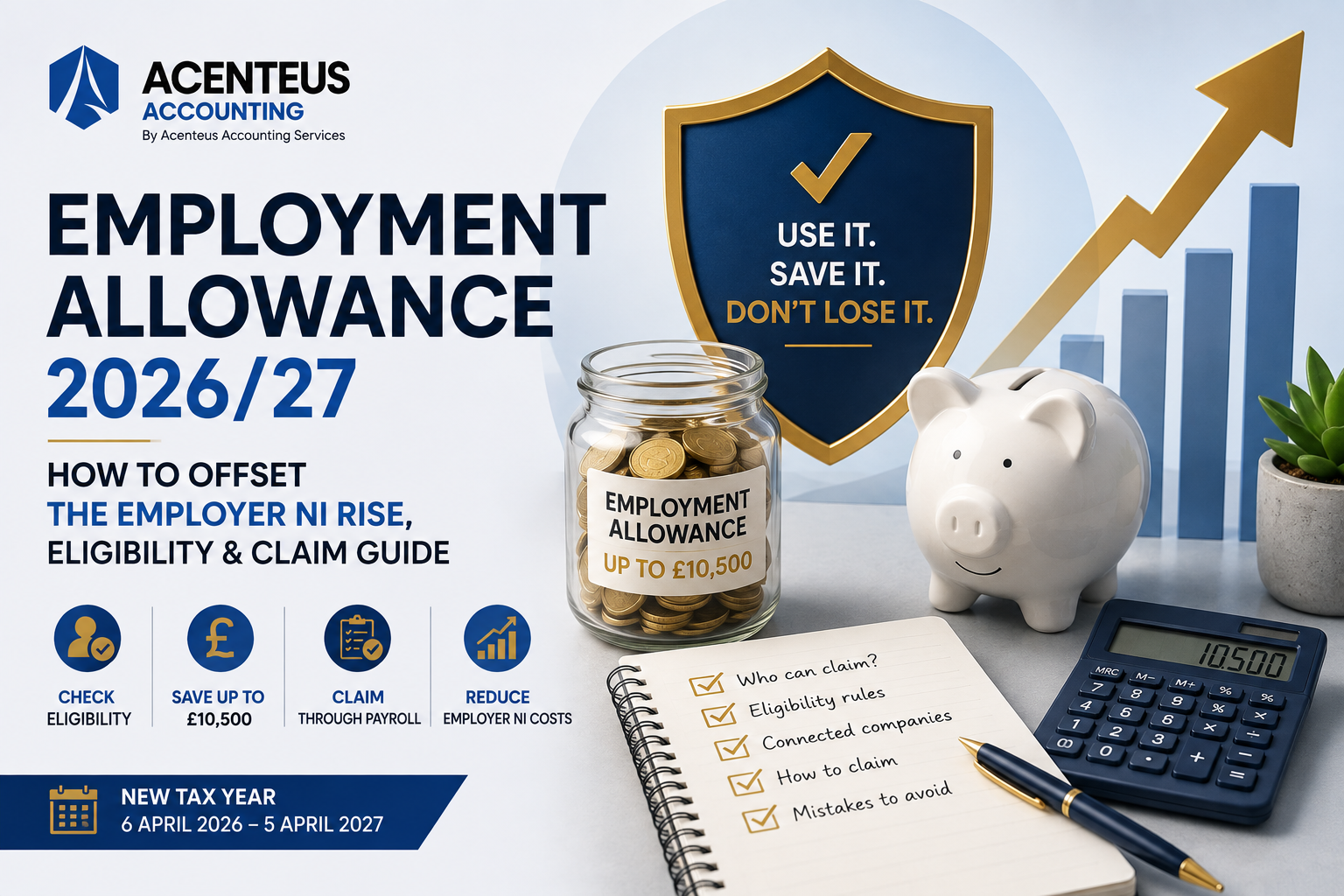
Employment Allowance is a government relief that lets eligible employers reduce their annual employer Class 1 National Insurance liability by up to £10,500 in the 2026/27 tax year. It is not a cash grant or a refund. Instead, it is offset against your employer National Insurance as it becomes due, each time you run payroll, until either the full £10,500 is used or the tax year ends. Most businesses, charities and community amateur sports clubs that pay employer National Insurance on at least one qualifying employee can claim it, and you make the claim yourself through your payroll software. For 2026/27 the allowance is worth up to £10,500, the employer National Insurance rate is 15%, and employer National Insurance is charged on earnings above a secondary threshold of £5,000 a year. If you are eligible and you do not claim, you simply pay more National Insurance than you need to.
That last point is the reason this guide exists. HMRC figures show that around 1.4 million employers benefited from the allowance in 2025/26, up by roughly 195,000 on the previous year after the rules were widened. Even so, thousands of eligible employers still miss it, and the ones who do claim often get the connected company or single director rules wrong. This guide walks through the current rates, who qualifies, who is excluded, how the allowance offsets the higher employer National Insurance, how to claim it through payroll, and the mistakes that cost businesses money.
Key takeaways
- Employment Allowance is £10,500 for 2026/27, the same as 2025/26. It lets eligible employers cut their annual employer (secondary) Class 1 National Insurance bill by up to that amount.
- It matters more now because employer NI rose to 15% and the secondary threshold fell to £5,000 a year from 6 April 2025, so the bills it offsets are much larger than they used to be.
- The old £100,000 eligibility cap was removed from April 2025, so business size no longer stops you claiming.
- You cannot claim if your only employee paid above the secondary threshold is a company director. You need at least one other employee, or another director, paid above £5,000.
- Connected companies and charities share one £10,500 allowance. Only one of them can claim it.
- For 2026/27, the de minimis state aid rules no longer restrict Employment Allowance claims for employers in Great Britain.
- You claim through your payroll software by setting the Employment Allowance indicator to Yes on an Employer Payment Summary (EPS). You must renew the claim every April.
The 2026/27 numbers at a glance
Here are the figures that drive every calculation in this guide. All of them are confirmed in HMRC’s PAYE manual for Employment Allowance and the National Insurance Contributions (Secondary Class 1 Contributions) Act 2025.
| Item | 2026/27 figure |
|---|---|
| Employment Allowance | £10,500 per employer, per year |
| Employer (secondary) Class 1 National Insurance rate | 15% |
| Secondary threshold (where employer NI starts) | £5,000 a year (£96 a week, £417 a month) |
| Former £100,000 eligibility cap | Removed from 6 April 2025 |
| Employee primary threshold | £12,570 a year |
| Upper earnings limit and upper secondary thresholds | £50,270 a year |
| Backdating window | Up to 4 earlier tax years |
Two things are worth pinning down straight away. First, the allowance offsets employer secondary Class 1 National Insurance only. It does not reduce the National Insurance your employees pay, and it does not touch Class 1A National Insurance on benefits in kind, Class 1B National Insurance on a PAYE Settlement Agreement, or the Apprenticeship Levy. Second, the allowance is a fixed annual figure. Any part of the £10,500 you do not use in the year is lost. It does not roll forward.
Why Employment Allowance matters more in 2026/27
For most of its life, Employment Allowance was a modest £2,000 to £5,000 offset that many small employers barely noticed. That changed with the Autumn Budget 2024, which reshaped employer National Insurance from April 2025. Three moves landed at once.
The employer National Insurance rate rose from 13.8% to 15%. The secondary threshold, the salary level at which employer National Insurance starts, was cut from £9,100 to £5,000 a year. That threshold cut is the quieter change, but it does a lot of the damage, because it pulls thousands of pounds of each salary that used to be exempt into the charge. To soften the blow for smaller employers, the government more than doubled Employment Allowance, from £5,000 to £10,500, and removed the £100,000 eligibility cap so more businesses could claim. These changes were legislated in the National Insurance Contributions (Secondary Class 1 Contributions) Act 2025. The government estimated that, taken together, more than half of employers would see no change or a reduction in their overall bill, largely because of the bigger allowance.
For a very small team, the bigger allowance can wipe out the whole employer National Insurance bill, so those employers may see little or no overall change despite the higher rate. For a larger team, the picture is different. The allowance is a fixed £10,500, but it now sits against a 15% charge on a much wider band of pay, so it covers a smaller share of a bigger bill. The worked examples further down show exactly how that plays out at different team sizes. If you want to model your own numbers first, our employer National Insurance calculator and guide for 2026/27 sets out the rate, threshold and per employee cost in detail.
The practical message is simple. Because the bills are larger, claiming the allowance you are entitled to is worth more than it has ever been, and getting the eligibility rules right is worth more too.
Who can claim Employment Allowance in 2026/27?
You can claim Employment Allowance for 2026/27 if you are an employer with a liability to pay employer (secondary) Class 1 National Insurance, and you are not caught by one of the exclusions in the next section. In plain terms, you qualify if all of the following are true.
- You are registered as an employer with HMRC and run a PAYE scheme.
- You pay employer Class 1 National Insurance on the earnings of at least one employee during the tax year.
- At least one of those employees is not a director, or you have more than one director paid above the secondary threshold. This is the point that catches single director companies, and it is covered in full below.
- You are not a public authority carrying out mainly functions of a public nature, unless you are a charity.
The following types of employer can all claim, provided they meet those tests:
- Limited companies with at least one employee, or more than one director, paid above the secondary threshold.
- Sole traders and partnerships that employ staff and pay employer Class 1 National Insurance.
- Charities and organisations with charitable status, including many schools, academies and universities, even where they carry out public sector work.
- Community amateur sports clubs.
- Individuals who employ a care or support worker, for example to look after themselves or a family member because of old age, illness, or a physical or mental disability.
The big change from April 2025 is that the previous £100,000 cap has gone. Before then, an employer whose secondary Class 1 National Insurance liability in the previous tax year was £100,000 or more could not claim at all. That restriction was removed, so a larger employer with a substantial National Insurance bill can now claim the £10,500 like everyone else. Business size is no longer a barrier.
Who cannot claim Employment Allowance?
Knowing the exclusions upfront saves a rejected claim and an awkward correction later. They come from the exceptions in the National Insurance Contributions Act 2014. You cannot claim Employment Allowance in 2026/27 if any of the following apply.
The single director company rule
This is the exclusion that catches the most people. A limited company cannot claim Employment Allowance if its only employee paid above the secondary threshold is a director. In HMRC’s words, the company must incur an employer Class 1 National Insurance liability on the earnings of at least one employee, or one director, who is not the sole director being paid above the threshold.
In practice, that means a typical one person limited company, where the single director draws a salary above £5,000 and there are no other staff, cannot claim. If the company takes on a second employee who is paid above the secondary threshold, or appoints a second director who is paid above it, the company becomes eligible. There is a worked example of this planning point below, along with the important caveats that stop it becoming a tax trap.
Public authorities that are not charities
An employer cannot claim if it is a public authority whose activities wholly or mainly, meaning 50% or more, involve carrying out functions of a public nature. That covers government departments, local authorities and the NHS. The key exception is charitable status. A charity can claim even where it delivers public sector work such as NHS or council contracts, provided it meets the ordinary eligibility tests.
Employers of personal or domestic staff
If you employ someone for personal, domestic or household work, such as a nanny, a gardener, a cleaner or an au pair, you generally cannot claim Employment Allowance for them. The exception is care or support workers, where a claim is allowed.
Off-payroll workers caught by IR35
You cannot use Employment Allowance against the deemed employer National Insurance that arises on payments to workers who fall inside the off-payroll working (IR35) rules. Those deemed payments are excluded from the calculation.
Employment Allowance eligibility decision tree
Work through these questions in order. The first No or Not eligible answer stops the process.
- Do you pay employer (secondary) Class 1 National Insurance on at least one employee? If no, there is nothing to offset, so there is no claim to make. If yes, continue.
- Are you a public authority carrying out mainly functions of a public nature, and not a charity? If yes, you cannot claim. If no, continue.
- Is your only employee paid above the £5,000 secondary threshold a single company director, with no other qualifying employee or director? If yes, you cannot claim this year. If no, continue.
- Is the person you employ purely personal or domestic staff, such as a nanny or gardener, who is not a care or support worker? If yes, you cannot claim for them. If no, continue.
- Are you part of a group of connected companies or charities where another member is already claiming the single allowance? If yes, you cannot also claim, because only one member claims. If no, continue.
- You are eligible. Claim through your payroll software as set out below, and remember to renew the claim each April.
Connected companies: how the single allowance is shared
If you control more than one company, or a group of companies is under common control, those companies are treated as connected for Employment Allowance. The rule is straightforward and strict. Connected companies share a single £10,500 allowance between them, and only one company in the group can claim it. The same principle applies to connected charities.
Two further points trip people up. First, if companies are connected at the start of the tax year, they are treated as connected for the whole of that year, even if the ownership changes partway through. Second, you must decide, before you claim, which single company will make the claim. The sensible choice is usually the company with the largest employer National Insurance bill, so the allowance offsets as much as possible. If two connected companies both claim the full allowance, that is an error, and HMRC can recover the wrongly awarded amount with interest and, in some cases, a penalty.
If your group has several companies with modest National Insurance bills, it is worth checking which one to nominate each year, because the best choice can change as headcount and salaries move between entities.
De minimis state aid: what changed for 2026/27
For several years, Employment Allowance operated as de minimis state aid. Claimants in certain sectors, such as agriculture, fisheries or road haulage, had to confirm that claiming would not take them over a sector ceiling, and had to declare a business sector on the claim.
For 2026/27, that restriction no longer applies to Employment Allowance for employers in Great Britain. Most employers no longer need to think about de minimis state aid at all when they claim for the current year. There are two situations where it can still be relevant. If your business trades in goods in Northern Ireland, separate subsidy rules under the Windsor Framework may apply, so check the current HMRC guidance for your circumstances. And if you are backdating a claim to an earlier tax year, that year operated under the old regime, so the de minimis declaration may still be part of the earlier claim. For a straightforward current year claim by a business in Great Britain, you can generally answer that state aid rules do not apply.
How Employment Allowance offsets employer NI: worked examples
Employer National Insurance for 2026/27 is calculated as the employee’s annual earnings above the £5,000 secondary threshold, multiplied by 15%. Employment Allowance is then set against the total employer National Insurance bill for the whole business, up to the £10,500 limit. The examples below show how that works at different sizes. The figures are illustrative and rounded to whole pounds.
Example 1: a small team where the allowance covers everything
A café employs four part time staff, each earning £14,000 a year.
- Employer National Insurance per employee: (£14,000 minus £5,000) multiplied by 15% equals £1,350.
- Total employer National Insurance for four staff: £5,400.
- Employment Allowance available: £10,500.
Because the £10,500 allowance is larger than the £5,400 bill, the allowance wipes out the employer National Insurance entirely. The café pays nothing in employer National Insurance for the year, and the unused part of the allowance is simply lost, because it does not carry forward.
Example 2: a larger team where the allowance covers part of the bill
A marketing agency employs ten people on an average salary of £30,000.
- Employer National Insurance per employee: (£30,000 minus £5,000) multiplied by 15% equals £3,750.
- Total employer National Insurance for ten staff: £37,500.
- Employment Allowance available: £10,500.
- Employer National Insurance payable after the allowance: £27,000.
Here the fixed £10,500 allowance covers about 28% of a £37,500 bill. This is the point made earlier. The allowance is generous for small employers and, as the payroll grows, it offsets a smaller share of a much larger charge. Planning the timing of hires and understanding the true cost of each role becomes more important at this size, which is where a clear view of payroll outsourcing costs and per employee National Insurance helps with budgeting.
Example 3: the single director planning point
A one person limited company pays its sole director a salary of £12,570.
- Employer National Insurance: (£12,570 minus £5,000) multiplied by 15% equals £1,135.50.
- Employment Allowance available: nil, because a single director who is the only employee paid above the threshold cannot claim.
So the company pays £1,135.50 in employer National Insurance with no relief. Now suppose the company takes on a genuine second employee, for example a part time administrator paid £6,000 a year.
- Employer National Insurance on the director: £1,135.50.
- Employer National Insurance on the new employee: (£6,000 minus £5,000) multiplied by 15% equals £150.
- Total employer National Insurance: £1,285.50.
- Employment Allowance now available: £10,500, which covers the whole bill.
The company moves from paying £1,135.50 to paying nothing in employer National Insurance, because the second employee unlocks eligibility. This is a legitimate outcome, but it only works if the second role is real. The person must do genuine work, be paid a genuine wage, and be paid at least the National Minimum Wage for the hours worked. Paying a spouse a token amount purely to unlock the allowance, with no real job behind it, is exactly the kind of arrangement HMRC challenges. Treat the second salary as a real cost and a real hire, not a paper exercise.
Example 4: connected companies
A business owner controls two companies, a trading company and a property company. They are connected, so they share one £10,500 allowance. The owner nominates the trading company, which has the larger National Insurance bill, to make the single claim. The property company does not claim. If both had claimed the full allowance, the owner would have to correct the position and repay the excess, potentially with interest.
How to claim Employment Allowance through payroll
You claim Employment Allowance yourself, as part of your normal Real Time Information payroll reporting, following HMRC’s how to claim guidance. You do not apply on a separate form or wait for HMRC approval before you start using it.
If you use commercial payroll software
- Open your payroll software and find the Employer Payment Summary (EPS) options, sometimes shown under HMRC submissions or employer settings.
- Set the Employment Allowance indicator to Yes. Most software shows this as a simple tick box or a Yes or No field.
- For a current year claim by a business in Great Britain, you can usually confirm that state aid rules do not apply. If you are in one of the limited situations where de minimis still applies, select the relevant business sector.
- Send the EPS to HMRC as normal.
You only need to tell HMRC once per tax year. Once the claim is set, your software offsets the allowance against your employer Class 1 National Insurance each pay period, until the £10,500 is used up or the year ends. You can start using the allowance as soon as you submit the claim.
If your software has no EPS field, or you run a very small payroll
Use HMRC’s free Basic PAYE Tools. Select the correct employer on the home page, choose Employment Allowance, check the eligibility criteria, and send the EPS as normal. Basic PAYE Tools is adequate for very small or single scheme payrolls, though it does not produce full payslips or handle pension auto enrolment, so most growing employers move to commercial payroll software fairly quickly.
After you claim
HMRC does not send a confirmation letter. If your claim is rejected, you receive an automated message, usually within five working days. There is no need to chase confirmation otherwise. The allowance simply reduces your National Insurance payments as they fall due.
Renewing every April
This is a common trap. Since April 2020, Employment Allowance does not roll over automatically. You must make a fresh claim at the start of each tax year by sending an EPS with the indicator set to Yes. If you forget to renew in April, you stop getting the relief until you do. Build the renewal into your payroll year start checklist so it is not missed.
Backdating a claim to earlier years
If you were eligible in a past year and did not claim, you can usually backdate. Claims are limited to the four tax years before the current one, as set out in HMRC’s National Insurance Manual, and you cannot claim for any year before 2014/15, when the allowance began. For a claim made during 2026/27, that means you can reach back to 2022/23. Each closed year needs its own separate EPS, and the claim must be made within four years of the end of that tax year.
Backdated years use the rules and figures that applied at the time, not the current ones, so the allowance and the National Insurance rate are lower for the older years.
| Tax year | Employment Allowance | Employer NI rate | Secondary threshold | Claim by |
|---|---|---|---|---|
| 2025/26 | £10,500 | 15% | £5,000 | 5 April 2030 |
| 2024/25 | £5,000 | 13.80% | £9,100 | 5 April 2029 |
| 2023/24 | £5,000 | 13.80% | £9,100 | 5 April 2028 |
| 2022/23 | £5,000 | 13.80% | £9,100 | 5 April 2027 |
For the older years, the previous eligibility rules also apply, including the £100,000 cap and, where relevant, the de minimis state aid declaration. If your current year payroll is paid up to date when you make a backdated claim, HMRC usually sets the recovered allowance against future payments, unless you ask for a refund.
Stopping or changing a claim
If your circumstances change and you stop being eligible partway through the year, you should stop the claim by setting the Employment Allowance indicator to No on your next EPS, and repay any allowance you have already used. If you do not pay the resulting employer National Insurance in full and on time, HMRC can charge a late payment penalty.
Two situations are worth calling out because they are easy to get wrong.
- Do not stop the claim just because you have used the full £10,500 before the year ends. Reaching the limit does not make you ineligible. The claim runs to the end of the tax year.
- Do not stop the claim just because you have stopped employing people mid year. The allowance continues to the end of that tax year. You simply make a fresh claim in a later year if you take staff on again.
There is also a helpful mid year rule for companies. If you had several employees paid above the secondary threshold, but during the year your circumstances change so that a director becomes the only one paid above it, you can still claim for that whole tax year. You then stop the claim for the following year, unless you take on another qualifying employee.
Common mistakes to avoid
Across payroll work, the same Employment Allowance errors come up again and again. Avoiding them keeps your claim clean and your National Insurance bill correct.
- Forgetting to renew in April. The single most common error since claims stopped rolling over in 2020. No renewal means no relief.
- Claiming as a single director company. If the director is your only employee paid above £5,000, you are not eligible, however tempting the £10,500 looks.
- Two connected companies both claiming. Only one member of a connected group claims the single allowance. Double claiming has to be unwound.
- Expecting it to reduce employee National Insurance or benefits in kind. The allowance only touches employer secondary Class 1 National Insurance. It does not reduce employee National Insurance, Class 1A on benefits, or the Apprenticeship Levy.
- Stopping the claim early for the wrong reason. Hitting the £10,500 limit, or ceasing to employ people mid year, are not reasons to switch the claim off.
- Paying a token salary to a spouse to unlock eligibility. The second employment must be genuine, with real work and at least National Minimum Wage pay, or HMRC will challenge it.
- Missing the four year backdating window. If you were eligible in an earlier year, a backdated claim can still be worth real money, but only within the time limit.
Where Employment Allowance fits in your wider payroll compliance
Employment Allowance is one moving part in a payroll year that also includes correct Real Time Information reporting, the right National Insurance category letters, pension auto enrolment, National Minimum Wage checks, and accurate year end filing of P60s and, where relevant, P11Ds. Getting the allowance right saves money. Getting the surrounding compliance right avoids penalties, and the two go together, because the same EPS that carries your Employment Allowance claim also carries other statutory information.
This is where the value of accurate payroll operation shows up. In one verified Clutch review, a Cambridge accounting firm that has outsourced its payroll, bookkeeping and VAT work to Acenteus Accounting on an ongoing basis since November 2024 described the work as completed “on time with minimal errors,” supported by “clear and well-structured” reporting. On payroll, that accuracy is exactly what protects an Employment Allowance claim, because the claim is only as reliable as the National Insurance figures and the EPS it sits on.
If you would rather not track the renewal, the connected company rules and the eligibility tests yourself each year, this is a natural task to hand over. You can see how the wider service works in our guides to payroll year end duties, including P60 and P32 deadlines and to outsourcing your payroll, and you can line the allowance up against the rest of the year using our 2026/27 tax year key dates and deadlines.
Frequently Asked Questions (FAQ)
Employment Allowance is £10,500 for the 2026/27 tax year, the same amount as 2025/26. It lets eligible employers reduce their employer (secondary) Class 1 National Insurance bill by up to £10,500 for the year.
Most businesses, charities, community amateur sports clubs and people who employ a care or support worker can claim, provided they pay employer Class 1 National Insurance on at least one qualifying employee and are not a public authority carrying out mainly public functions. The former £100,000 eligibility cap was removed in April 2025, so business size no longer prevents a claim.
No. A company cannot claim if its only employee paid above the £5,000 secondary threshold is a director. If the company takes on a genuine second employee, or a second director, paid above the threshold, it becomes eligible.
Set the Employment Allowance indicator to Yes on an Employer Payment Summary (EPS) and send it to HMRC. Your software then offsets the allowance against your employer National Insurance each pay period until the £10,500 is used or the year ends. If your software has no EPS field, use HMRC's free Basic PAYE Tools. You must renew the claim every April.
No. It only reduces the employer's secondary Class 1 National Insurance. It does not change what employees pay, and it does not offset Class 1A National Insurance on benefits in kind, Class 1B on a PAYE Settlement Agreement, or the Apprenticeship Levy.
Connected companies and connected charities share a single £10,500 allowance, and only one of them can claim it. If they are connected at the start of the tax year, they are treated as connected for the whole year. The group should nominate the company with the largest National Insurance bill to make the claim.
Yes. You can claim for up to the four tax years before the current one, so during 2026/27 you can reach back to 2022/23. Each year needs a separate EPS, and older years use the allowance, rate and threshold that applied at the time, along with the eligibility rules then in force.
Yes. Charities can claim on the same basis as other employers, and they are exempt from the public authority exclusion, so a charity can claim even where it carries out public sector work, provided it meets the ordinary eligibility tests.
For employers in Great Britain, the de minimis state aid rules no longer restrict Employment Allowance for the current year, so most businesses no longer need to declare a sector. Separate rules may still apply if you trade in goods in Northern Ireland, and de minimis can still be relevant to a backdated claim for an earlier year.