TL;DR:
- For 2026/27, most UK companies pay Corporation Tax at 19% if taxable profits are £50,000 or less, 25% if profits exceed £250,000, and marginal relief applies in between.
- If your profits fall between the lower and upper limits, your effective Corporation Tax rate rises gradually rather than jumping straight from 19% to 25%.
- The £50,000 and £250,000 thresholds are reduced if your accounting period is shorter than 12 months or your company has associated companies.
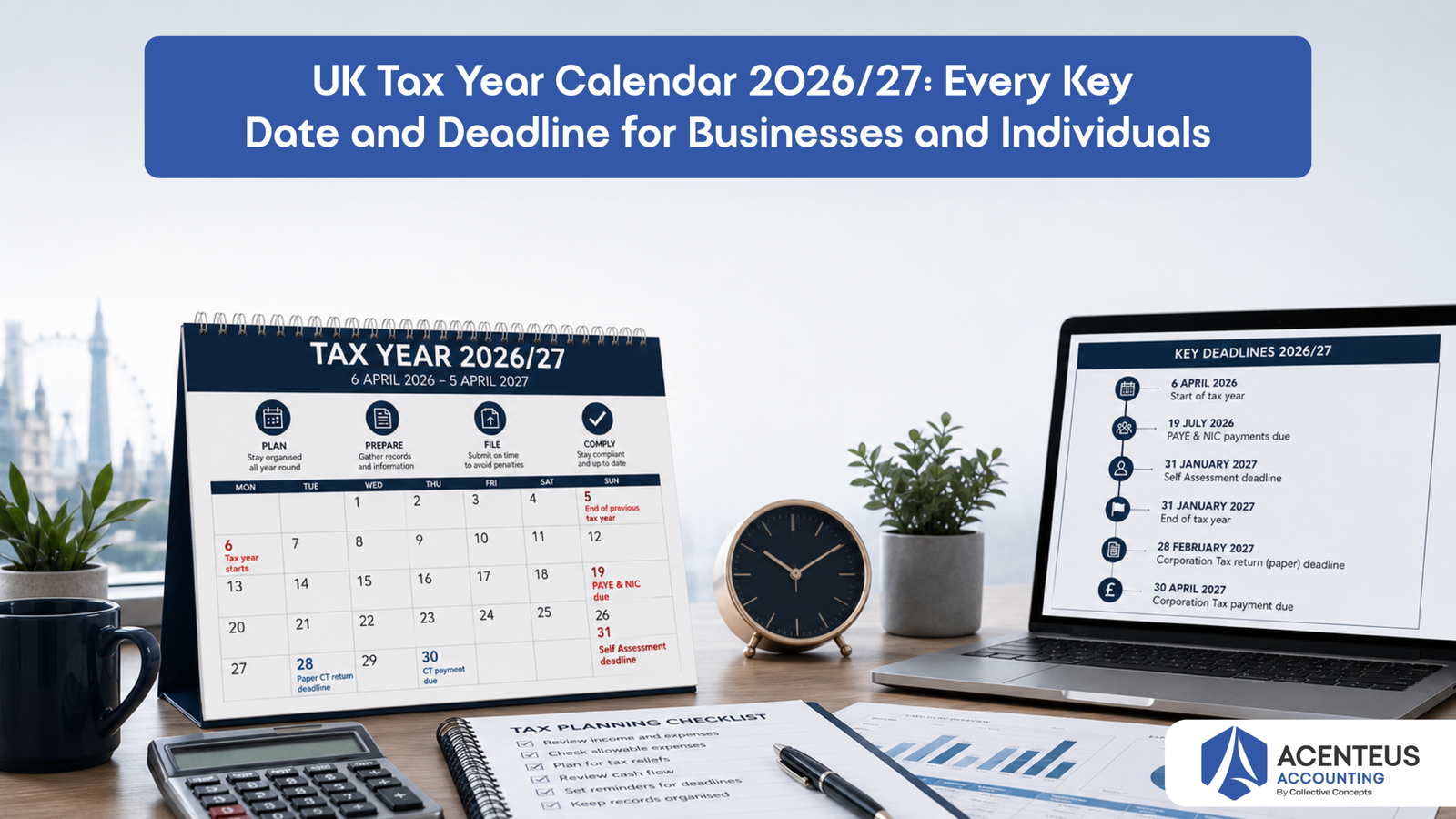
- Small companies normally pay Corporation Tax 9 months and 1 day after the end of the accounting period, while the CT600 filing deadline is 12 months after the end of that period.
- Corporation Tax is charged on taxable profits, not turnover, and those profits can include trading income, investment income and chargeable gains.
- This calculator is useful for a quick estimate, but the final position should always be checked against your accounts, reliefs and filing position before payment.
Introduction: What Is Corporation Tax and Who Pays It?
Corporation Tax is the tax a company or other chargeable organisation pays to HMRC on profits made in an accounting period. In practice, that means most UK limited companies need to work out their taxable profits, apply the correct rate, then pay and file on time.
A company may pay Corporation Tax on trading profits, investment income and chargeable gains, so it is broader than many directors first expect. If you are asking how Corporation Tax works for a new limited company in its first year, the answer is that the same basic rules apply, but the accounting period and time apportionment can affect the calculation if the first period is short or straddles different dates.
This tool is designed for directors who want a quick limited company tax bill estimate in the UK, for advisers who want a shareable corp tax calculator, and for sole traders comparing incorporation with their current income tax position. Corporation Tax also differs from sole trader income tax because a company is a separate legal entity that pays its own tax on profits, while a sole trader is taxed personally on business profits.
A growing number of firms also use resources such as accounting services for small businesses or outsourcing for accountants when they want cleaner reporting and more reliable tax workflows around year end.
Calculator
Use the tool below for a quick corporation tax calculator result based on your estimated taxable profits, accounting period details and associated company position. It is intended to help you estimate how much Corporation Tax a UK limited company may pay under the 2026/27 rules.
 Acenteus
Estimator
UK Corporation Tax Calculator
Estimate Corporation Tax with marginal relief, associated companies and short accounting periods.
Calculate Corporation Tax
For UK company profits where the tax limits may need adjustment.
Enter the taxable profits
Adjust the tax bands
Your tax estimate
Discover Our Support Options
Share your details and Acenteus can help review the Corporation Tax position or wider compliance workflow.
Once you have used the calculator, the explainer below shows how the number is worked out, what counts as taxable profit, how marginal relief works and when the tax must be paid. That context matters because a limited company tax calculator is only as good as the figures entered into it.
UK Corporation Tax Rates for 2026/27
For 2026/27, the headline UK Corporation Tax rates remain the same as the regime introduced from April 2023: the small profits rate is 19% for profits of £50,000 or less, the main rate is 25% for profits above £250,000, and marginal relief may apply between those limits. HMRC sets out these rates in its guidance on Corporation Tax rates, expenses and reliefs, and the 2026 rates and allowances table confirms the same lower limit, upper limit and standard fraction.
That means if you are asking what is the Corporation Tax rate in the UK for 2026/27, there is not just one answer. The right rate depends on your taxable profits and whether your company falls fully into the small profits band, the main rate band, or the marginal relief band between them.
For many directors, the simplest way to think about it is this:
- Profits up to £50,000, taxed at 19%.
- Profits above £250,000, taxed at 25%.
- Profits between £50,000 and £250,000, taxed at an effective rate between 19% and 25% after marginal relief.
This is why a corporation tax calculator small business UK page is useful. A company with profits of £48,000 will get a very different result from one with profits of £180,000, even though both may be described loosely as small or medium-sized businesses.
It is also important to understand that the thresholds are not always the full £50,000 and £250,000. HMRC states that the limits are reduced for short accounting periods and are also divided by the number of associated companies, which is a key point many directors miss when estimating a limited company tax bill.
For example, if a company has three associated companies, the thresholds are divided by four, so the lower limit becomes £12,500 and the upper limit becomes £62,500. That can move a business into the marginal relief band, or even the main rate band, much sooner than expected.
This is one reason finance teams often tighten their reporting processes before year end, sometimes using Xero and QuickBooks integrations or reviewing how to solve year-end accounting bottlenecks when the tax number must be estimated quickly and accurately.
How Marginal Relief Works
Marginal relief exists to prevent a cliff edge between the 19% small profits rate and the 25% main rate. If your taxable profits are between £50,000 and £250,000, your company pays tax at the main rate and then reduces that amount by marginal relief, producing a gradual increase in the effective rate across the band.
So what is marginal relief and how does it affect your Corporation Tax bill? It reduces the tax you would otherwise pay at 25%, which means the effective rate rises steadily as profits increase rather than jumping in one step.
HMRC’s guidance on Marginal Relief for Corporation Tax explains that the standard fraction is 3/200 and that the relief is available where taxable profits fall between the lower and upper limits, subject to the normal exclusions and threshold adjustments. Those same .UK materials also make clear that the limits are reduced for associated companies and for accounting periods shorter than 12 months.
The formal marginal relief formula you asked to cover is commonly expressed as:
Corporation Tax=(Main rate×profits)−(3200×(upper limit−profits)×profitsaugmented profits)\text{Corporation Tax} = (\text{Main rate} \times \text{profits}) – \left(\frac{3}{200} \times (\text{upper limit} – \text{profits}) \times \frac{\text{profits}}{\text{augmented profits}}\right)Corporation Tax=(Main rate×profits)−(2003×(upper limit−profits)×augmented profitsprofits)
HMRC’s published framework supports this approach through the main rate, lower limit, upper limit and standard fraction it provides for marginal relief calculations.
If that sounds technical, the practical takeaway is simpler. Between £50,000 and £250,000, each extra pound of profit increases the effective tax rate gradually. That is why a corporation tax marginal relief calculator is useful for companies in the middle band, because the result is not a flat 19% or a flat 25%.
Associated companies matter here as well. If you are asking how the associated companies rule affects Corporation Tax thresholds, HMRC’s answer is that the lower and upper limits are divided by the number of associated companies, including the company itself, which can sharply reduce the range in which small profits rate or marginal relief applies.
Short accounting periods also need care. If your company has an accounting period shorter than 12 months, HMRC says the limits are proportionately reduced, which means even a modest profit can land in a different band from the one you expected.
Directors often assume this part is too complex to estimate themselves, but the principle is manageable if the inputs are correct. The hard part is usually getting clean profit numbers and the right company structure details, not understanding the existence of marginal relief itself.
What Counts as Taxable Profit?
A common question is: what profits are subject to Corporation Tax in the UK? HMRC’s overview says taxable profits include trading profits, investment profits and gains from selling assets for more than they cost, known as chargeable gains.
That is why Corporation Tax is not charged on revenue alone. If you are asking whether Corporation Tax is paid on revenue or profit, the answer is profit, specifically taxable profit after allowable deductions and adjustments, not gross sales.
For a typical limited company, taxable profit may start with accounting profit and then be adjusted for tax purposes. Some expenses are deductible, some are not, and some items are taxed under separate rules.
In broad terms, the following usually matter:
- Trading income from normal business activity.
- Less allowable business expenses and certain reliefs, where applicable.
- Plus any taxable investment income.
- Plus any chargeable gains.
This is where directors often ask how to calculate Corporation Tax for a UK limited company. The practical sequence is to work out taxable profits correctly first, then apply the relevant rate structure, then check whether marginal relief applies, and only then estimate the final tax bill.
Salary is another regular point of confusion. In most owner-managed companies, salary paid through payroll is normally a business expense and can therefore reduce taxable profits, provided it is properly incurred and recorded. That is why people often ask whether they can deduct their own salary before calculating Corporation Tax, and in ordinary trading cases the answer is usually yes, though the wider personal tax and NIC position still has to be considered.
If you are comparing a sole trade with a company, this is one of the core differences. A sole trader is taxed personally on business profits, whereas a company calculates its own taxable profit and then pays Corporation Tax in its own name. That is why someone thinking about incorporation may use this page as both a ltd company tax calculator and a planning guide before changing legal structure.
You can also reduce your Corporation Tax bill legally in the UK, but only through legitimate deductions, reliefs, allowances and proper timing, not through guesswork or reclassifying personal spending as business cost. HMRC’s Corporation Tax guidance makes clear that companies may be able to get deductions or claim tax credits and reliefs, which is why the quality of bookkeeping and tax adjustments matters so much.
Many firms dealing with this at scale also review tax compliance outsourcing, VAT compliance outsourcing and operational capacity issues such as the accountancy talent crisis when deadlines and reporting quality begin to slip.
When Is Corporation Tax Due?
If you are asking when do I need to pay Corporation Tax in the UK, HMRC’s rule for most small companies is straightforward: payment is due 9 months and 1 day after the end of the accounting period. .UK’s payment guidance on paying Corporation Tax sets this out clearly.
The filing deadline is different. HMRC says the Company Tax Return, usually the CT600, must generally be filed within 12 months of the end of the accounting period, which means the payment deadline normally comes before the return deadline.
This directly answers one of the most common search questions: what is the difference between the Corporation Tax payment deadline and the CT600 filing deadline? The payment deadline for most small companies is 9 months and 1 day after the period end, while the CT600 filing deadline is 12 months after the period end.
Large companies can be different. HMRC notes that some companies pay by quarterly instalments rather than under the normal single payment timetable. So if your business is large enough to fall into instalment rules, a simple small business corporation tax estimate will not be enough on its own.
A few examples make the timing clearer:
- Accounting period ends 31 March 2027, payment usually due 1 January 2028, CT600 usually due 31 March 2028.
- Accounting period ends 30 June 2026, payment usually due 1 April 2027, CT600 usually due 30 June 2027.
If your company has not yet filed the CT600, can you still pay Corporation Tax on time? Yes, because the payment deadline can arrive before the filing deadline, and HMRC expects the tax to be paid by the due date even if the return is filed later within the permitted window.
What happens if you pay Corporation Tax late in the UK? HMRC’s payment framework makes clear that late payment creates interest exposure, and late filing can trigger separate penalties under the filing regime. That is why cash flow planning matters just as much as the tax computation itself.
This is also why some teams compare offshore and onshore accounting models or tighten internal controls around security and process using guidance on GDPR and security red flags in an outsourced accounting provider before handing year-end tax work to external support.
Common Mistakes UK Limited Companies Make With Corporation Tax
The most common mistake is using turnover instead of taxable profit. Corporation Tax is charged on taxable profits, not revenue, so any calculator result is only meaningful if the profit number is right.
The second mistake is ignoring marginal relief. Directors often assume their whole profit is taxed at either 19% or 25%, when in fact companies in the middle band need the relief calculation to get a reasonable estimate.
The third is forgetting about associated companies. HMRC explicitly says the thresholds are divided by the number of associated companies, and this can materially change the outcome for groups and owner-managed structures.
The fourth is missing the difference between payment and filing deadlines. Many people think filing the CT600 and paying the tax happen on the same date, but they usually do not.
The fifth is failing to adjust for short accounting periods. If the accounting period is shorter than 12 months, the small profits and marginal relief thresholds are proportionately reduced, so using the full annual thresholds can understate tax.
The sixth is assuming new companies get special treatment on the basic rate structure. A new limited company still works under the same Corporation Tax framework, although its first accounting period, setup timing and bookkeeping quality often create practical complications.
The seventh is trying to reduce tax with weak or unsupported expense claims. You can reduce a Corporation Tax bill legally, but only if deductions are genuinely allowable and properly evidenced.
The eighth is leaving the estimate too late. Once year end has passed, poor bookkeeping, missing accruals, weak payroll records and uncleared director transactions can all make the final tax position harder to confirm before the payment deadline.
How an Outsourced Tax Compliance Service Can Help
An outsourced tax compliance service can help by turning incomplete bookkeeping, draft accounts and tax adjustments into a clearer Corporation Tax estimate before the payment deadline, then supporting the formal return process afterwards. That is especially useful for companies that need a limited company tax calculator result quickly but still want the final number checked against accounts, reliefs and filing requirements.
It can also help where the company structure is more complex, such as cases involving associated companies, shorter accounting periods, marginal relief calculations or a first-year trading period that does not fit a neat 12-month pattern. In practice, this support often sits alongside accounting outsourcing for UK accounting firms, wider tax compliance outsourcing or general workflow support found through the Acenteus Accounting homepage.
Acenteus Accounting provides outsourced tax compliance support for UK firms and businesses that need help with year-end tax calculations, filing workflows and deadline management.
Conclusion: Get Your Corporation Tax Right From the Start
A good corporation tax calculator helps you answer the immediate question, which is usually how much Corporation Tax will I pay in the UK. The better question is whether your profit figure, deadlines and relief position are all correct before you rely on the result.
For 2026/27, the basic structure is clear: 19% up to £50,000, 25% above £250,000, and marginal relief in between, with threshold reductions for associated companies and short periods. If you get those building blocks right, the calculator becomes genuinely useful rather than just a rough guess.
Frequently Asked Questions (FAQ)
For 2026/27, the small profits rate is 19% up to £50,000, the main rate is 25% above £250,000, and marginal relief may apply between those limits.
You usually qualify if taxable profits are £50,000 or less, but the threshold can be reduced for short accounting periods and by the number of associated companies.
Marginal relief reduces the tax otherwise charged at 25% for companies with profits between the lower and upper limits, using HMRC’s published fraction of 3/200 and the relevant profit limits.
For most small companies, Corporation Tax is due 9 months and 1 day after the end of the accounting period.
Corporation Tax is paid on taxable profit, not revenue. That can include trading profits, investment income and chargeable gains.
In most ordinary company situations, salary paid through payroll is a business expense and reduces taxable profit, though the wider tax position still needs to be checked.
HMRC says the profit thresholds for the small profits rate and marginal relief are proportionately reduced for short accounting periods, so the banding may change.
HMRC divides the lower and upper limits by the total number of associated companies, including the company itself, so more associated companies mean lower thresholds.
Late payment can lead to interest, while late filing can trigger separate penalties under HMRC’s return rules, so paying and filing should be tracked separately.
Yes. The Corporation Tax payment deadline normally comes before the CT600 filing deadline, so the tax can and should still be paid on time.