Last updated: August 2026
Cloud accounting software for a UK accounting practice is the platform you run your clients’ books on, not your own. The right choice depends on how well it handles multiple clients under one login, how deeply it supports MTD for VAT and the new MTD for Income Tax, and whether it gives your team the accountant-specific tools, workpapers, practice management and permissions that generic small-business software does not.
For UK practices in 2026, Xero is the strongest overall ecosystem for multi-client management through Xero HQ, practice management and workpapers. QuickBooks Online is a capable alternative with a growing accountant toolkit and the widest app library.
Sage Accounting suits practices already embedded in the Sage ecosystem, especially those with Sage 50 desktop clients migrating to cloud. FreeAgent is free for NatWest Group clients and works well for sole-trader-heavy books, but its practice tools are thinner. And IRIS, Capium and TaxCalc serve practices that want compliance, accounts production and tax under one UK-built roof.
This is a guide for accountants choosing a platform for their clients, not for sole traders choosing software for themselves. The difference matters, because a practice needs multi-client dashboards, team permissions, bulk MTD submissions, client-facing collaboration, and the ability to hand work to an outsourced team when capacity runs out. That last point is where this guide goes further than the vendor comparisons: it covers when software alone stops being enough.
Key takeaways
- The big three for UK practices: Xero (strongest multi-client ecosystem), QuickBooks Online (widest app library, growing accountant tools) and Sage Accounting (best migration path from Sage 50 desktop).
- Practice tools matter more than features: Xero HQ, QuickBooks Online Accountant and Sage for Accountants are the multi-client dashboards. Rate platforms on these, not on the end-client product.
- MTD readiness in 2026: all three are HMRC-recognised for MTD for VAT. MTD for Income Tax Self Assessment is now live for sole traders and landlords with qualifying income above £50,000 (from April 2026), with the £30,000 threshold following from April 2027. Confirm your platform supports quarterly ITSA submissions on HMRC’s recognised software list before you commit more clients.
- Pricing has risen sharply: QuickBooks raised UK prices in January 2026 (our comparison of the best payroll software for small businesses covers the same pricing-shift dynamic for payroll tools) (up to 47% on the Plus plan). Xero has increased annually for three years. Budget for the real per-client cost including payroll, multi-currency and add-ons.
- Software does not solve capacity problems. A better platform makes existing capacity more efficient, but it does not replace the people who do the work. If your constraint is headcount, not tooling, the answer is either hiring or outsourcing, not another subscription.
- Free does not mean free for practices. FreeAgent is free for NatWest Group clients, but the practice tools and multi-client management are limited compared with Xero HQ or QuickBooks Online Accountant.
Why this guide is different
Almost every “best cloud accounting software” article online is written for sole traders or small businesses choosing software for their own books. That is a different question from the one a practice partner asks: which platform should I standardise my client base on, and what accountant tools come with it?
A sole trader cares about invoicing and bank feeds. A practice cares about managing 200 client organisations from one dashboard, assigning work to staff, running bulk VAT and ITSA submissions, producing workpapers, setting client-level permissions, and collaborating with an outsourced team that may be processing the bookkeeping on your behalf. The vendor pages blur this, because they want both audiences. This guide separates them.
How we compared the platforms
We assessed each platform against the criteria that matter specifically to a UK accounting practice managing multiple clients, not to an individual business choosing its own software. Features were checked against vendor information at the time of writing, and all change frequently, so confirm current details before you commit.
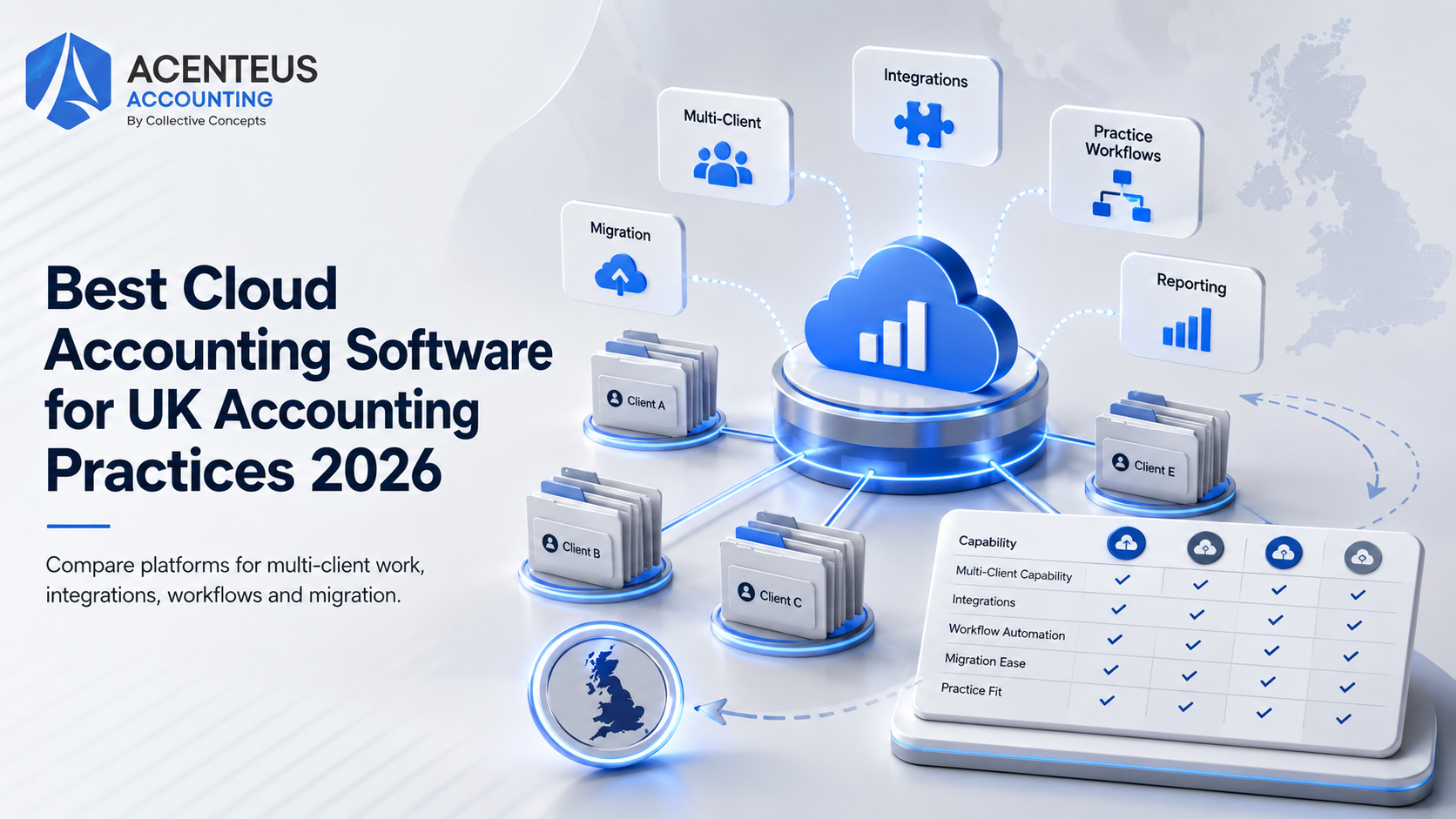
- Multi-client management: a central dashboard (Xero HQ, QuickBooks Online Accountant, Sage for Accountants) to manage all client organisations, switch between them, and see health at a glance.
- Accountant functionality: workpapers, adjustments, year-end tools, trial balance mapping, and practice management (jobs, time, billing).
- MTD for VAT and ITSA: HMRC-recognised, with agent submissions, bulk filing and quarterly ITSA support.
- Bank feeds and reconciliation: coverage of UK banks, Open Banking, rule-based coding and auto-matching.
- Reporting and dashboards: management reports, KPIs and client snapshots, ideally with tools like Fathom, Syft or Futrli.
- Permissions and collaboration: granular user roles so staff see only their clients, and outsourced teams get controlled access.
- App integrations: the breadth and depth of the third-party ecosystem for payroll, AP, AR, expenses and practice management.
- Migration: how cleanly clients can be moved from desktop (Sage 50, desktop QuickBooks) or from another cloud platform.
- Automation: bank rules, recurring invoices, scheduled reports and AI-assisted coding.
- Scalability: how well the platform handles a growing client base without degrading.
- Support: UK-based or UK-hours support, partner-programme responsiveness, and community.
- Pricing: the real per-client cost once payroll, add-ons and partner discounts are counted.
Platform comparison table
The table compares the platforms on the criteria that differ most between them. All are cloud-based, all support MTD for VAT, and all connect to major UK banks. The differences that matter for a practice sit in the accountant ecosystem, not the base product.
| Platform | Best for practices that | Multi-client dashboard | Practice management | MTD ITSA 2026 | UK pricing (per client, exc. VAT) |
|---|---|---|---|---|---|
| Xero | Want the deepest accountant ecosystem | Xero HQ (free for partners) | XPM (free at Silver+, else $149/mo) | Yes, on HMRC list | From £15/mo (Starter) to £50/mo (Comprehensive), partner discounts |
| QuickBooks Online | Want the widest app library and a growing accountant toolkit | QBO Accountant (free) | Via ProAdvisor, third-party (Karbon) | Yes, on HMRC list | From £16/mo (Simple Start) to £115/mo (Advanced), partner discounts |
| Sage Accounting | Are migrating Sage 50 clients to cloud | Sage for Accountants | Via Sage Practice Suite | Yes (Standard tier+) | From £18/mo (Start) to £39/mo (Standard), partner pricing |
| FreeAgent | Have NatWest Group clients wanting free software | FreeAgent Practice Dashboard | Limited | Yes, HMRC pilot partner | Free for NatWest/RBS/Mettle clients, else £24/mo |
| IRIS | Want UK-built compliance and accounts production | IRIS Practice Management | IRIS PM, time and billing | Via IRIS MTD tools | Quote-based, practice licence |
| Capium | Want all-in-one UK compliance under one licence | Capium portal | Built-in jobs and workflow | Built-in | From about £50/mo, modular |
Detailed platform profiles
Xero
Xero is the most widely used cloud accounting platform among UK practices, and its edge is the accountant ecosystem rather than the base product. Xero HQ gives you a single dashboard across every client organisation, with activity feeds, client health snapshots, and the ability to switch between clients without logging out.
Above that sit Xero Practice Manager (jobs, time tracking, billing, free at Silver partner status or above), Xero Workpapers (digital compliance workflows) and Xero Tax (tax return preparation). For a practice that standardises on Xero, this is the most integrated stack available, and it means your practice management and your client ledgers share a single client record.
On MTD, Xero is HMRC-recognised for both VAT and ITSA. Agent submissions, bridging software and quarterly ITSA support are built in. Bank feeds cover all major UK banks plus Open Banking connections.
The watch outs are real. Pricing has risen annually for three years, and the Comprehensive plan at £50 a month is now required for multi-currency. Inventory is thin for product businesses. And if you have clients on QuickBooks or Sage, Xero HQ only manages Xero organisations, so you still need a separate view for those clients.
Best for: practices that want to standardise on one ecosystem and get practice management, workpapers and tax in the same platform.
QuickBooks Online
QuickBooks Online is the second most common cloud platform for UK practices, and its strength is the app ecosystem: over 750 integrations, the widest of any platform, which matters when clients bring varied needs. QuickBooks Online Accountant gives you a free multi-client dashboard, and the ProAdvisor programme provides training, certification and partner discounts.
On MTD, QuickBooks is HMRC-recognised for VAT and has been in the ITSA pilot, with the Sole Trader plan positioned for quarterly submissions from April 2026. Agent-level submissions are supported through QBO Accountant.
The watch out that changed in 2026 is pricing. QuickBooks raised UK prices in January 2026, with the Plus plan going from £34 to £50 a month, a 47% increase. Cumulative increases over four years have reached 75% on some plans.
For a practice with 200 clients, that cost lands on the client, but the practice absorbs the complaints. Budget for the real number, not the promotional rate. Our guide to how Xero and QuickBooks integrate with an outsourcing partner covers the integration depth that matters when part of the work is delivered by an external team.
Best for: practices with a mixed client base that values app breadth and flexibility over a single-vendor ecosystem.
Sage Accounting
Sage Accounting is the cloud product inside the Sage ecosystem, and its strongest position is as the migration path for the large installed base of Sage 50 desktop users. For a practice with Sage 50 clients, moving them to Sage Accounting keeps them inside familiar branding and makes the transition easier than a full platform switch.
Sage for Accountants provides a multi-client dashboard, and the Practice Suite adds workflow and compliance tools. On MTD, Sage Accounting is HMRC-recognised for VAT and supports ITSA from the Standard tier (£39 a month) upward. The Start tier at £18 a month does not currently include ITSA quarterly submissions, which is a critical distinction to check before committing clients.
The watch out is that the cloud ecosystem is less mature than Xero’s or QuickBooks’. The app marketplace is smaller, workpapers are less developed, and practice management lags behind XPM. For a practice starting fresh on cloud, Sage Accounting is a harder recommendation than Xero or QuickBooks unless the Sage 50 migration path is the deciding factor.
Best for: practices migrating Sage 50 desktop clients to cloud.
FreeAgent
FreeAgent occupies a unique position: it is free for anyone who banks with NatWest, RBS or Mettle, which makes it the cheapest cloud option for sole-trader and micro-business clients in those banks. It is MTD-recognised for both VAT and ITSA and was one of the earliest HMRC pilot partners for ITSA.
The FreeAgent Practice Dashboard provides a multi-client view, but it is simpler than Xero HQ or QBO Accountant. Practice management, workpapers and bulk compliance tools are limited. For a practice with a large book of sole traders on NatWest, FreeAgent removes the software cost from the equation entirely, which is a strong commercial argument.
The watch out is that free does not mean complete. Limited company clients, growing businesses and clients who need multi-currency, project tracking or advanced reporting will outgrow FreeAgent quickly, so most practices run it alongside a primary platform rather than as their sole standard.
Best for: practices with a high proportion of sole-trader clients banking with NatWest Group.
IRIS and Capium
IRIS and Capium deserve a mention because they are UK-built platforms designed specifically for UK accountancy practices, with accounts production, tax, compliance and practice management under one licence. They suit practices that the ICAEW’s software guidance would describe as compliance-first, and that want everything in one system and are willing to trade the open app ecosystem of Xero and QuickBooks for a tighter, compliance-first toolset.
IRIS is the established name with a large UK practice base. Capium is newer, more affordable and modular, and positions around simplicity. Both handle MTD through their own tools.
Best for: practices that prioritise UK compliance integration above all else and prefer a single-vendor approach.
Best-for summary
- Best overall ecosystem for practices: Xero.
- Best app breadth and flexibility: QuickBooks Online.
- Best migration from Sage 50 desktop: Sage Accounting.
- Best free option for NatWest Group sole traders: FreeAgent.
- Best single-vendor UK compliance suite: IRIS or Capium.
When software does not solve the problem
Here is the honest section most software comparison guides do not include, because the vendors writing them have no reason to.
Software makes existing capacity more efficient. It does not create capacity. If your team is stretched, a better platform speeds up reconciliation, automates reminders and reduces errors, but it does not produce the management accounts, run the payroll, file the year-end or answer the client queries. Those jobs still need people, and if you do not have enough of them, the bottleneck stays.
The symptoms are familiar. Month-end reporting slips. Bookkeeping backlogs build up. Partners spend time on production work instead of advisory. Staff burn out at peak season, and the practice turns away work it could price.
A new software subscription does not fix any of those. What fixes them is either hiring, with all the cost, recruitment risk and training time that comes with it, or outsourcing the production work to a team that runs it under your brand while your in-house team focuses on clients and advisory.
That is the gap Acenteus Accounting is built to fill, and it is the reason a guide about software is published by an outsourcing firm.
We help practices get more out of the platform they already use by running the bookkeeping, payroll, year-end, management accounts and tax preparation inside their Xero, QuickBooks or Sage, so the practice keeps the client relationship and the margin without hiring. Our guide to the top UK accounting outsourcing firms covers the provider landscape if you want to compare partners.
If your constraint is tooling, choose the right platform from this guide. If your constraint is people, our outsourced finance function page explains how the model works, and our guide to outsourced bookkeeping costs sets out what it actually costs.
For practices thinking about MTD for Income Tax readiness, the capacity question gets sharper from April 2026 because quarterly submissions add volume that annual filing never did. For practices that also outsource payroll, our comparison of the top payroll outsourcing companies covers the partner options.
Migration: moving clients to a new platform
Migrating a client base from desktop to cloud, or from one cloud platform to another, is the reason many practices stay on software they have outgrown. The friction is real, but it is manageable if you plan it.
Most migrations involve exporting the chart of accounts, customer and supplier lists, and opening balances from the old system, then importing them into the new one. For Sage 50 to Sage Accounting, Sage offers a built-in conversion tool. For Sage 50 or desktop QuickBooks to Xero, Xero provides a conversion wizard and partner support. QuickBooks Online has its own import tools for desktop QuickBooks data. Bank feeds reconnect through Open Banking once the new platform is live.
The typical migration takes one to two weeks per client for a straightforward set of books. Allow longer for clients with complex multi-currency, inventory or project structures. Run the old and new systems in parallel for at least one VAT period to confirm the data is clean.
Migrate in batches, not all at once. If you want to understand the cost of the bookkeeping work that sits underneath, our breakdown of how much bookkeepers charge in the UK benchmarks the current rates.
Start with ten straightforward clients, run them through a full month-end, and fix any process issues before you migrate the rest. If your team does not have the bandwidth to run migrations alongside normal work, outsourcing the migration to a partner who already works inside your target platform is faster and lower-risk.
Frequently Asked Questions (FAQ)
Xero is the strongest overall ecosystem for practices, with Xero HQ, Practice Manager and Workpapers under one roof. QuickBooks Online is the best alternative for app breadth. Sage Accounting is the best migration path from Sage 50 desktop. The right choice depends on your client base, your team's skills and how much of the work you do in-house versus outsource.
Expect £15 to £50 a month per client on Xero (Starter to Comprehensive), £16 to £115 on QuickBooks Online (Simple Start to Advanced), and £18 to £39 on Sage Accounting (Start to Standard), all excluding VAT. Partner programmes offer discounts, but budget for the standard rate, because discounts can change.
Xero has the deeper accountant ecosystem: Xero HQ, Practice Manager, Workpapers and Tax in one platform. QuickBooks has the wider app library and a growing accountant toolkit through QBO Accountant and ProAdvisor. Most UK practices lean toward Xero, but practices with a mixed client base or a need for specific integrations may prefer QuickBooks.
Yes. Xero, QuickBooks and Sage are all on the HMRC-recognised software list for MTD for Income Tax Self Assessment. MTD ITSA is now live for sole traders and landlords with qualifying income above £50,000 (from April 2026), with the £30,000 threshold following from April 2027. Confirm your specific plan supports quarterly submissions before onboarding clients.
Yes. Xero, QuickBooks and Sage all support granular user permissions, so you can give an outsourced team access to specific clients with defined roles without exposing your wider practice data. Our note on onshore versus offshore delivery and data security covers the compliance framework for that access. This is how white-label outsourcing works: the provider processes the bookkeeping, payroll or management accounts inside your client's ledger, and the client sees only your brand.
If your clients' needs are met by Sage 50 and your team is comfortable, there is no urgency. Switch when MTD ITSA requires cloud-based quarterly submissions for your client base, when your team needs to work remotely, or when you want to integrate with cloud tools like Dext, Fathom or Chaser. Sage Accounting is the easiest migration from Sage 50, but Xero may be the stronger long-term platform.
If your constraint is people rather than tooling, buying more software will not help. The answer is either hiring or outsourcing the production work (bookkeeping, payroll, year-end, management accounts) to a team that runs it inside your existing platform under your brand. That is what practice-facing outsourcing providers like Acenteus Accounting are built for.
UK accounting forums and Reddit threads consistently favour Xero for multi-client practice use, citing Xero HQ, Practice Manager and the UK accountant community as the deciding factors. QuickBooks earns praise for its app ecosystem and mobile app, but draws criticism for recent price increases and for practice tools that lag behind Xero's. The common advice is to standardise on one platform where possible, but keep the ability to support clients on both.