Last updated: 22 September 2026
This article is general guidance on UK tax and is not advice for your specific circumstances. All figures use 2026/27 rates for England, Wales and Northern Ireland. Scottish taxpayers pay different income tax rates on trading profits and salary, which changes the sole trader side. Confirm the current position on GOV.UK before you act.
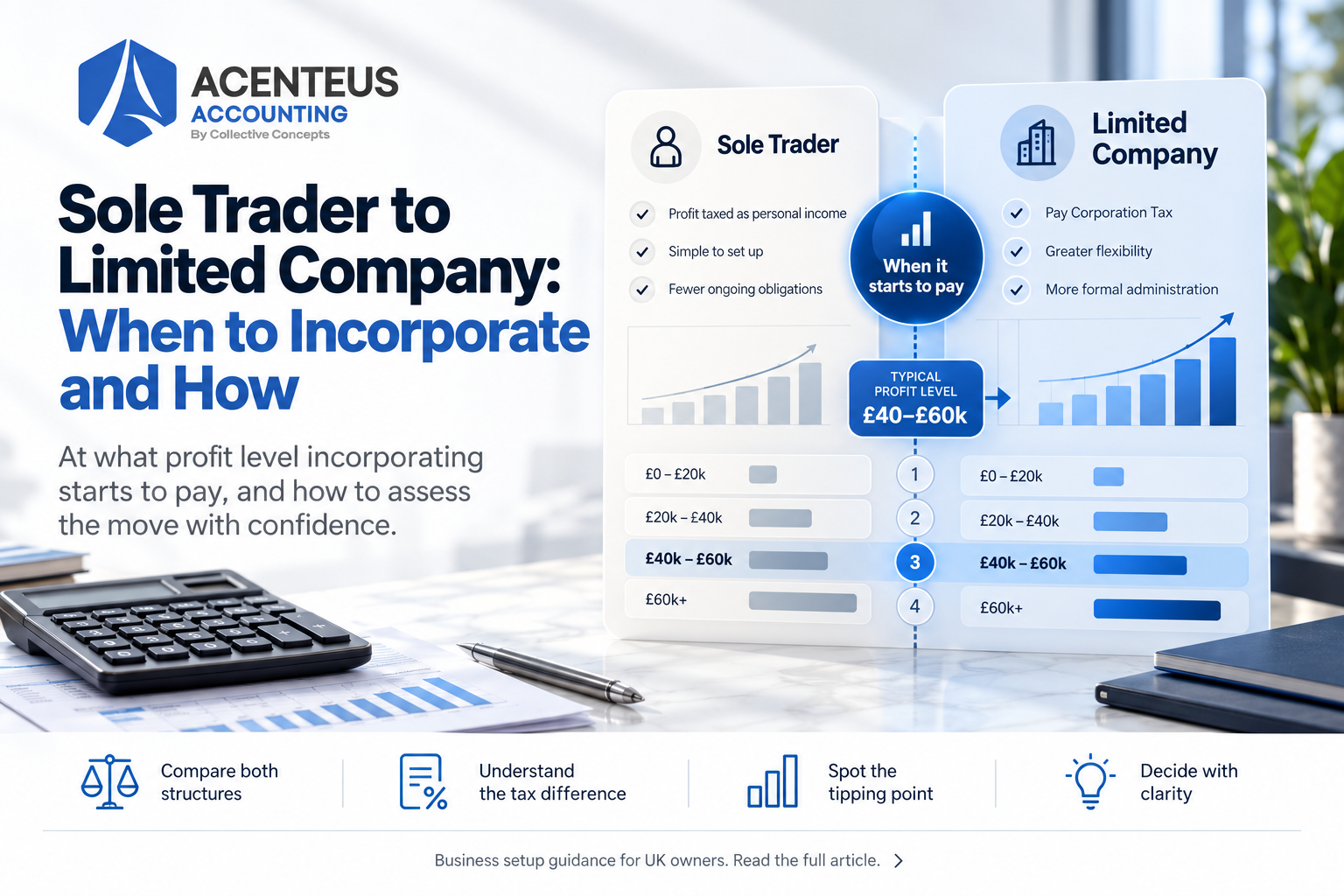
On 2026/27 rates, incorporating does not save tax if you draw every pound of profit out of the company. Across profits from £30,000 to £120,000 a sole trader pays less than a single director company that extracts everything. The company only wins when profit stays inside it, and on our modelling the crossover sits at roughly £47,000 of profit if you retain everything, rising to about £58,000 if you draw £45,000 a year.
That is a change, and it is recent. Dividend tax rose in April 2026, employer National Insurance is 15% on almost every pound of salary, and the old rule of thumb about a magic turnover number no longer describes what is happening. The question is not how much you earn. It is how much of it you need.
Key takeaways
- The headline: on full extraction the sole trader pays less at every profit level we tested between £20,000 and £400,000.
- What actually decides it: how much you draw. Retention is where the company advantage now lives, because corporation tax at 19% to 26.5% beats income tax plus National Insurance at up to 47%.
- The crossover: about £47,000 of profit if you retain everything, about £51,000 if you draw £30,000, about £58,000 if you draw £45,000.
- Why it moved: dividend tax went to 10.75% and 35.75% in April 2026, and employer National Insurance is 15% above a £5,000 secondary threshold.
- Transferring the business: incorporation relief is automatic if you transfer the whole business for shares. Goodwill carries two separate traps, one on each side of the deal.
- The non-tax reasons still stand: limited liability, contracts that require a company, credibility, and the ability to bring in shareholders. Those have not changed at all.
What changed in April 2026, and why the old answer stopped working
Three things moved, and they all move in the same direction. Dividend tax rates rose, employer National Insurance became expensive on almost the whole salary, and the relief that used to soften a future exit got more expensive too.
| What | Position now (2026/27) | Effect on the incorporation decision |
|---|---|---|
| Dividend tax | 10.75% basic, 35.75% higher, 39.35% additional | The main extraction route got 2 percentage points more expensive at basic and higher rate |
| Dividend allowance | £500 | Almost nothing is sheltered before dividend tax starts |
| Employer National Insurance | 15% above a £5,000 secondary threshold | A £12,570 director salary now costs the company £1,136 in employer NI |
| Employment Allowance | £10,500, but not available where a sole director is the only employee | Most one person companies cannot use it |
| Corporation tax | 19% to £50,000, 25% above £250,000, 26.5% marginal rate between | Unchanged, and now the most attractive rate in the system |
| Business Asset Disposal Relief | 18% from 6 April 2026, up from 14%, up from 10% | The eventual exit is taxed more heavily than it was two years ago |
Those are the published rates, from GOV.UK income tax rates, tax on dividends, corporation tax rates and Business Asset Disposal Relief. The 26.5% marginal rate between £50,000 and £250,000 comes from the 3/200 standard fraction set out in HMRC’s Company Taxation Manual.
Sole trader or limited company: the tax at four profit levels
The table below assumes you take all the profit. For the company that means a £12,570 salary, employer National Insurance on it, corporation tax on what is left, and the whole remaining balance paid out as dividends. This is how most one person companies actually run.
| Profit before tax | Sole trader tax and NI | Effective rate | Limited company tax and NI | Effective rate | Difference |
|---|---|---|---|---|---|
| £30,000 | £4,532 | 15.10% | £5,597 | 18.70% | Sole trader better by £1,065 |
| £50,000 | £9,732 | 19.50% | £11,138 | 22.30% | Sole trader better by £1,406 |
| £80,000 | £22,289 | 27.90% | £24,235 | 30.30% | Sole trader better by £1,947 |
| £120,000 | £41,089 | 34.20% | £45,346 | 37.80% | Sole trader better by £4,257 |
- Assumptions: 2026/27 rates for England, Wales and Northern Ireland. No other income, no pension contributions, no student loan, no Employment Allowance, one director who is the only employee.
- Sole trader side: income tax on profits after the £12,570 personal allowance, plus Class 4 National Insurance at 6% and then 2%.
- Company side: £12,570 salary, employer National Insurance of £1,136, corporation tax on the balance, and everything left paid as dividends.
- What is not in it: the cost of running the company, which the table below deals with separately.
We searched the whole range from £20,000 to £400,000 of profit and found no crossover. On full extraction, at every level, the sole trader pays less. If a page tells you there is a turnover figure above which incorporating saves tax, ask what extraction assumption sits behind it.
Why the company still wins if you do not take all the money out
The company advantage is not a lower rate on income. It is a lower rate on profit you do not need yet. A sole trader is taxed on the whole profit whether it reaches their bank account or not. A company is taxed at 19% to 26.5% on profit that stays inside it, and the second layer of tax only arrives when a dividend is voted.
| Profit | Sole trader tax, all profit taxed | Company tax if nothing is drawn beyond a £12,570 salary | Company tax drawing £45,000 a year |
|---|---|---|---|
| £50,000 | £9,732 | £9,500 | £11,138, nothing retained |
| £60,000 | £13,889 | £12,150 | £13,364 |
| £80,000 | £22,289 | £17,450 | £18,386, with £20,046 retained |
| £100,000 | £30,689 | £22,750 | £23,686 |
| £120,000 | £41,089 | £28,050 | £28,986, with £49,446 retained |
Read the £120,000 row carefully. Drawing £45,000 and leaving the rest in the company costs £12,103 less tax in that year than trading as a sole trader, and leaves £49,446 inside the business. That money is not tax free forever. It is deferred, and the dividend tax is waiting. But deferred at 26.5% instead of paid at 42% is a real advantage, and it is the only one that survives the 2026 rate changes.
The draw line: the threshold that actually matters
Because the answer depends on extraction rather than turnover, the sensible question is not what profit level to incorporate at. It is: given what you need to live on, at what profit does the company start to win? Here is that line, from our model.
| What you draw each year | Profit at which the company starts to cost less tax |
|---|---|
| Everything, full extraction | Never, on the range we tested |
| £60,000 | About £60,200 |
| £45,000 | About £57,800 |
| £30,000 | About £50,800 |
| Only the £12,570 salary, retain the rest | About £46,700 |
The pattern is the point. The less you need to take, the lower the profit at which incorporating pays. A consultant billing £90,000 who needs all of it is better off as a sole trader. A consultant billing £90,000 who lives on £40,000 and is building a reserve is better off in a company. Same turnover, opposite answer. You can sanity check the corporation tax half of this against our free UK corporation tax calculator.
How does National Insurance differ on each side?
A sole trader pays Class 4 National Insurance on profits: 6% between £12,570 and £50,270, then 2% above that. Class 2 is no longer payable where profits are £7,105 or more, and is treated as paid for contributory benefits, per GOV.UK.
A director takes salary, which attracts employee National Insurance at 8% between £12,570 and £50,270 and 2% above, and employer National Insurance at 15% on everything above the £5,000 secondary threshold. Dividends attract no National Insurance at all, which is the whole reason the salary and dividend split exists.
- The trap at the bottom: the £5,000 secondary threshold is low. A £12,570 salary costs the company £1,136 in employer National Insurance before anything else happens.
- Why £12,570 is still the right salary: it uses the full personal allowance and the corporation tax saved on the salary and the employer NI exceeds the NI cost. A £5,000 salary avoids employer NI and is worse overall, by £1,276 on a £30,000 profit.
- Employment Allowance: £10,500 would wipe out the employer NI, but a company whose only employee liable for secondary Class 1 is its sole director cannot claim it, per HMRC. Two people on the payroll changes that, and our Employment Allowance guide covers who qualifies.
If you want to model the employer side on your own salary figures, our employer National Insurance calculator guide sets out the arithmetic.
How do salary and dividends actually work, and what is the effective rate?
A dividend is paid out of profit after corporation tax, so the money is taxed twice: once in the company, once in your hands. The effective rate is what matters, and it is higher than the headline dividend rate suggests.
| Layer | Basic rate shareholder | Higher rate shareholder |
|---|---|---|
| Corporation tax on the profit | 19% | 26.5% in the marginal band |
| Left to distribute | 81p of each £1 | 73.5p of each £1 |
| Dividend tax on that | 10.75% | 35.75% |
| Combined effective rate | 27.70% | 52.80% |
| Compare: sole trader marginal rate | 26% (20% tax plus 6% Class 4) | 42% (40% tax plus 2% Class 4) |
That last row is the finding in one line. At basic rate the two routes are close. At higher rate the company route on fully extracted profit costs about 52.8% against 42% for a sole trader, and no amount of salary and dividend planning closes a gap that size. What closes it is not extracting the money.
One genuine exception: employer pension contributions. A company contribution is deductible for corporation tax and is not taxed as income, so it escapes both layers. For an owner already funding a pension, that single point can change the answer, and it is the first thing to model before writing incorporation off.
What does it actually cost to run a limited company?
A company costs money the sole trade did not. Before comparing tax, take the running cost off the saving, because a £1,500 tax advantage disappears entirely against £1,500 of extra compliance.
| Obligation | Sole trader | Limited company |
|---|---|---|
| Annual filing | Self Assessment return | Annual accounts to Companies House, CT600 to HMRC, Self Assessment for the director |
| Companies House fees | None | £100 to incorporate, £50 a year for the confirmation statement, both digital |
| Payroll | None | PAYE scheme, RTI submissions every pay period, even for one director |
| Identity verification | Not applicable | Directors and PSCs must verify with Companies House |
| Public record | None | Accounts, officers and PSCs published |
| Accountancy fees | Lower | Typically higher, because there are more returns and a statutory format |
None of this is difficult, but it is all mandatory and it all has a deadline. The filing timetable is in our UK tax year 2026/27 key dates guide, the CT600 side in our corporation tax services and filing deadlines guide, and the verification requirement in our Companies House identity verification guide.
How do you transfer the business itself?
Incorporating is a disposal. You are selling your business to a separate legal person, and that triggers capital gains tax unless a relief applies. Two reliefs do most of the work, and they are not alternatives you pick between: one is automatic, the other has to be claimed.
Incorporation relief
Incorporation relief under section 162 defers the gain by rolling it into the base cost of your shares, so no tax is payable until you sell them. It applies automatically if you transfer the whole business as a going concern, with all its assets except cash, wholly in exchange for shares, per GOV.UK.
- No claim needed: if the conditions are met it applies whether you want it or not. Electing out is possible and occasionally sensible.
- All assets except cash: leave a trade debtor or a van behind and the relief can fail on the whole transfer.
- Wholly for shares: take any part of the consideration in cash or as a loan account credit and that proportion of the gain is taxable now.
- The loan account point: many incorporations credit the value to a director’s loan account so the owner can draw it tax free later. That is cash consideration, and it restricts the relief.
Holdover relief
Holdover relief under section 165 is the alternative where incorporation relief does not fit, for example where you are transferring individual business assets rather than the whole business. It holds the gain over into the company’s base cost, so the company inherits it. Unlike incorporation relief it must be claimed jointly, and it is the route to use when you deliberately want to leave assets such as property outside the company.
Goodwill, and the two traps
Goodwill is where incorporations go wrong, and there is a separate trap on each side of the transaction.
- Your side: Business Asset Disposal Relief is not available on goodwill transferred to a close company where you keep 5% or more of the shares, for disposals on or after 3 December 2014, per HMRC’s Capital Gains Manual. That is almost every owner managed incorporation.
- The company’s side: the company generally gets no corporation tax relief for amortising goodwill acquired from a related party on incorporation, under the Finance Act 2015 rules that apply from the same date, with only restricted relief available in limited circumstances under the later Finance Act 2019 rules, per HMRC’s intangibles manual.
- What that means in practice: valuing goodwill highly on incorporation usually creates a taxable gain for you with no deduction for the company. The old planning does not work, and it has not worked for a decade.
Assets, the trade and existing contracts
Assets transfer at market value between connected parties, whatever price you put on the invoice, so a nominal transfer value does not avoid the tax consequence. Capital allowances follow their own rules and an election can preserve written down values rather than triggering balancing charges.
Contracts are the part people forget. A contract with a sole trader does not automatically become a contract with the company. Customer agreements, supplier terms, leases, insurance, finance and licences all need to be novated or reissued in the company’s name. A lease assigned without the landlord’s consent, or insurance still in a personal name, is a live problem rather than an administrative one.
What happens to your VAT registration?
You have two choices, and they carry different risks. Either the company registers afresh and you deregister the sole trade, or you transfer the existing VAT number to the company on form VAT68 as a transfer of a going concern, using HMRC’s form.
- Register afresh: cleanest. The company gets a new number and a clean compliance history, and the sole trade files a final return and deregisters.
- Transfer the number with VAT68: keeps continuity with customers and systems, but the company inherits the number’s history, including any outstanding liabilities, errors or penalty exposure attached to it.
- The threshold point: a transfer of a going concern carries the transferor’s turnover history with it, so the company can be required to register from day one even though it has just been formed.
- Making Tax Digital: the company keeps digital records and files through compatible software from its first return either way, as covered in our guide to submitting a VAT return.
My default is to register the company separately unless there is a specific reason to keep the number. Inheriting a VAT history to save updating a few invoice templates is a poor trade.
How do you close the sole trade properly?
Tell HMRC you have stopped being self employed, file a final Self Assessment return covering the period to cessation, and settle the Class 4 National Insurance on it. The cessation is a tax event in its own right, not an administrative tidy up.
- Notify HMRC: stop being self employed through your Government Gateway account. Do not simply stop filing.
- The final return: covers trading to the date of cessation. Timing matters, because two sets of profits can land in one tax year, and our Self Assessment deadlines guide sets out when it is due.
- Capital allowances: a cessation triggers balancing adjustments on assets not transferred under an election.
- Payments on account: reduce them if the following year’s income will be lower, otherwise you fund HMRC for a year for nothing.
- Keep the records: the sole trade’s records still have to be kept for the statutory period after cessation.
When is staying a sole trader the right answer?
More often than the internet suggests, and on 2026/27 rates more often than last year. Stay as you are if any of the following describe you.
- You need all the money: if every pound of profit funds your household, the company adds cost and compliance for a worse tax outcome.
- Profits are below about £50,000: even with full retention the company does not win, because the personal allowance and the 6% Class 4 rate are doing a lot of work on the sole trader side.
- Profits are volatile: a bad year in a company still costs you accounts, a CT600, payroll and Companies House fees.
- You want privacy: company accounts, officers and PSCs are public. Sole trader accounts are not.
- You are about to need a mortgage: lenders assess company directors differently and usually want two to three years of company accounts. Incorporating six months before an application can make borrowing harder, not easier.
The reverse is also worth saying plainly. Limited liability, winning contracts that will not engage a sole trader, bringing in a co-owner, and building a business you can one day sell are all sound reasons to incorporate that have nothing to do with the tax table. If one of those applies, incorporate and treat the tax as a cost of the structure rather than the reason for it.
When should you make the switch, and what does the changeover involve?
The clean answer is the start of a new accounting period, and in practice the start of a tax year, because it avoids splitting a year between two entities and two tax treatments. Incorporating mid year is possible and routinely done, it just creates two sets of accounts, two returns and an apportionment nobody enjoys.
- Open the bank account first: and do not trade through the personal account after the transfer date. Mixed banking is the single most common mess we see on a first company year end.
- Move the insurance: professional indemnity, public liability and employer’s liability all need to be in the company’s name from day one.
- Reissue contracts and terms: customers, suppliers, landlord, finance agreements and any licence or registration.
- Update everything customer facing: invoices, website, email footers and stationery must show the company name, number and registered office.
- Tell HMRC about both sides: register the company for corporation tax and PAYE, and close the sole trade.
The mechanics of the incorporation itself, the name, the SIC code, the officers, the registered office and the first 90 days, are covered step by step in our guide to setting up a limited company in the UK. This article is the decision. That one is the process.
How Acenteus Accounting helps
The conversation I have most often starts with an owner who has read that they should incorporate at a certain turnover and wants to know if it is true. It usually is not, and the honest answer takes ten minutes of arithmetic on their actual figures rather than a rule of thumb. What we do first is model the decision on your real profit and your real drawings, including pension contributions, because that is the variable most likely to flip the answer.
If the answer is yes, we handle the whole changeover: incorporation, the transfer of the business and its assets, incorporation relief, the VAT position, closing the sole trade with HMRC, setting up PAYE and corporation tax, and the first year of filings. That work sits inside our business setup service, and the ongoing compliance inside accounting for small businesses.
The pain points owners tell us about are consistent: not knowing what the real tax difference is, missing the contracts and insurance in the changeover, drawing money that turns out to be an overdrawn loan account, and discovering the extra filing burden after the fact. Every one of those is avoidable with a plan made before the company is formed rather than after. Our guide to UK income tax rates for 2026/27 has the personal side of the numbers if you want to check ours.
You do not have to take our word for how we work. We hold a verified Clutch profile with a 5.0 rating across three client reviews. Shobhana Solanki, Managing Director of TAXTEK CAMBRIDGE LTD in Cambridge, wrote that our “openness to questions and feedback fostered a positive working relationship, which helps to build trust”. A director at a financial services company in Northern Ireland wrote that we “provide high-quality work at a cost-effective rate”. The same reviews note clients would like even more proactive suggestions, which is fair, and is exactly the habit this kind of decision needs.
If you want the answer for your own numbers rather than a general one, send us last year’s accounts and what you actually drew and we will tell you which side of the line you are on.
Frequently Asked Questions (FAQ)
On 2026/27 rates, stay a sole trader if you need to draw all your profit. Incorporate if you can leave profit in the business, if profits are above roughly £47,000 and you retain most of it, or if you need limited liability or want to bring in shareholders.
When your drawings are comfortably below your profits and the retained amount is meaningful, or when a non-tax reason applies. On our model the crossover is about £47,000 of profit with full retention, about £51,000 if you draw £30,000, and about £58,000 if you draw £45,000.
Yes. You incorporate a company, transfer the business and its assets to it, notify HMRC that you have stopped being self employed, file a final Self Assessment return, and move contracts, insurance, banking and VAT across.
Incorporate at Companies House, open a company bank account, transfer the trade and assets in exchange for shares, deal with the VAT position, register for corporation tax and PAYE, reissue contracts and terms, and close the sole trade with HMRC.
Incorporation relief defers the capital gain on transferring your business to a company by rolling it into the base cost of your shares. It applies automatically where you transfer the whole business as a going concern, with all assets other than cash, wholly in exchange for shares.
The dividend allowance is £500 for 2026/27. Beyond that, dividends are taxed at 10.75%, 35.75% or 39.35% depending on your band. If your salary does not use your full personal allowance, dividends covered by the remaining allowance are also untaxed.
No. Dividends carry no National Insurance, which is why owner managers take a small salary and the balance as dividends. The trade off is that dividends are paid out of profit that has already borne corporation tax.
It taxes qualifying gains on selling a business or shares at a reduced rate: 18% from 6 April 2026, up from 14% in 2025/26 and 10% before that. It is not available on goodwill transferred to a close company where you retain 5% or more of the shares.
Potentially yes. Transferring goodwill to your own company is a disposal at market value, Business Asset Disposal Relief is generally blocked, and the company usually gets no corporation tax relief for amortising it. Incorporation relief can defer the gain if the whole business transfers for shares.
Lenders usually want two to three years of company accounts from a director, whereas a sole trader's Self Assessment history carries across. Incorporating shortly before a mortgage application can make borrowing harder rather than easier.