Last updated: 24 September 2026
This article is general guidance on UK GAAP and is not advice for a specific set of accounts. The standard, the FRC factsheets and the tax treatment all change, so confirm the current position with the FRC and your own technical review before you file.
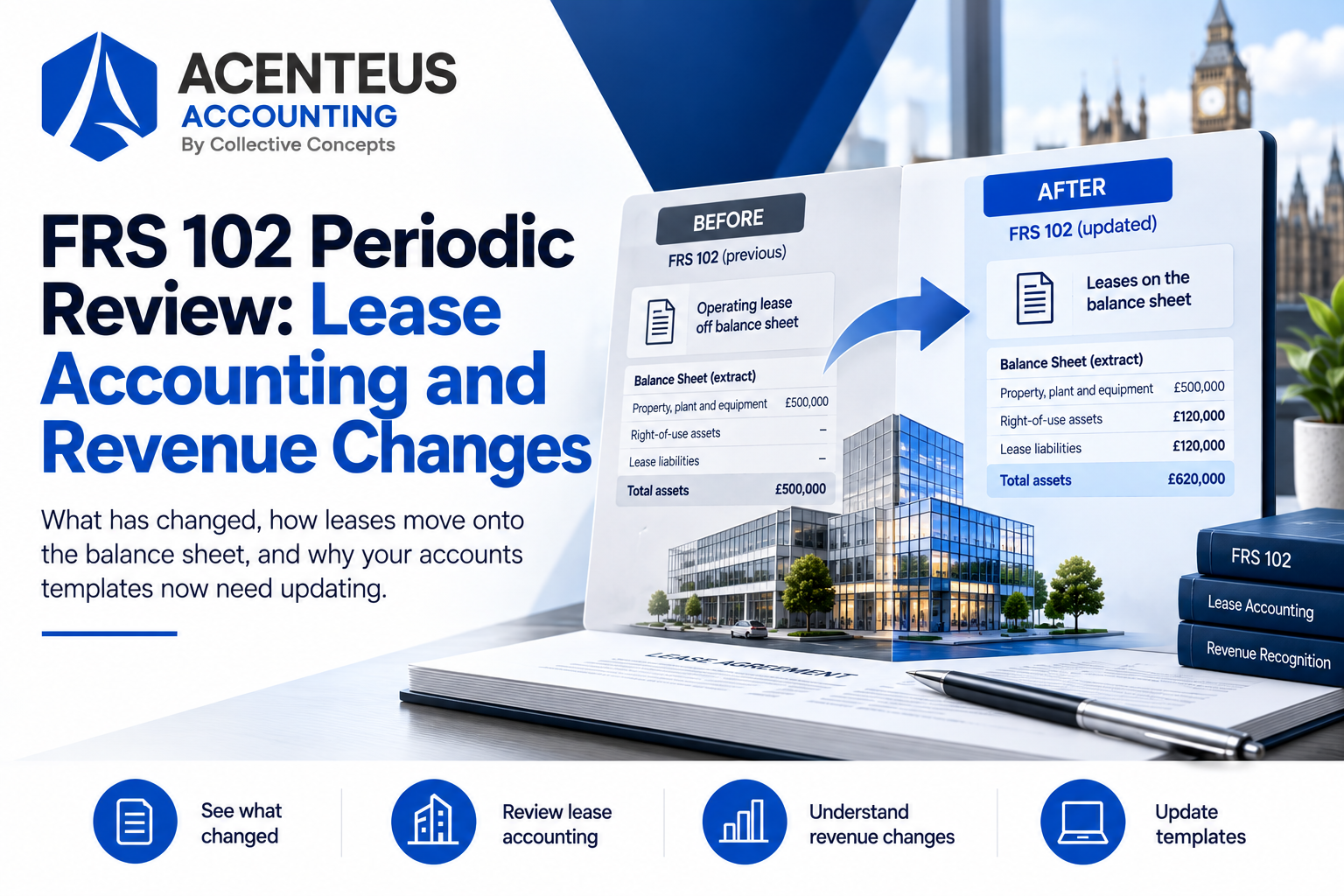
The FRS 102 Periodic Review 2024 amendments apply to accounting periods beginning on or after 1 January 2026. Two changes do most of the work. Lessees put almost every lease on the balance sheet as a right of use asset and a lease liability, and revenue moves to a five step model imported from IFRS 15. For a 31 December year end, the first affected accounts are the ones you will prepare in 2027, and the comparatives you need were captured in 2026.
That second sentence is the reason this article exists now rather than next spring. The lease data has to be collected before the first affected year end, not after it, and the transition adjustment lands in opening retained earnings on the first day of the period. If you are a preparer, the work starts with an inventory, not with a template.
Key takeaways
- Effective date: accounting periods beginning on or after 1 January 2026. Supplier finance disclosures came in a year earlier, from 1 January 2025.
- Leases: the operating and finance lease split disappears for lessees. You recognise a right of use asset and a lease liability, with two exemptions.
- The exemptions: short term leases of 12 months or less with no purchase option, by class of asset, and low value assets lease by lease. Property and cars are never low value.
- Transition for leases: modified retrospective only. Comparatives are not restated and the cumulative effect goes to opening retained earnings.
- Transition for revenue: you choose: modified retrospective, or full retrospective with restated comparatives. This is a real decision, not a formality.
- The number that moves most: EBITDA. Rent leaves operating costs entirely and reappears as depreciation and interest below the line.
What did the FRS 102 periodic review actually change, and when does it take effect?
Most of the Periodic Review 2024 amendments are effective for accounting periods beginning on or after 1 January 2026, with the supplier finance disclosure requirements taking effect a year earlier from 1 January 2025, per the FRC’s explainer. The two changes that alter the numbers rather than the notes are leases and revenue.
| Area | What changed | Where it shows up |
|---|---|---|
| Section 20, Leases | Lessees recognise a right of use asset and a lease liability for most leases. The operating and finance distinction goes | Balance sheet, profit and loss split, cash flow classification, every KPI built on EBITDA |
| Section 23, Revenue | A five step model based on IFRS 15, recognising revenue when control transfers | Timing of revenue on contracts with multiple promises, variable consideration and staged delivery |
| Section 2A, Fair value | New section on fair value measurement, with fair value of a liability as a transfer value reflecting non performance risk | Investment property, financial instruments, anything measured at fair value |
| Section 1A, Small entities | Additional disclosures, including going concern, provisions, contingencies, share based payments, current and deferred tax, leases, performance obligations and dividends | The notes in every small company set, including filleted accounts |
| Supplier finance | New disclosure requirements, effective a year ahead of the rest | Notes, for any entity using supplier finance or reverse factoring |
The FRC issued further amendments in 2026 covering adapted financial statement formats in FRS 102 and clarifications to FRS 105, as ICAEW reported. Worth checking before you finalise a template, because format flexibility is exactly the sort of thing that gets built into accounts production software late. The current text of the standard and a note of which version applies sits on the FRC’s FRS 102 page.
How does lease accounting work for lessees under the amended FRS 102?
At the commencement date a lessee recognises a lease liability at the present value of the unpaid lease payments, and a right of use asset at cost, being the initial liability plus any payments made at or before commencement and initial direct costs, less any lease incentives received, per FRC Factsheet 11. The asset is then depreciated and the liability unwinds with interest.
The liability includes fixed payments and in substance fixed payments, variable payments linked to an index or rate measured using the rate at commencement, residual value guarantees, the exercise price of a purchase option if exercise is reasonably certain, and termination penalties where the term reflects them.
Which discount rate do you use?
Use the interest rate implicit in the lease if it can be readily determined. If it cannot, and in practice it usually cannot, FRS 102 lets a lessee elect between the incremental borrowing rate and the obtainable borrowing rate, the rate at which the entity could borrow an amount equal to the total undiscounted lease payments. Public benefit entities may use a deposit rate where neither is determinable.
The obtainable borrowing rate is a genuine FRS 102 simplification with no IFRS 16 equivalent, and it is the one most small preparers should use. It removes the need to construct an asset specific and term specific rate for every lease, which is where IFRS 16 implementations burned most of their hours.
What are the two recognition exemptions?
Two, and they behave differently. Short term leases are elected by class of underlying asset. Low value leases are elected lease by lease, with no limit on how many you take.
- Short term: a lease term of 12 months or less at commencement, with no purchase option. Elected by class of underlying asset, so it is all or nothing within a class.
- Low value: the underlying asset is of low value. Elected lease by lease. FRS 102 sets no monetary threshold, and the exemption is broader than IFRS 16.
- Never low value: real estate and motor vehicles are named as assets that are not low value, so the property lease and the company car are both on the balance sheet.
- Two blockers: the low value exemption is not available if the lessee subleases or expects to sublease the asset, or if the asset is highly dependent on or highly interrelated with other assets.
My practical read: the short term exemption is worth electing across obvious classes and then forgetting about. The low value exemption is where preparers waste time, because without a monetary threshold in the standard every firm has to set and document its own, and then apply it consistently. Set that policy once, write it down, and stop relitigating it per client. ICAEW keeps its working material on the topic on its FRS 102 leases page.
A worked example: a five year property lease before and after
Take an office lease, five years, £30,000 a year payable annually in advance, no purchase option. Property is never low value and the term is over 12 months, so no exemption applies. The discount rate is 6%, taken as the obtainable borrowing rate. The first payment is made at commencement, so the liability is the present value of the four remaining payments.
| Measure | Old treatment, operating lease | New treatment |
|---|---|---|
| Balance sheet at day one | Nothing. A commitment note only | Right of use asset £133,953, lease liability £103,953 |
| Profit and loss, year 1 | £30,000 rent in operating costs | Depreciation £26,791 plus interest £6,237, total £33,028 |
| Where it sits | Above EBITDA | Both below EBITDA |
| Total charge over five years | £150,000 | £150,000, depreciation £133,953 plus interest £16,047 |
The total is identical. Only the timing and the classification change. Here is the profile year by year, which is the part a client will ask about when the first year looks worse.
| Year | Opening liability | Interest | Closing liability | Total charge | Against £30,000 old charge |
|---|---|---|---|---|---|
| 1 | £103,953 | £6,237 | £80,190 | £33,028 | £3,028 higher |
| 2 | £80,190 | £4,811 | £55,002 | £31,602 | £1,602 higher |
| 3 | £55,002 | £3,300 | £28,302 | £30,091 | £91 higher |
| 4 | £28,302 | £1,698 | Nil | £28,489 | £1,511 lower |
| 5 | Nil | Nil | Nil | £26,791 | £3,209 lower |
Depreciation is £26,791 in every year and the payment is £30,000 in years 1 to 4, both constant, so they are left out of the table to keep it readable. The total charge column is depreciation plus interest.
Three things to take from that table. The charge is front loaded, by £3,028 in year one on a lease this size. The liability and the asset both unwind to nil, so nothing is left stranded. And EBITDA improves by the full £30,000, because the rent has left operating costs entirely. On a portfolio of leases that last point is the one that moves covenants.
What are the transition options, and which one should you pick?
For leases there is no choice of approach: initial application is modified retrospective. The cumulative effect is recognised as an adjustment to the opening balance of retained earnings at the date of initial application, and comparatives are not restated, per FRC Factsheet 9. For revenue you do have a choice, and it matters.
| Leases, Section 20 | Revenue, Section 23 | |
|---|---|---|
| Approach | Modified retrospective only | Modified retrospective or full retrospective, your choice |
| Comparatives | Not restated | Not restated under modified, restated under full |
| Adjustment goes to | Opening retained earnings | Opening retained earnings under modified |
| Scope on transition | All leases in force, except those exempt | Incomplete contracts only under modified, all contracts under full |
How previously operating and previously finance leases differ on transition
A lease previously classified as a finance lease carries over at its existing carrying amounts. The right of use asset and lease liability are recognised at the carrying amounts of the leased asset and obligation immediately before transition, and there is no adjustment to retained earnings.
A lease previously classified as an operating lease is measured fresh: the liability is the present value of the remaining lease payments discounted at the lessee’s incremental borrowing rate, and the right of use asset is set equal to the liability, adjusted for any accrued or prepaid lease payments already on the balance sheet. That equality is what keeps the day one retained earnings adjustment small for most straightforward leases.
The four practical expedients worth using
- A single discount rate for a portfolio: apply one rate to a portfolio of leases with reasonably similar characteristics. This is the biggest time saver and most firms should use it.
- Hindsight: use hindsight when assessing the lease term, including whether extension or termination options will be exercised.
- Rely on the previous onerous lease assessment: instead of performing an impairment review of the right of use asset at transition.
- Grandfathering: do not reassess whether existing contracts contain a lease. Apply the new definition only to contracts entered into after the date of initial application.
On revenue, I would take modified retrospective unless there is a specific reason not to. Full retrospective restates the comparatives, which means running two years under two models and explaining the difference to a client who did not ask for it. The exception is an entity heading for a transaction or a funding round where the comparability of the comparative year genuinely matters. ICAEW’s implementation guidance on the changes to FRS 102 and its helpsheet on lease accounting initial application are the references to have open when you make the call.
How does the five step revenue model work?
Section 23 now recognises revenue when control of a promised good or service transfers to the customer, using the five step model imported from IFRS 15. For a business selling one thing at one price at one time, nothing changes. For anyone selling bundles, staged work, or anything with a variable price, the timing can move.
| Step | What it asks | Where preparers get caught | |
|---|---|---|---|
| 1. Identify the contract | Is there an enforceable contract with a customer? | Rolling arrangements and framework agreements with no clear contract boundary | |
| 2. Identify the performance obligations | What distinct goods or services has the entity promised? | Bundled installation, training, support and warranty treated as one line | |
| 3. Determine the transaction price | What consideration is the entity entitled to? | Variable consideration, rebates, discounts and any constraint on estimates | |
| 4. Allocate the price | Split the price across the obligations on relative standalone selling prices | No standalone price exists because it is never sold separately | |
| 5. Recognise revenue | Recognise as each obligation is satisfied, over time or at a point in time | Assuming it is over time because the contract is long |
The step that changes numbers most often is step two. A contract that was billed and recognised as one amount may contain two or three distinct promises delivered at different times, and once they are separated the revenue profile moves even though the invoicing does not. Construction, software, equipment with installation and anything sold with a multi year support element are the usual candidates.
Deferred tax, EBITDA and the other numbers that move
The lease change does not alter the cash, the rent or the total cost. It alters four things that people measure: EBITDA, gearing, interest cover and, in most cases, deferred tax. On a portfolio of leases the effect is not marginal.
- EBITDA rises: operating lease rent leaves operating costs entirely. On the example above that is £30,000 a year on one lease, before you add the rest of the portfolio.
- Gearing rises: the lease liability is debt on the face of the balance sheet. Any covenant defined by reference to borrowings or net debt needs reading again.
- Interest cover falls: the interest element is now a finance cost, so it sits in the denominator of a cover ratio that previously ignored it.
- Net assets move: in the example, the asset and liability diverge as the lease runs, leaving a net asset of £26,972 at the end of year one.
- Deferred tax arises: the tax deduction continues to follow the lease payments for most leases, while the accounting charge is now depreciation plus interest. That mismatch is a timing difference, and it needs computing rather than assuming.
Covenants are the item to raise with clients first, and to raise now rather than at the year end. A covenant drafted before 2026 and defined by reference to accounting measures can be breached by an accounting change that alters nothing about the business. Most facility agreements have a frozen GAAP or equivalent clause, but somebody has to read it, and the bank conversation is easier six months early than six weeks late.
What changes for small entities under Section 1A?
Small entities get the same lease and revenue requirements, plus more disclosure. Section 1A has been extended to require additional disclosures covering going concern, provisions, contingencies, share based payments, current and deferred tax, leases, performance obligations and dividends, as ICAEW’s small entities guidance covers.
That is the part that surprises people. The reduced disclosure regime is still reduced, but the gap between a Section 1A set and a full FRS 102 set has narrowed, and a filleted set filed at Companies House now carries more in the notes than it did. For a practice running volume small company work, this is a template change on every single file, not an exception handled client by client.
What should a preparer change in their accounts templates now?
Six things, in this order. The first two have to happen before the first affected year end, and the rest can follow once the data exists.
| Step | What to do | When |
|---|---|---|
| 1. Build the lease inventory | Every lease, by client: asset, start and end dates, payment amount and frequency, break and extension options, whether it is a property or vehicle | Before the first affected year end |
| 2. Set the policies | Discount rate method, the low value threshold, which classes take the short term exemption, and which practical expedients you will use | Before the first affected year end |
| 3. Build the lease schedule | A working amortisation schedule per lease that produces the liability, the asset, depreciation and interest | With the inventory |
| 4. Update the accounts templates | New balance sheet captions, the split of the charge, cash flow reclassification, and the new Section 1A notes | Before the first set is prepared |
| 5. Compute the transition adjustment | Opening retained earnings entry at the date of initial application, per lease and in total | First affected period |
| 6. Review revenue contracts | Identify clients with bundled, staged or variable price contracts and test them against the five steps | Before the first affected year end |
Step one is the whole job. Everything after it is mechanical, and everything before it is theory. The firms that will struggle in 2027 are the ones that still do not know how many leases sit across their client base. If your accounts production system is part of the answer, our review of cloud accounting software for UK practices covers which packages are building this in, and our complete guide to accounts outsourcing sets out how the preparation work is usually split.
How Acenteus Accounting helps
The lease inventory is the piece nobody has time for, and it is the piece that has to happen first. It is high volume, low judgement, entirely checkable work: read the lease, pull the dates and the payments, flag the options, build the schedule. That is exactly the shape of work we take on, and it sits inside our audit and accounts outsourcing service.
The split does not change. We prepare the inventory, the schedules and the transition computation, your team reviews the judgements that matter, which are the discount rate, the low value policy and the lease term assessments. Those are yours, and they should be. The same principle we set out in our outsourced accounting quality control checklist applies here: the review step is the control and it does not move.
For practices, the timing problem is that the transition work lands on top of an ordinary year end rather than instead of it. That is a capacity question before it is a technical one, and we have written about it in solving year end bottlenecks with outsourcing and scaling practice capacity. If this would be a first engagement, our decision framework for first time outsourcing works through the sequencing, and building capacity without permanent hires covers the staffing side.
You can check how that works in practice rather than taking it from a service page. We hold a verified Clutch profile with a 5.0 rating across three client reviews. Shobhana Solanki, Managing Director of TAXTEK CAMBRIDGE LTD in Cambridge, wrote that our “openness to questions and feedback fostered a positive working relationship, which helps to build trust”. A director at a financial services company in Northern Ireland wrote that we “provide high-quality work at a cost-effective rate”. The same reviews note clients would like even more proactive suggestions, which on a transition project is exactly right: the useful provider is the one who flags the break clause nobody mentioned.
How the engagement runs is on our outsourcing for UK accounting firms page, the detail on file preparation is in our audit working papers guide, and the efficiency case is in improving audit efficiency with outsourced support and the strategic advantages of audit outsourcing. If you would rather start with a number, send us a client list with the lease count and we will tell you how many hours the inventory is.
Frequently Asked Questions (FAQ)
The Periodic Review 2024 amendments apply to accounting periods beginning on or after 1 January 2026. Supplier finance disclosure requirements took effect a year earlier, from 1 January 2025. For a 31 December year end, the first affected accounts are those for 2026.
Lessees no longer split leases into operating and finance. Almost every lease produces a right of use asset and a lease liability on the balance sheet, with the charge split between depreciation and interest instead of a single rental expense.
Short term leases of 12 months or less at commencement with no purchase option, elected by class of underlying asset, and leases of low value assets, elected lease by lease. Real estate and motor vehicles are never low value.
The interest rate implicit in the lease if readily determinable. If not, elect either the incremental borrowing rate or the obtainable borrowing rate, being the rate to borrow an amount equal to the total undiscounted lease payments.
Not for leases. Lease transition is modified retrospective, with the cumulative effect in opening retained earnings and comparatives left alone. For revenue you choose between modified retrospective and full retrospective, and only full retrospective restates comparatives.
Identify the contract, identify the performance obligations, determine the transaction price, allocate the price to the obligations, and recognise revenue as each obligation is satisfied. It is the IFRS 15 model brought into Section 23.
EBITDA rises. Operating lease rent leaves operating costs and is replaced by depreciation and interest, both of which sit below EBITDA. Gearing rises and interest cover falls at the same time, which is why covenants need checking.
In most cases yes. The tax deduction generally continues to follow the lease payments while the accounting charge is depreciation plus interest, so a timing difference arises. It needs computing on the actual tax treatment rather than assumed.
Small entities face additional disclosures covering going concern, provisions, contingencies, share based payments, current and deferred tax, leases, performance obligations and dividends. The lease and revenue recognition requirements apply to them in full.
Build the lease inventory across the client base and set the firm's policies on discount rate, low value threshold and practical expedients. Everything else is mechanical once those two exist, and neither can be done retrospectively.