Last updated: 22 September 2026
This article is general guidance on UK VAT and is not tax advice for your specific circumstances. Thresholds and rates change, so confirm the current figures on GOV.UK before you act.
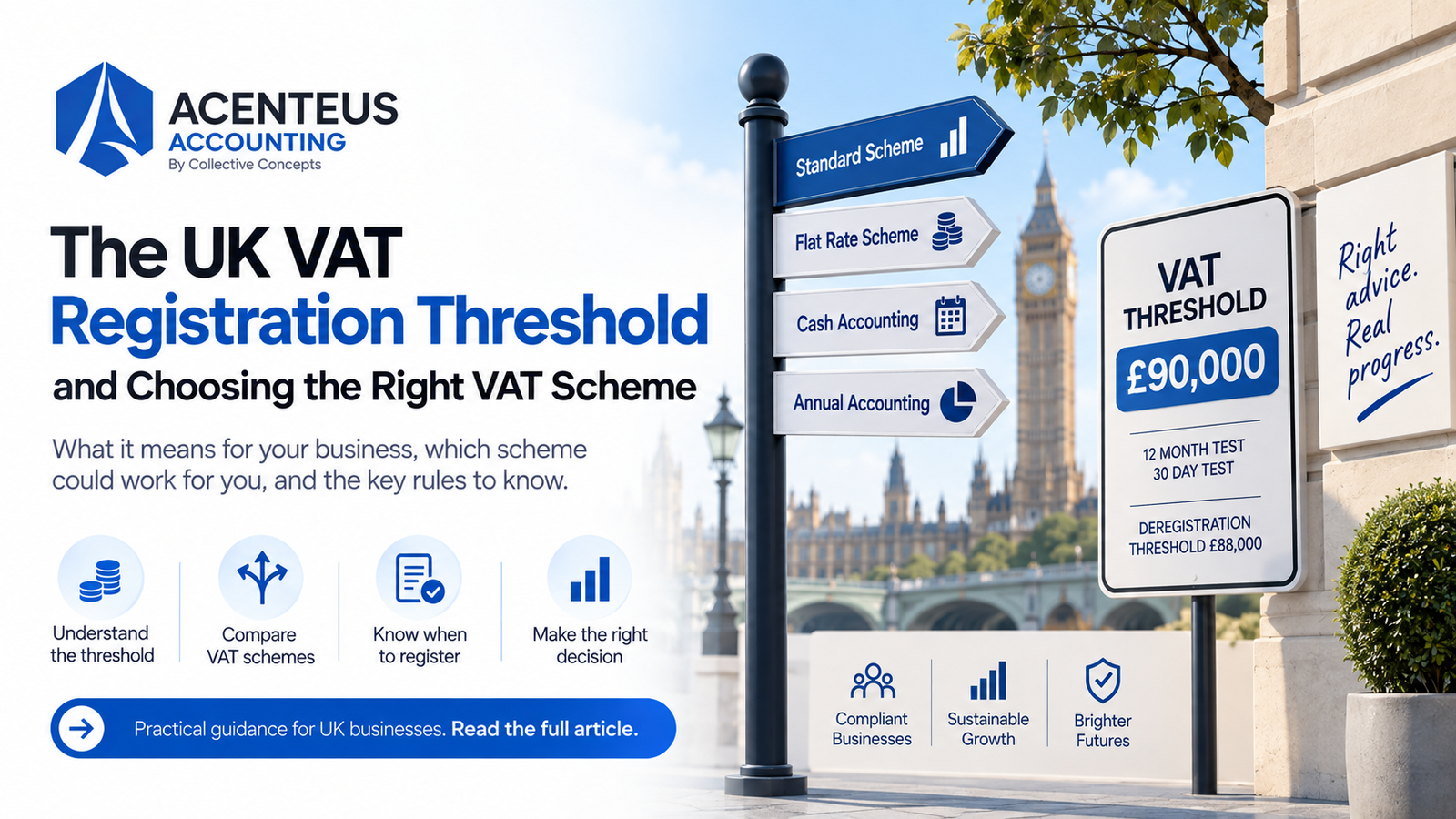
The UK VAT registration threshold is £90,000 of taxable turnover. You must register if your taxable turnover over any rolling 12 months goes above £90,000, or if you expect it to go above £90,000 in the next 30 days alone. The deregistration threshold is £88,000. Registration is only half the decision: once you are in, you choose how you account for VAT, and that choice, standard, Flat Rate, cash accounting or annual accounting, changes what you pay and when you pay it.
Most guidance stops at the threshold. That is the easy part. The part that costs businesses real money is the scheme sitting behind it, and in particular a Flat Rate Scheme that was a genuine saving ten years ago and is a trap for a lot of service businesses today. This guide covers both, with the arithmetic shown.
Key takeaways
- The number: the VAT registration threshold is £90,000 of taxable turnover, unchanged since 1 April 2024. Deregistration sits at £88,000.
- Two tests, not one: the rolling 12 month test looks backwards. The 30 day test looks forwards, and it can make you register with no trading history at all.
- Voluntary registration: usually right when your customers are VAT registered businesses, usually wrong when they are consumers.
- The Flat Rate Scheme: join below £150,000, leave at £230,000, and check the limited cost trader rule first. At 16.5% the scheme gives most consultancies nothing.
- Scheme choice is reversible: cash accounting fixes a cash flow problem, annual accounting fixes an admin problem, and you can run both together.
- Making Tax Digital applies to all of them: digital records and digitally linked software from your first return, whichever scheme you pick.
What is the VAT registration threshold in 2026?
The VAT registration threshold is £90,000 of taxable turnover in any rolling 12 month period. It has been £90,000 since 1 April 2024, when it rose from £85,000. The figure is published by HMRC on the GOV.UK guidance on when to register for VAT.
The threshold is not an annual allowance and it does not reset on 6 April or on your accounting year end. It is a running total of the last 12 months, recalculated every month. A business can cross it in August, drop back below it in September, and still have a registration obligation triggered in August that does not go away.
Has the VAT threshold changed, or is it about to?
As at the date on this article the threshold is £90,000 and no change has taken effect. The threshold is a Budget lever, so it can move at any fiscal event, and searches asking whether it is changing spike every autumn. Treat any figure you read, including this one, as correct on its publication date and check GOV.UK before you file. That is not a disclaimer for its own sake: a business that plans around a threshold that moved in November has mispriced every quote it issues.
Which turnover counts towards the VAT threshold?
Taxable turnover means everything you sell in the UK that is not exempt from VAT or outside the scope of VAT. That includes standard rated sales at 20%, reduced rated sales at 5%, and zero rated sales at 0%. Zero rated is the one people get wrong. A zero rated sale carries no VAT, but it still counts towards the £90,000.
- Counts: standard rated, reduced rated and zero rated sales, goods you hire out, and the value of goods and services you barter or exchange.
- Does not count: VAT exempt supplies such as most insurance, finance, and some education and healthcare, plus anything outside the scope of UK VAT.
- Commonly missed: disbursements recharged incorrectly, sales made through a marketplace where you are the principal, and goods you take from stock for your own use.
Online sellers get caught here more than anyone. Whether the marketplace or you counts as the supplier decides whose turnover the sale belongs to, and therefore whether you have crossed £90,000 at all. Amazon and Shopify do not treat it the same way, which is unpicked in our e-commerce accounting guide.
How do the rolling 12 month and 30 day tests work?
There are two registration tests and they work in opposite directions. The backward look test measures what you have already sold. The forward look test measures what you are about to sell. You only need to fail one of them to have a legal obligation to register.
| Test | What triggers it | Deadline and effective date |
|---|---|---|
| Backward look (rolling 12 months) | Taxable turnover for the previous 12 months goes over £90,000. | Register within 30 days of the end of the month you went over. Registration takes effect from the first day of the second month after you went over. |
| Forward look (next 30 days) | You expect taxable turnover to go over £90,000 in the next 30 days on its own. | Register by the end of that 30 day period. Registration takes effect from the date you realised, not the date the money arrives. |
Read the forward look effective date again, because it is the one that generates unexpected VAT bills. If you sign a £120,000 contract on 3 October that will be delivered and invoiced within the month, you are registered from 3 October. Every invoice from that date carries VAT, including invoices you issue before HMRC sends your VAT number.
The backward look test has a softer landing. Cross the threshold in the 12 months to 31 August, notify by 30 September, and you are registered from 1 October. That gap is the window to reprice, tell customers, and get your records onto software that can file. It is not a grace period for forgetting.
When is voluntary VAT registration worth it?
Voluntary registration is worth it when your customers can reclaim the VAT you charge them, and it is usually a mistake when they cannot. That single test settles most cases. Everything else, credibility, looking bigger than you are, tidiness, is secondary to whether charging 20% more costs you sales.
If you sell to VAT registered businesses, the VAT you add is neutral to your customer and you get to reclaim the VAT on your own costs. You are better off registered. If you sell to consumers or to exempt businesses such as many care providers, insurers or small charities, your price either rises 20% or your margin absorbs it.
- Register voluntarily if: your customers are VAT registered, you buy significant standard rated stock or equipment, or you make zero rated sales and would be in a repayment position.
- Think hard if: you sell to the public, your input VAT is small because your main cost is your own time, or your turnover is nowhere near £90,000 and will not be soon.
- Remember the cost: registration brings quarterly returns, digital record keeping and a penalty regime. That is a real compliance overhead, not a rounding error.
Be honest about that last point before you volunteer. Four returns a year, records kept digitally, and a penalty clock that starts on your first late filing. For most owners it comes down to their own evenings or a line in the budget, and what bookkeepers charge in the UK will tell you roughly which one you are choosing.
One point in favour of registering earlier than you have to: you can reclaim VAT on some costs incurred before registration. Goods still on hand at the date of registration can go back four years, and services can go back six months, under the rules set out in HMRC’s VAT input tax manual. A business about to buy equipment often registers the month before, not after.
What is the VAT deregistration threshold?
The VAT deregistration threshold is £88,000. If your taxable turnover falls below £88,000 you can ask HMRC to cancel your registration, as explained in the GOV.UK guidance on cancelling a VAT registration. Deregistering is a choice at that level, not an obligation.
It becomes an obligation when you stop making taxable supplies altogether, for example when you cease trading, sell the business or join a VAT group. In those cases you must cancel within 30 days. HMRC usually confirms within 40 working days.
Two things catch people on the way out. You still have to file a final return, and if you reclaimed VAT on stock and assets you still hold, you may have to account for VAT on them when the total VAT due is more than £1,000. Deregistration is not a clean exit if the balance sheet is full of equipment.
Which VAT scheme should you choose?
There are four mainstream options: standard VAT accounting, the Flat Rate Scheme, the Cash Accounting Scheme and the Annual Accounting Scheme. They are not alternatives to each other in a neat way. Cash accounting and annual accounting can run together. The Flat Rate Scheme has its own cash based turnover method and cannot be combined with cash accounting.
| Scheme | Who can join | Must leave when | How the VAT is worked out | Best suited to |
|---|---|---|---|---|
| Standard accounting | Any VAT registered business. | Not applicable. | Output VAT on sales invoiced, less input VAT on purchases invoiced. | Businesses with real input VAT, and anyone in a regular repayment position. |
| Flat Rate Scheme | Taxable turnover £150,000 or less, excluding VAT. | Total income including VAT goes over £230,000 at your anniversary. | A fixed sector percentage of gross turnover. No input VAT reclaim except capital assets over £2,000. | Businesses with a low sector rate and genuinely low costs. |
| Cash Accounting Scheme | Taxable turnover £1.35 million or less. | Taxable turnover goes over £1.6 million. | VAT accounted for when money is received and paid, not when invoiced. | Businesses invoicing on credit terms and waiting to be paid. |
| Annual Accounting Scheme | Estimated taxable turnover £1.35 million or less. | Taxable turnover is, or is likely to be, over £1.6 million at the year end. | Instalments through the year, then one return and a balancing payment. | Stable businesses that want one return a year instead of four. |
The cash accounting limits come from HMRC’s cash accounting eligibility guidance, and the annual accounting limits and instalment dates from HMRC’s annual accounting deadlines guidance.
Cash accounting: the scheme most late paid businesses should look at first
Cash accounting means you pay VAT to HMRC when your customer pays you, and reclaim VAT when you pay your supplier. If you invoice on 30 or 60 day terms and your customers take longer, standard accounting makes you fund HMRC’s VAT out of your own working capital. Cash accounting removes that, and it gives automatic bad debt relief, because you never pay VAT on an invoice that is never paid.
What it will not do is make anyone pay you any sooner. It moves the VAT to match your bank account and leaves the debtor days exactly where they were, which is a credit control problem and a separate job. We deal with that one in accounts receivable management for UK SMEs.
It is a poor fit if you are usually in a repayment position, since you cannot reclaim input VAT until you have actually paid the supplier. You also cannot use it if you are on the Flat Rate Scheme, if your returns or payments are overdue, or if you have committed a VAT offence in the previous 12 months.
Annual accounting: one return, nine instalments, and a cash flow trap
Annual accounting replaces four returns with one, filed two months after your accounting period ends, with advance payments through the year. Monthly instalments are 10% of the estimated annual bill, due at the end of months 4 to 12. Quarterly instalments are 25%, due at the end of months 4, 7 and 10. You cannot join if you left the scheme in the last 12 months, if you are part of a VAT group, or if you have outstanding returns, per HMRC’s annual accounting eligibility rules.
The trap is growth. Instalments are based on last year, so a business that doubles turnover arrives at the balancing payment owing a year of under paid VAT in one instalment. Annual accounting suits stable businesses. It punishes fast growing ones.
How does the VAT Flat Rate Scheme work?
Under the Flat Rate Scheme you charge your customers VAT at the normal rate, then pay HMRC a fixed percentage of your gross turnover and keep the difference. In exchange you give up the right to reclaim input VAT, except on capital assets costing more than £2,000 including VAT. The rules are in VAT Notice 733.
- Joining limit: taxable turnover of £150,000 or less in the next 12 months, excluding VAT.
- Leaving limit: total income including VAT of more than £230,000 in the year ending on your anniversary date. You may be allowed to stay if HMRC accepts income in the next 12 months will not exceed £191,500.
- First year discount: a 1% reduction in your flat rate percentage for the first 12 months from your registration date, not from the date you join the scheme.
Flat rate percentages by sector
Your percentage depends on the sector that best fits your main business activity. A selection of the most common rates is below. The full list is published on GOV.UK.
| Business sector | Flat rate | Rate in the first 12 months |
|---|---|---|
| Accountancy or book-keeping | 14.50% | 13.50% |
| Computer and IT consultancy or data processing | 14.50% | 13.50% |
| Management consultancy | 14% | 13% |
| Lawyer or legal services | 14.50% | 13.50% |
| Architect, civil and structural engineer or surveyor | 14.50% | 13.50% |
| General building or construction services | 9.50% | 8.50% |
| Labour-only building or construction services | 14.50% | 13.50% |
| Hairdressing or beauty treatment | 13% | 12% |
| Transport or storage, including couriers and taxis | 10% | 9% |
| Retailing not listed elsewhere | 7.50% | 6.50% |
| Catering services from 1 April 2022 | 12.50% | 11.50% |
| Any other activity not listed elsewhere | 12% | 11% |
| Limited cost trader, any sector | 16.50% | 15.50% |
What is the limited cost trader rule?
A limited cost trader is a business whose spending on relevant goods is either less than 2% of its flat rate turnover, or more than 2% but less than £1,000 a year, which is £250 a quarter. If you meet that test you use 16.5% regardless of your sector, and 16.5% of gross turnover is almost exactly the 20% VAT you collected.
Relevant goods means physical goods used exclusively in the business: stock, stationery, cleaning products, gas and electricity. It excludes services of any kind, vehicle fuel outside the transport sector, food and drink for staff, capital items, and promotional goods. For a consultant whose costs are software subscriptions, accountancy fees and a laptop, almost nothing counts.
Here is the arithmetic on £100,000 of net sales, so £120,000 including VAT. The comparison assumes modest input VAT of £1,000 for the consultancy and £6,000 for the builder.
| Scenario | Standard scheme VAT payable | Flat Rate Scheme VAT payable | Better option |
|---|---|---|---|
| IT consultant, limited cost trader, 16.5% | £19,000 | £19,800 | Standard, by £800 |
| Accountancy practice, 14.5%, not limited cost | £19,000 | £17,400 | Flat Rate, by £1,600 |
| General builder, 9.5%, not limited cost | £14,000 | £11,400 | Flat Rate, by £2,600 |
| General builder, 9.5%, first year at 8.5% | £14,000 | £10,200 | Flat Rate, by £3,800 |
My position on this is straightforward. Since the limited cost trader rule was introduced, the Flat Rate Scheme has stopped being a saving for most consultancies and service businesses and has become a rate you pay for simpler bookkeeping you no longer need, because the software does the bookkeeping anyway. It still pays for businesses that buy goods and sit on a low sector rate. Run the numbers on your own figures before you join, and run them again each year, because the test is applied every VAT period.
A five step check for choosing your VAT scheme
Work through these in order. The first answer that applies decides the scheme, and you stop there.
- Step 1, are you usually in a repayment position: if you make mainly zero rated sales or buy heavily, stay on standard accounting. The Flat Rate Scheme would cost you your reclaims and cash accounting would delay them.
- Step 2, do customers pay you late: if your debtor days run beyond your VAT quarter, cash accounting is the single highest value change you can make, at any turnover up to £1.35 million.
- Step 3, would you be a limited cost trader: if relevant goods are under 2% of turnover or under £1,000 a year, the Flat Rate Scheme at 16.5% is off the table. Go back to standard or cash accounting.
- Step 4, if not, does your sector rate beat your real input VAT: compare the flat rate percentage of gross turnover against output VAT less input VAT on your last four quarters. If the flat rate is lower, join, and take the 1% first year discount if you are newly registered.
- Step 5, is your turnover stable and your admin the problem: if returns are the burden rather than the cash, add annual accounting. If turnover is growing fast, do not, because the balancing payment will land badly.
The point of working in that order is that cash flow and reclaim position rule out schemes before percentages ever come into it. Most businesses that end up on the wrong scheme got there by starting at step 4.
What happens after you register for VAT?
Three things start immediately: you charge VAT from your effective date of registration, you keep digital records under Making Tax Digital, and you file returns to a fixed timetable that has to sit alongside every other filing date in your year. None of them wait for your VAT number to arrive. Our UK tax year 2026/27 key dates and deadlines guide has the full calendar in one place.
Charging VAT before your VAT number arrives
You cannot show VAT on an invoice until you have your number, but you are still liable for the VAT from your effective date. The practical answer is to raise invoices for the VAT inclusive amount without a VAT line, then reissue proper VAT invoices once the number comes through. Tell the customer in advance. A business to business customer will not object. A consumer will, which is another reason the voluntary registration question matters.
Making Tax Digital for VAT
All VAT registered businesses must follow Making Tax Digital for VAT unless HMRC has granted an exemption. You must keep specified records digitally, including the time of supply, net value and VAT rate for every sale, and file through functional compatible software using HMRC’s API. VAT Notice 700/22 sets out the detail.
The rule that trips practices up is digital links. Data has to move between software without manual intervention. A formula in a spreadsheet, a CSV import or an API transfer all qualify. Copy and paste does not. If your VAT return is assembled by hand from a spreadsheet each quarter, that is a compliance failure waiting to be found. Cloud accounting software for UK practices sets out which packages file natively and which still need a bridging step.
Reclaiming VAT on costs incurred before registration
Goods bought up to four years before registration can be reclaimed if they were still on hand at the date of registration and are for the registered business. Services can be reclaimed if they were supplied no more than six months before registration. You need the evidence, normally a valid VAT invoice, and the cost has to relate to taxable supplies.
For a new company this is often worth several thousand pounds in equipment, fit out and professional fees. It is also the claim most often missed, because it sits on the first return and nobody is looking for it. Setting up a limited company in the UK covers what to keep from day one so the claim is there when you need it.
What are the VAT penalty points?
Late VAT returns attract penalty points rather than an immediate fine. You get one point per late submission. When you reach the threshold for your filing frequency you get a £200 penalty, and a further £200 for every late submission after that while you remain at the threshold. The full rules are on GOV.UK.
| Return frequency | Points threshold | Period of compliance to reset to zero |
|---|---|---|
| Monthly | 5 points | 6 months, with 6 returns submitted on time |
| Quarterly | 4 points | 12 months, with 4 returns submitted on time |
| Annual | 2 points | 24 months, with 2 returns submitted on time |
Individual points expire automatically roughly 24 months after the missed deadline if you have not hit the threshold. Once you have hit it, points only reset when you complete the period of compliance and submit every outstanding return from the previous 24 months, as HMRC explains. Late payment is penalised separately. The return itself, the nine boxes and the filing deadlines are covered in submitting a VAT return in the UK.
For one business, £200 is an irritation. For a practice it is the same point accruing across every client whose records arrive in the last week of the quarter, and the penalty lands on the client while the phone call lands on you. That is the case we made in VAT compliance outsourcing for UK accountants.
How Acenteus Accounting helps
We run VAT compliance as a process rather than a quarterly scramble. A rolling turnover monitor tells a client they are approaching £90,000 before they cross it, not after. Scheme choice is reviewed at registration and again at every anniversary, because the limited cost trader test is applied afresh each period. Returns are prepared, reconciled and filed to a fixed timetable. That whole cycle is what our tax compliance outsourcing service covers.
For accountancy practices the work is identical and the pressure is not. VAT quarters land on top of year ends and payroll, so the marginal return gets prepared by whoever is free rather than whoever is best. We have written before about building practice capacity without permanent hires, and VAT is where most firms start, because it is high volume, tightly defined and easy to quality check.
Our team prepares and reconciles, your team reviews and signs, and nothing goes to HMRC without a partner behind it. How that engagement is run, from file handover to review turnaround, is on the outsourcing for UK accounting firms page.
If the first question is cost, and for most firms it is, we would rather you did not have to ask. The models we price this work on are published in accounting outsourcing cost and pricing models.
Otherwise, send us your last four quarters and we will tell you plainly whether your current scheme is costing you money.
Frequently Asked Questions (FAQ)
The UK VAT registration threshold is £90,000 of taxable turnover over any rolling 12 month period. It has applied since 1 April 2024. The deregistration threshold is £88,000.
The threshold is £90,000 as at the date on this article, and no announced change has taken effect. It is set at Budget events, so it can move. Check GOV.UK before relying on the figure for pricing or planning.
Register within 30 days of the end of the month in which your rolling 12 month taxable turnover went over £90,000, or by the end of the 30 day period in which you expect to go over £90,000 in the next 30 days alone. The forward look test makes you registered from the date you realised.
The same £90,000. The threshold applies to the person or entity making the supplies, not to the legal form. A sole trader running two unincorporated businesses adds the turnover of both together.
It is worth it if your customers are VAT registered and can reclaim what you charge, or if you have significant input VAT to recover. It is usually not worth it if you sell to consumers, because you either raise prices by 20% or absorb the VAT in your margin.
It is a simplified scheme for businesses with taxable turnover of £150,000 or less. You pay HMRC a fixed percentage of gross turnover instead of output VAT less input VAT, and you give up input VAT recovery apart from capital assets over £2,000.
You do not avoid it, you test for it. If your spending on relevant goods is genuinely more than 2% of flat rate turnover and more than £1,000 a year, you are not a limited cost trader. Manufacturing spending to fail the test is not a plan, since the test is applied every VAT period and the goods have to be real business goods.
No. The Flat Rate Scheme has its own cash based turnover method, so the two cannot be combined. You can combine cash accounting with annual accounting, and you can combine the Flat Rate Scheme with annual accounting.
Individual points expire automatically about 24 months after the missed deadline if you have not reached the threshold. Once you reach the threshold, points only reset after a full period of compliance and after every outstanding return from the previous 24 months has been submitted.