Last updated: August 2026
Tool features and pricing were checked against public sources at the time of writing and change often, so confirm current details with each vendor. Acenteus does not sell software and has no commercial tie to the tools listed.
Accounts receivable software automates the work of getting paid: it issues and tracks invoices, chases overdue payments on a schedule, allocates incoming cash, and reports on what you are owed, so your team stops chasing manually. For UK businesses in 2026 the best fit depends on your accounting system and size. Chaser and Kolleno suit growing businesses and finance teams, Satago adds credit checks and financing, Upflow leads on analytics for scaling B2B, Credit Hound fits Sage based credit teams, and Xero or QuickBooks built-in reminders cover the simplest needs for free. Most UK tools cost between about £45 and £200 a month, with enterprise platforms priced on quote. This is a vendor neutral comparison from an accounting firm that sells outsourcing, not software, so the recommendations are about fit, not commission.
That last point matters, because almost every “best AR software” list online is published by one of the vendors it ranks. Late payment is the reason any of this exists. The Small Business Commissioner and the Department for Business and Trade estimate that late payments cost the UK economy almost £11 billion a year and leave businesses owed around £26 billion at any one time. More than half of UK small business invoices are now paid late, and Western European business to business Days Sales Outstanding averaged about 52 days in 2025, up from 41 in 2023. Software is one answer to that. Outsourcing is another. This guide compares the tools, explains what they cost, shows how to match one to your accounting stack, and then helps you decide whether to automate receivables in house or hand the whole function over. It is the software counterpart to our guides on accounts payable automation software and accounts receivable outsourcing.
Key takeaways
- What it does: accounts receivable software automates invoicing, chasing, cash allocation and reporting. It is also sold as AR automation, credit control software, debtor management or collections software, which all describe overlapping versions of the same job.
- Three product types: free built-in reminders (Xero, QuickBooks, Sage), collections or chasing tools (simpler and cheaper), and full cycle AR platforms that add payments, cash application and credit risk.
- The best by use case: Chaser for established UK SMEs and accounting firms, Satago for chasing plus credit checks and finance, Kolleno for AI led all in one, Upflow for analytics and scaling B2B, Credit Hound for Sage based credit teams, Paidnice for automatic UK statutory interest, and built in reminders for the simplest needs.
- Typical UK cost: free for built in reminders, about £45 to £80 a month at the entry level, £150 to £900 a month for full cycle tools tiered by revenue, and quote based pricing above that.
- The UK detail most guides miss: whether a tool applies statutory interest under the Late Payment of Commercial Debts (Interest) Act 1998 (the Bank of England base rate plus 8 percent) automatically. Few do.
- Automate or outsource: software still needs someone to run it. If you have no one to own credit control, outsourcing the function can beat buying a tool you will not use well.
What is accounts receivable automation software?
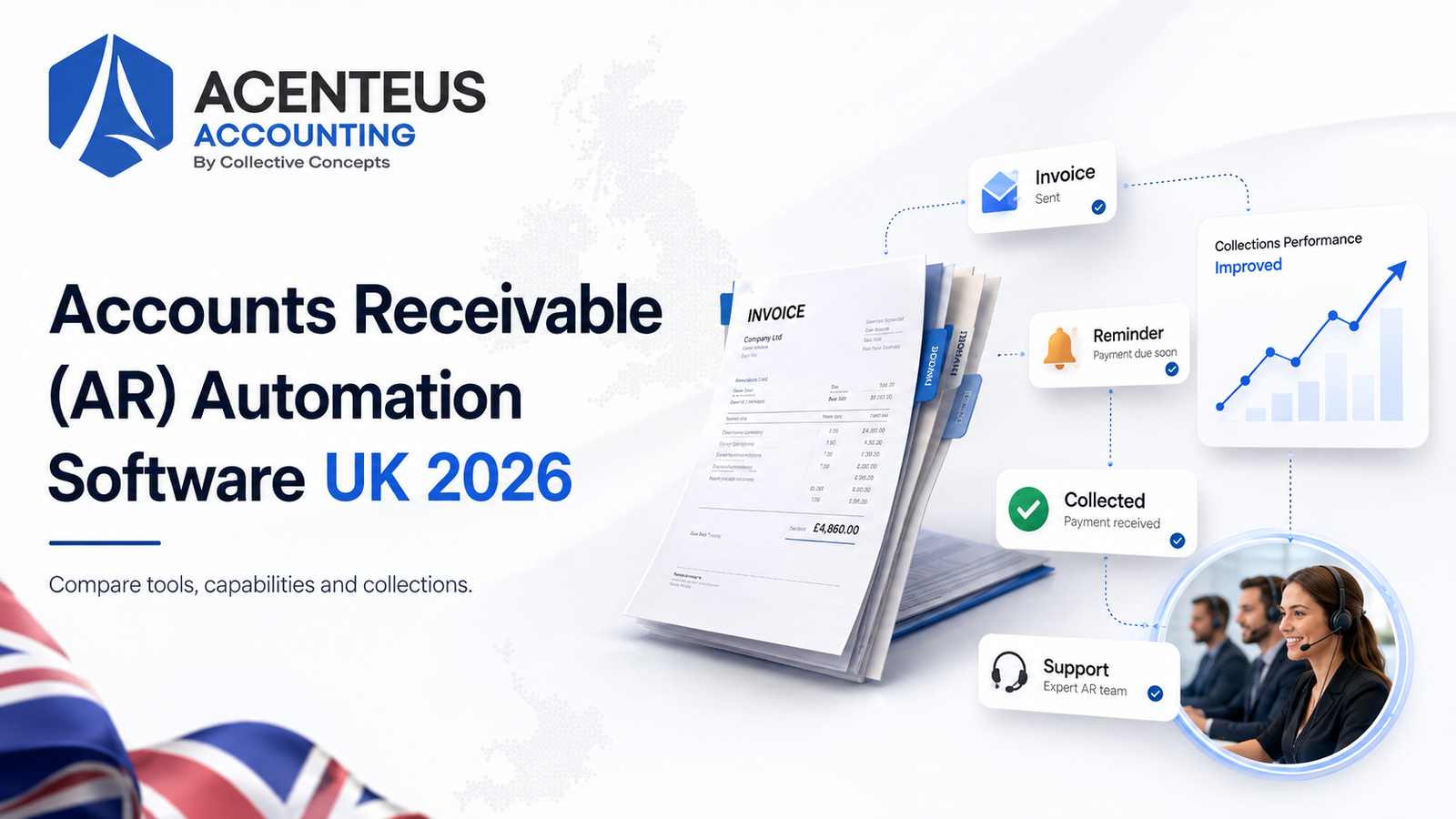
Accounts receivable automation software connects to your accounting system, monitors what customers owe, and runs the repetitive parts of getting paid without someone doing them by hand. In practice it generates and sends invoices, tracks due dates, sends reminders and statements on a schedule, escalates when a customer does not respond, allocates incoming cash against the right invoice, and reports on aged debt and Days Sales Outstanding. The better platforms add a customer payment portal, credit risk checks, dispute handling and cash forecasting. The point is to shorten the gap between raising an invoice and banking the cash, which is where working capital leaks.
The keyword hides three different products, and knowing which you need saves money. First, built-in reminders, the free scheduled nudges inside Xero, QuickBooks and Sage. They are fine for the simplest needs and are the baseline every paid tool competes against. Second, collections or chasing tools, sometimes called dunning software, which focus on one job: chase unpaid invoices consistently and keep a record of every chase. These are simpler and cheaper. Third, full cycle AR platforms that run more of the receivables lifecycle, from credit checks and invoicing through chasing to payments and cash application, in one system. A related category, credit control software, leans into credit risk: assessing customers, setting limits and monitoring exposure, not just chasing.
Most modern tools cover more than one of these, but each leads with one. That is why two tools with the same “AR software” label can behave completely differently, and why the first step is to decide whether your problem is chasing, the whole cycle, or credit risk. If your problem is managing receivables in house as a process rather than buying a tool, our guide to reducing late payments and improving cash flow covers the manual method, and this guide picks up where you decide to automate it.
How we compared the tools
We assessed each tool against the criteria that decide whether AR software actually improves your cash position for a UK business, rather than just adding another dashboard. The comparison is editorial, based on public product information checked at the time of writing, and every buyer should confirm current features and pricing with the vendor.
- Chasing and dunning: multi step, scheduled reminders and statements sent from your own domain, so chasing runs without you.
- Credit risk: customer credit checks, limits and monitoring, to prevent late payment rather than only react to it.
- Cash application: automatic matching of incoming payments to invoices, ideally using live bank data rather than a CSV.
- Payment portal: a self service page where customers can view and pay invoices instantly.
- UK statutory interest: whether the tool can apply the Bank of England base rate plus 8 percent under the Late Payment of Commercial Debts (Interest) Act 1998, and keep it current.
- Integrations: clean two way sync with your ledger, Xero, QuickBooks, Sage or FreeAgent, and with your ERP if you run one.
- Reporting and analytics: aged debt, DSO trend, at risk invoices and forecasting.
- Pricing model: transparent, and matched to your size rather than quote only.
- Scalability and service: the ability to grow with you, and whether human collections escalation is available when software alone stalls.
The best accounts receivable software in the UK for 2026
The table shortlists the tools UK businesses most commonly consider, then each profile goes deeper. Prices are indicative 2026 figures from public sources at the time of writing, not quotes, and change often.
| Tool | Best for | Standout strength | UK integrations | Indicative 2026 price |
|---|---|---|---|---|
| Chaser | Established SMEs and accounting firms | Trusted chasing, credit monitoring, human escalation option | Xero, QuickBooks | From about £199 a month, tiered by revenue |
| Satago | Chasing plus credit risk and finance | Experian credit checks and invoice finance | Xero, QuickBooks, Sage | From about £45 a month |
| Paidnice | Xero and QuickBooks SMEs | Automatic UK statutory interest and late fees | Xero, QuickBooks | Flat published pricing |
| Kolleno | Mid market and multi ERP teams | AI led all in one collections, payments, reconciliation | Xero, QuickBooks, NetSuite | Custom, quote based |
| Upflow | Scaling B2B and SaaS | Strongest AR analytics and payment portal | Xero, QuickBooks, Stripe | Free analytics, paid on quote |
| Credit Hound | Sage based credit teams | Task driven credit control worklists | Sage, Dynamics | Quote based |
| Xero or QuickBooks built in | Simplest, low volume needs | Free and already in your ledger | Native | Free |
Chaser
Chaser is the most established AR automation tool in the UK, with a large user base and a strong reputation in the accounting community. It does chasing very well: automated, personalised reminders sent from your own email address, multi step dunning workflows, payment tracking, a payment option through Chaser Pay, and Companies House credit monitoring. For accounting firms it supports multiple clients from one account, and it offers optional human collections escalation as an add on when software alone is not moving an account. Best for: established UK SMEs and accounting firms that want a trusted, chasing led platform. Watch outs: it is email first, so buyers who want SMS or WhatsApp outreach should confirm current channels, and its entry price sits at the premium end for very small businesses.
Satago
Satago pairs automated chasing with credit control, and its differentiator is data: built in Experian credit checks so you can assess a customer before extending terms, plus optional invoice finance if you need cash faster. It integrates with Xero, QuickBooks and Sage, and its entry pricing is among the lowest here. Best for: businesses that want chasing plus credit risk information, and the option of financing, in one place. Watch out: the lowest tiers are basic, and the financing element is a core part of the proposition, so judge it on the credit control features you will actually use.
Paidnice
Paidnice is built around a specifically UK feature that most tools handle poorly: it applies statutory interest and late fees automatically, indexing interest to the Bank of England base rate plus 8 percent, and it bills on flat, published pricing with unlimited users. It integrates with Xero and QuickBooks and rates well on the Xero App Store. Best for: Xero or QuickBooks SMEs that want dependable chasing with UK statutory interest handled for them, at a predictable price. Watch out: it is focused on the small and mid sized end, so larger teams with complex ERP needs should look at the platforms below.
Kolleno
Kolleno is an AI led, end to end AR platform that unifies collections, payments, cash application and credit control, and connects to multiple systems at once, including Xero, QuickBooks, NetSuite and Salesforce. It suits a finance team that wants to run more of the receivables cycle in one place and collaborate inside it. Best for: mid market finance teams, especially those on more than one ledger or ERP. Watch outs: setup can be time intensive while you build workflows, and pricing is custom, so it is a bigger commitment than a chasing tool.
Upflow
Upflow is an AR platform aimed at scaling business to business and SaaS companies, and its strength is analytics: DSO, ageing, cohort analysis, at risk accounts and cash forecasting, alongside a smooth customer payment portal. It offers a free analytics tier so you can benchmark your current process before paying for automation. Best for: data led finance teams in scaling B2B and SaaS, often on Stripe or Chargebee billing. Watch out: enforcement, the automatic late fees and interest that actually change payment behaviour, is lighter than in tools built for that, and paid automation is quote based.
Credit Hound
Credit Hound is task driven credit control software built around the Sage and Microsoft Dynamics ecosystems, giving credit controllers structured worklists and reminders inside the systems they already use. It suits larger businesses with a dedicated credit control function rather than a sole trader wanting simple chasing. Best for: Sage based businesses with a credit control team. Watch out: it is tied to the Sage and Dynamics world, so confirm fit if your ledger sits elsewhere.
Xero and QuickBooks built in reminders
Before buying anything, remember your accounting system already sends invoice reminders for free. Xero and QuickBooks both schedule basic reminders, which is genuinely enough for a low volume business with reliable customers. They run out of road when you need multi step escalation, statements, credit risk, cash application or statutory interest, which is the point at which a dedicated tool earns its fee. Best for: the simplest needs and the lowest volumes. Watch out: reminders alone are reactive, and they will not prevent late payment or handle a growing aged debt problem.
Enterprise order to cash platforms
At the top of the market, HighRadius, BlackLine, Versapay, Quadient AR and Sidetrade automate order to cash for large enterprises, covering credit, invoicing, collections, cash application, disputes and AR intelligence, usually as part of a wider finance platform. They are custom priced and typically start in the thousands of pounds a month. Best for: large enterprises with complex, high volume receivables. Watch out: they are heavier and costlier than a UK SME needs, so most readers of this guide will not require them.
How much does accounts receivable software cost in the UK?
Accounts receivable software in the UK spans free to enterprise, and most SME tools sit between about £45 and £200 a month. The figures below are indicative 2026 benchmarks from public pricing at the time of writing, not quotes. Annual billing typically saves 15 to 20 percent, and add ons such as SMS, payment portals or human escalation are often priced separately, so read what is included.
| Tier | Typical tools | Indicative 2026 UK price | Best suited to |
|---|---|---|---|
| Built in reminders | Xero, QuickBooks, Sage | Free within your subscription | Low volume, reliable payers |
| Entry chasing | Satago, Paidnice, Trove | About £45 to £80 a month | Sole traders and small businesses |
| Full cycle AR | Chaser, Kolleno | About £150 to £900 a month, tiered by revenue | Growing businesses and firms |
| Analytics led | Upflow | Free analytics tier, paid on quote | Scaling B2B and SaaS |
| Enterprise order to cash | HighRadius, BlackLine, Versapay | Custom, typically £2,000 plus a month | Large enterprises |
Read software pricing against the alternative, not in isolation. A dedicated credit controller costs about £34,500 all in for a £30,000 salary once employer National Insurance at 15 percent and pension are added, before software and overheads. A £100 a month tool that recovers a fortnight of Days Sales Outstanding usually pays for itself many times over, because the return is faster cash, lower bad debt and hours saved, not just the licence fee. The honest comparison is tool plus the time to run it, against either a hire or an outsourced service.
How to choose: match the tool to your stack and size
The fastest way to shortlist is to filter by your accounting system first, then your size. Integration depth matters, because a tool that only syncs invoices is weaker than one that syncs invoices, payments and customers both ways.
- On Xero or QuickBooks: you have the widest choice. Chaser, Satago, Kolleno, Upflow and Paidnice all integrate, so choose on the job you need: chasing, credit risk, all in one, analytics, or statutory interest.
- On Sage: look first at Credit Hound and Satago, which are strongest in the Sage ecosystem, and confirm current Sage support with any other tool before committing.
- On FreeAgent: support is thinner, so confirm your specific ledger is fully supported rather than assuming it.
- By size: a sole trader or micro business often needs nothing more than built in reminders or an entry tool. A growing SME with rising aged debt benefits from a full cycle platform. A mid market or multi entity finance team should look at Kolleno or Upflow. A large enterprise needs an order to cash suite.
Whatever you shortlist, make sure the tool syncs cleanly with your ledger so it stays the single source of truth, and check the reporting gives you aged debt and DSO you can act on. Clean system integration and reporting is what stops receivables leaking between tools, and it is where a lot of cheap setups quietly fail.
UK statutory interest: the criterion most guides miss
Here is the UK specific detail that separates tools built for this market from those adapted to it. Under the Late Payment of Commercial Debts (Interest) Act 1998, a business can charge interest on overdue commercial invoices at 8 percent above the Bank of England base rate, plus a fixed recovery cost of £40, £70 or £100 depending on the invoice size. With the base rate at 3.75 percent in 2026, that is a statutory rate of 11.75 percent. From April 2026 the government also confirmed mandatory statutory interest in commercial contracts as part of a wider late payment reform package, which strengthens the supplier’s position.
Most small businesses never charge this, for fear of damaging relationships, but the ability to apply it correctly, and to keep it current as the base rate moves, is a genuine differentiator. A few tools apply UK statutory interest and late fees automatically and include the figures in chase emails. Others provide a calculator but do not apply the amounts for you, and many do not handle it at all. If charging statutory interest is part of your credit control policy, make it a shortlisting criterion and confirm exactly how each tool handles it, because the wording changes whenever the base rate does.
Automate or outsource your accounts receivable?
Software is not the only route, and it is not always the right one. A tool automates the chasing, but someone still has to own the process: set the cadence, handle the replies and disputes, make the credit decisions and escalate the hard cases. If you have that person, software multiplies them. If you do not, buying a tool often just moves the bottleneck, because an unrun tool collects nothing.
That is the real choice for many UK businesses: automate receivables in house with software, or outsource credit control to a team that runs it for you. Software wins when you have the finance capacity to operate it and want to keep the function in house at low cost. Outsourcing wins when no one owns collections, when chasing stops the moment one person is on holiday, or when you would rather buy an outcome than a licence. The two are not mutually exclusive: many outsourced providers, including us, run the receivables process on software like the tools above, so you get the automation and the human oversight without hiring. Our guide to accounts receivable outsourcing sets out the providers, pricing and thresholds for that decision in full.
The practical test is capacity and consistency. If your debtor days sit close to your terms and one person comfortably runs chasing, buy a tool that fits your stack and get on with it. If debtor days are drifting, aged debt over 90 days is rising, or collections depend on someone who is stretched, the working capital cost of an inconsistent in house process usually outweighs the fee for either better software or an outsourced team.
How Acenteus Accounting helps
Acenteus Accounting does not sell accounts receivable software and has no commercial tie to the tools in this guide, which is exactly why our clients ask us which one fits. We help in two ways. First, as your outsourced finance function, we can run your receivables end to end, chasing under your brand, allocating cash, and reporting aged debt and DSO, using the right tool for your ledger rather than selling you ours. Second, we advise on tool selection and setup as part of a wider bookkeeping and management reporting engagement, so the software is configured to your process rather than the other way round.
The proof point that matters for receivables is accuracy and clear reporting, because chasing is only as reliable as the ledger behind it. In one verified Clutch review, a Cambridge accounting firm that has outsourced its finance work to Acenteus Accounting since November 2024 described the delivery as completed “on time with minimal errors” and supported by “clear and well-structured” reporting. That is the standard a credit control process needs: accurate balances, cash allocated correctly, and reporting you can act on, whether the automation runs on your software or ours.
Frequently Asked Questions (FAQ)
Accounts receivable software automates invoicing, chasing overdue payments, allocating incoming cash and reporting on what you are owed. It connects to your accounting system and runs the repetitive parts of getting paid, and it is also sold as AR automation, credit control, debtor management or collections software.
There is no single best, only the best for your situation. Chaser suits established SMEs and accounting firms, Satago adds credit checks and finance, Paidnice handles UK statutory interest well, Kolleno is a strong all in one for mid market teams, Upflow leads on analytics for scaling B2B, Credit Hound fits Sage based credit teams, and Xero or QuickBooks built in reminders cover the simplest needs for free.
Built in reminders are free, entry level tools start around £45 to £80 a month, full cycle platforms run from about £150 to £900 a month tiered by revenue, and enterprise order to cash suites are custom priced, typically £2,000 or more a month. These are 2026 benchmarks, so confirm current pricing with each vendor.
They overlap heavily. Accounts receivable automation is the broader term, spanning credit checks, invoicing, chasing, cash application and reporting. Credit control software leans into the chasing and credit risk parts specifically, assessing customers and recovering overdue invoices. Many platforms do both but lead with one.
Most UK tools integrate with both, including Chaser, Satago, Kolleno, Upflow and Paidnice. Sage users should look at Credit Hound and Satago first. Check whether the integration syncs invoices, payments and customers both ways, not just invoices, before you commit.
Some can. Under the Late Payment of Commercial Debts (Interest) Act 1998 you can charge the Bank of England base rate plus 8 percent, plus a fixed recovery cost. A few tools apply this automatically and keep it current as the base rate moves, others offer only a calculator, and many do not handle it. Make it a shortlisting criterion if it is part of your policy.
Automate in house if you have someone to own and run the process and want to keep it low cost. Outsource if no one owns collections, chasing stops when one person is away, or you would rather buy an outcome than a licence. Many outsourced providers run the software for you, so you can get the automation and the oversight together.
For a low volume business with reliable customers, often yes. It becomes insufficient when you need multi-step escalation, statements, credit risk checks, cash application or statutory interest, which is the point at which a dedicated tool or an outsourced service earns its cost.