Last updated: 28 August 2026
Corporation tax services are the professional preparation, review and filing of a UK company’s Company Tax Return, which means the CT600 form, the supporting tax computation and the statutory accounts, tagged in iXBRL and submitted to HMRC. In 2026 that definition became narrower and more expensive to ignore. HMRC closed its free filing route on 31 March 2026, so every company now needs commercial software or an agent. Fixed late filing penalties doubled on 1 April 2026, so a return one day late costs £200 rather than £100. The two changes landed within twenty four hours of each other, and the companies most exposed to the second are the ones displaced by the first.
That is the practical headline for 2026 and most guides on this topic have not caught up with it. They still describe a free HMRC web form that no longer exists and a £100 penalty that has doubled.
This guide covers both audiences searching for corporation tax services, because they want very different things. A company director wants someone to take the CT600 off their desk and file it correctly. An accountancy practice principal wants production capacity to get a portfolio of CT600s through review without hiring. The mechanics overlap, the buying decision does not, so the two are separated below rather than blended.
Every rate, deadline and penalty here was checked against HMRC, ICAEW, Companies House and professional body guidance in August 2026, and where the position is genuinely unsettled, such as Companies House software only accounts filing, that is stated plainly rather than presented as fact.
Key takeaways
- Free filing has gone. HMRC and Companies House closed the joint Company Accounts and Tax Online service on 31 March 2026. From 1 April 2026 the CT600 must be filed through commercial software or by an agent.
- Fixed penalties doubled. For returns with a filing date on or after 1 April 2026, the day one penalty is £200 and the three month penalty is a further £200. Persistent late filers face £1,000 and £2,000.
- Payment comes before filing. Corporation tax is due nine months and one day after the accounting period ends. The CT600 is due twelve months after. You have to calculate the liability three months before the return is legally required.
- There is no late payment penalty for corporation tax. Only interest, currently 7.75% a year. This is the single most common error in published guidance, which imports the Self Assessment surcharges into a regime that does not have them.
- Rates are unchanged but capital allowances are not. 19%, 25% and marginal relief continue for 2026/27, while the main pool writing down allowance fell from 18% to 14% for corporation tax from 1 April 2026.
- One associated company can cost thousands. The £50,000 and £250,000 limits are divided by the number of associated companies plus one. The worked example below shows £1,875 of additional tax on the same profit.
- MTD for Corporation Tax is cancelled, not delayed. HMRC confirmed in its July 2025 Transformation Roadmap that it does not intend to introduce it. Companies House software only accounts filing was paused in January 2026 with no new date.
What are corporation tax services, and which version do you need?
Corporation tax services are the set of tasks required to determine a company’s corporation tax liability and report it to HMRC correctly and on time. At minimum that means converting the statutory accounts into a tax computation, completing the CT600 and any supplementary pages, tagging the accounts and computation in iXBRL, and submitting the package through recognised software before the filing date.
The phrase is used for two very different commercial offers, and confusing them wastes everybody’s time on the first call.
| If you are | What you are actually buying | What matters most |
|---|---|---|
| A company director or finance lead | An accountant who prepares and files the CT600 for your company, usually alongside statutory accounts | Correct rate and reliefs, filing on time, someone who answers the phone in month nine |
| An accountancy practice principal | White label production capacity that prepares CT600s and computations for your clients, returned to you for review and submission | Technical accuracy, turnaround inside your year end peaks, and review discipline that does not create rework |
| A group or larger company | Specialist advisory alongside compliance: group relief, transfer pricing, quarterly instalments, R and D claims | Sector specific technical depth, not volume throughput |
The rest of this guide covers the mechanics first, because both buyers need them, then splits into a section for directors and a section for practices. If your requirement sits on the practice side, our tax compliance outsourcing service explains the delivery model. If it sits on the advisory side, corporate tax advisory is the closer fit.
What changed for corporation tax filing in 2026?
Three changes reshaped corporation tax compliance in 2026, and two of them took effect a day apart. Taken individually, each is manageable. Taken together, they raise the cost of a process failure for exactly the companies least equipped to handle one.
| Change | Effective from | Who it hits hardest |
|---|---|---|
| Joint HMRC and Companies House filing service (CATO) closed permanently | 31 March 2026 | Small and micro companies that self filed for free and had no software |
| Fixed CT600 late filing penalties doubled | Returns with a filing date on or after 1 April 2026 | Every late filer, including dormant and loss making companies |
| Main pool writing down allowance cut from 18% to 14% | 1 April 2026 for corporation tax | Companies with large brought forward pool balances |
| Making Tax Digital for Corporation Tax formally dropped | Confirmed July 2025 | Nobody, but it removes a change many firms had budgeted for |
| Companies House software only accounts filing | Paused in January 2026, no new date | Firms that bought software early on the assumption of an April 2027 deadline |
The CATO closure is the one with commercial consequences. The service had been available since 2011 and let unrepresented companies with simple affairs file accounts and a CT600 together, free, with the iXBRL conversion handled automatically. ICAS set out the position clearly: from 1 April 2026, filing has to be done separately with each organisation, and commercial software is required for the HMRC side. The ATT confirmed the same, adding that returns previously submitted through CATO can no longer be accessed or amended through it.
HMRC’s stated reason, reported by RSM UK, is that the service no longer met modern digital standards or recent company law requirements. That is fair. It also means several hundred thousand directors who had a free, working process in March 2026 needed a paid one in April.
What is a CT600 and what does a complete Company Tax Return include?
A CT600 is the form on which a company reports its taxable profit and corporation tax liability to HMRC. On its own it is not a complete Company Tax Return. HMRC expects a package, and an incomplete package is a rejected submission rather than a late one only in the sense that it still counts as not filed.
A complete return normally contains four parts.
- The CT600 form itself, reporting turnover, trading profit, other income, chargeable gains, reliefs claimed, the rate applied and the tax due.
- The corporation tax computation, showing how accounting profit was adjusted to taxable profit: disallowed expenditure added back, capital allowances deducted, losses applied. This is where the technical judgement sits and where most errors originate.
- The statutory accounts, tagged in iXBRL, so the figures are machine readable. Tagging is not cosmetic. Incorrect taxonomy selection is one of the main causes of gateway rejection.
- Supplementary pages, where relevant, each covering a specific claim or circumstance.
| Supplementary page | What it covers | Typical trigger |
|---|---|---|
| CT600A | Loans to participators, the section 455 charge | An overdrawn director’s loan account at the period end |
| CT600B | Controlled foreign companies | Interests in overseas subsidiaries |
| CT600C | Group and consortium relief | Losses surrendered or claimed within a group |
| CT600E | Charities and community amateur sports clubs | Exempt income and claims to exemption |
| CT600L | Research and development claims | Any R and D expenditure credit or relief claim |
| CT600M | Freeports and investment zones | Qualifying activity in a designated site |
The section 455 point on CT600A deserves emphasis because it catches owner managed companies repeatedly. Where a director’s loan account is overdrawn at the period end and not repaid within nine months and one day, the company owes a separate charge on the outstanding balance. It is paid alongside corporation tax, reclaimed once the loan is cleared, and reliably missed by anyone filing without a proper computation.
What are the corporation tax deadlines, and why does payment come before filing?
Corporation tax runs on the company’s accounting period, not the tax year, which is why a generic tax calendar rarely answers the question. Two deadlines matter and they are three months apart, in the counterintuitive order.
| Obligation | Deadline | Example: period ending 31 March 2026 |
|---|---|---|
| Pay corporation tax (companies not in instalments) | 9 months and 1 day after the end of the accounting period | 1 January 2027 |
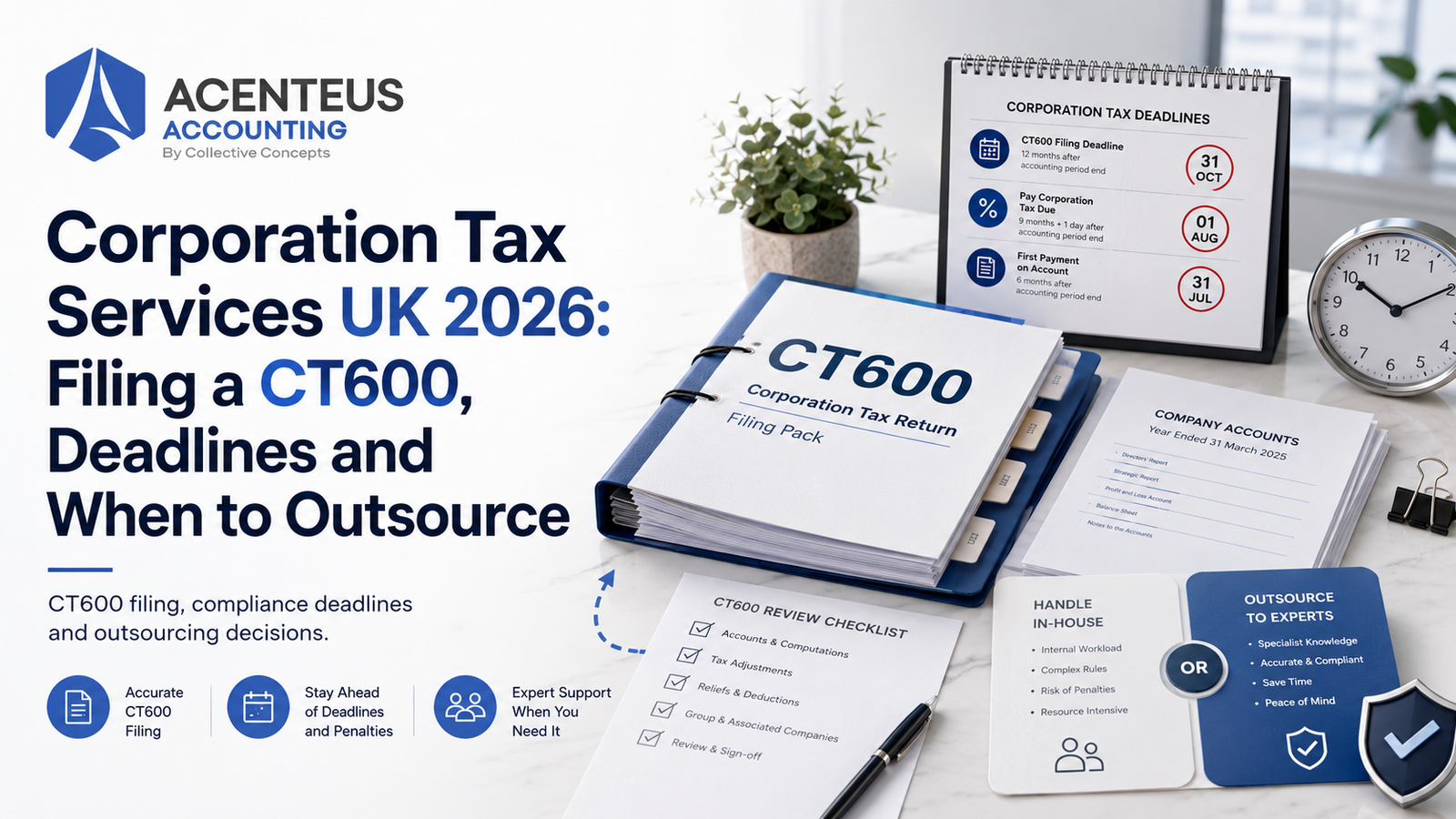
| File the CT600 and Company Tax Return | 12 months after the end of the accounting period | 31 March 2027 |
| File annual accounts at Companies House (private company) | 9 months after the accounting reference date | 31 December 2026 |
| First accounts after incorporation | 21 months from the date of incorporation | Varies |
| Confirmation statement | Within 14 days of the end of the review period | Varies |
Payment falls due three months before the return that calculates it. That is not an anomaly, it is the design, and it has a practical consequence most directors discover late: the tax computation has to be substantially complete by month nine even though nothing has to be filed until month twelve. A practice that schedules corporation tax work to the filing deadline will systematically produce clients who pay interest.
Companies with taxable profits above £1.5 million pay by quarterly instalments during the accounting period itself, and those above £20 million pay on an accelerated instalment pattern that starts earlier still. Both thresholds are divided among associated companies, so a growing group can fall into the instalment regime a year before anyone expects it. A different, lower interest rate applies to underpaid instalments, so check the current figure rather than applying the standard rate.
The wider filing calendar, including PAYE, VAT and Self Assessment dates that compete for the same team, is set out in our UK tax year 2026/27 key dates guide.
What are the corporation tax rates for 2026/27 and how does marginal relief work?
The rate structure introduced in April 2023 continues unchanged into 2026/27. There are two rates and a taper between them.
| Taxable profits | Rate | Effect |
|---|---|---|
| Up to £50,000 | 19% small profits rate | Flat 19% on the whole profit |
| £50,001 to £250,000 | 25% less marginal relief | Effective rate rises gradually from 19% to 25%, with a 26.5% marginal rate on each extra pound |
| Over £250,000 | 25% main rate | Flat 25% on the whole profit, no relief |
Marginal relief is calculated as 3/200 of the difference between the upper limit and the company’s augmented profits, adjusted where the company has non trading income. Filing software applies it automatically, but the arithmetic is worth understanding because the associated company rules sit on top of it.
Take a standalone company with taxable profits of £120,000 and no associated companies. Tax at the main rate is £30,000. Marginal relief is 3/200 of (£250,000 minus £120,000), which is £1,950. The liability is £28,050, an effective rate of 23.4%.
Now give the same director one other company under common control. The limits halve to £25,000 and £125,000. Marginal relief becomes 3/200 of (£125,000 minus £120,000), which is £75. The liability rises to £29,925, an effective rate of 24.9%.
Same profit, £1,875 more tax, purely because a second company exists. Associated company status is not a filing formality, it is a rate determinant, and it is the check most self prepared returns skip entirely. Dormant companies are generally excluded, but companies under common control through a spouse, a family member or a business partnership can count. If you want to sanity check a figure quickly, our free UK corporation tax calculator handles marginal relief and the associated company divisor.
Short accounting periods scale the limits proportionally. A nine month period has limits of £37,500 and £187,500, and tax is charged on the actual profits of that period rather than an annualised figure.
What changed in capital allowances, and why does it matter this year?
The main rate writing down allowance for plant and machinery fell from 18% to 14% with effect from 1 April 2026 for corporation tax, confirmed in HMRC’s Capital Allowances Manual at CA23220. The special rate pool is unaffected at 6%, the Annual Investment Allowance remains £1 million, and full expensing continues.
Two practical consequences follow. First, a company with a large brought forward main pool gets less relief every year from now on, which is an effective cash tax increase even though the headline corporation tax rate did not move. Second, and more immediately, a hybrid rate applies to any chargeable period straddling 1 April 2026, apportioned across the period. Any December 2026 year end is a straddling period. Getting that apportionment wrong is a quiet error that only surfaces on the following year’s pool balance.
Alongside the cut, a new 40% first year allowance for main rate expenditure took effect from 1 January 2026. It is aimed at expenditure that could not access full expensing, principally assets provided for leasing and expenditure by unincorporated businesses, and it excludes second hand assets and cars. For most trading companies already using full expensing or the AIA it changes nothing. For a leasing business it changes a lot.
What does it cost to file a CT600 late?
More than it did in March 2026. ICAEW confirmed the increase for returns with a filing date on or after 1 April 2026, noting HMRC’s rationale that penalties set in 1998 had lost their real value and deterrent effect.
| How late | Filing date before 1 April 2026 | Filing date on or after 1 April 2026 |
|---|---|---|
| 1 day late | £100 | £200 |
| More than 3 months late | A further £100, total £200 | A further £200, total £400 |
| Third consecutive late return, within 3 months | £500 | £1,000 |
| Third consecutive late return, over 3 months | A further £500, total £1,000 | A further £1,000, total £2,000 |
| 6 months late | 10% of the unpaid tax | 10% of the unpaid tax (unchanged) |
| 12 months late | A further 10% of the unpaid tax | A further 10% of the unpaid tax (unchanged) |
Two features of this ladder are worth spelling out because they are widely misunderstood.
The fixed penalties apply whether or not tax is due. A dormant company, a loss making company and a company with a nil liability all pay £200 on day one if HMRC was expecting a return. The tax geared penalties apply only to unpaid tax. A company that pays on time and files late is exposed to the fixed penalties and nothing more.
That distinction produces very different outcomes on the same liability. Here are three positions worked through, using a £30,000 liability and the 7.75% interest rate, for a period ending 31 March 2026 with tax due 1 January 2027 and the return due 31 March 2027.
| Position | Fixed penalties | Tax geared and interest | Total |
|---|---|---|---|
| Dormant company, nil liability, return four months late | £400 | Nil | £400 |
| £30,000 paid on time, return filed seven months late | £400 | Nil, because no tax is unpaid | £400 |
| £30,000 unpaid, return filed twelve months late | £400 | £6,000 tax geared plus about £2,898 interest | About £9,298 |
The middle row is the actionable one. A company that cannot get its accounts finalised but can estimate and pay its liability caps its exposure at £400. The third row, the same company that also holds onto the money, pays roughly 31% of the liability in charges. If a client is going to miss something, pay the tax and be late with the return, never the reverse.
There is a further consequence beyond the numbers. At six months, HMRC can issue a determination, which is its own estimate of the tax due. A determination cannot be appealed. The only route out is to file the outstanding return so HMRC can recalculate, and in the meantime interest accrues on HMRC’s figure rather than the real one.
Is there a late payment penalty for corporation tax?
No. Corporation tax has no fixed or percentage late payment penalty. Paying late attracts interest only, currently 7.75% a year, set at the Bank of England base rate plus four percentage points and in effect since 9 January 2026 per the published HMRC interest rates. It is simple interest, charged daily from the day after the due date, with no grace period.
This is worth stating flatly because a surprising amount of published guidance on corporation tax imports the Self Assessment surcharges, the 5% at thirty days, six months and twelve months, and applies them to companies. Those surcharges do not exist in the corporation tax regime. If a client has been told they face a 5% surcharge on a late corporation tax payment, they have been given Self Assessment guidance by mistake.
The exception sits inside the quarterly instalment regime, where penalties can apply to a deliberate failure to pay or to deliberately understated instalments. That is a different rule aimed at different behaviour, and it does not turn ordinary lateness into a penalty.
Companies House operates a completely separate regime for late annual accounts, and the two run in parallel. A missed year end can produce charges from both bodies at once.
| How late are the accounts | Private company penalty | If late two years running |
|---|---|---|
| Up to 1 month | £150 | Doubled |
| 1 to 3 months | £375 | Doubled |
| 3 to 6 months | £750 | Doubled |
| More than 6 months | £1,500 | Doubled |
Why does the move to commercial software raise the risk of a late filing?
Because a submission that HMRC rejects has not been filed, and rejection is a software problem rather than a tax problem.
Every CT600 goes through HMRC’s Business Validation Rules at the gateway. A return can be technically correct on the tax and still bounce because the iXBRL tagging is wrong, the taxonomy selected does not match the accounting framework used, the computation is missing, or the accounting period on the return does not match the one HMRC holds. If the return bounces on the deadline and the error is not corrected and resubmitted before midnight, the filing is late and the £200 penalty applies automatically.
Now combine that with what happened in April 2026. The population most likely to hit a first time tagging or taxonomy error is the population that had never used filing software, because HMRC had been doing the conversion for them inside CATO. That population was moved onto commercial software in the same month the day one penalty doubled. Nobody designed that overlap, but it is real, and it is the reason a first filing under new software should be attempted weeks before the deadline rather than on it.
Three checks remove most of the risk. Confirm the accounting period HMRC holds matches the one in the software, using the business tax account. Confirm agent authorisation is in place before the deadline week, because a missing 64-8 or an unlinked client blocks submission at the worst possible moment. And run a test submission early enough that a rejection is an inconvenience rather than a penalty. If you need to reach HMRC about any of it, the numbers and the agent routes are in our guide to contacting HMRC about corporation tax.
What about Making Tax Digital for Corporation Tax and Companies House software only filing?
Neither is happening on the timetable most guidance still describes, and both corrections save real money in software budgets.
MTD for Corporation Tax has been cancelled, not postponed. HMRC stated in its July 2025 Transformation Roadmap that it will modernise internal corporation tax systems but does not intend to introduce MTD for CT, as reported by Accountancy Age. There is no quarterly update obligation for companies and no announced start date for one. Our MTD for Corporation Tax readiness guide covers what that means in practice and what still applies.
Companies House software only accounts filing was paused in January 2026. The reforms under the Economic Crime and Corporate Transparency Act, which would have removed abridged and filleted accounts and ended WebFiling from April 2027, are under review with no replacement date, and Companies House has committed to at least twenty one months’ notice before any mandatory change. Abridged accounts can still be filed and WebFiling still works. Several pages currently ranking for this topic state April 2027 as settled fact, and a few state April 2028. As of August 2026 neither is confirmed.
The direction of travel is not in doubt. The date is. If a software vendor is selling you an April 2027 deadline, ask them to cite the current Companies House guidance.
What is confirmed and does have a live deadline is identity verification. Companies House made verification a legal requirement on 18 November 2025 under the same Act, and its annual report for 2025 to 2026 sets out that it expects to verify six to seven million individuals by the end of the transition year in November 2026. For a practice, that is a client communication exercise sitting on top of the compliance calendar this autumn.
What should a company director look for in a corporation tax service?
Since April 2026 the realistic options for a small company are commercial software plus your own time, or an accountant. The free middle route no longer exists. If you are choosing an accountant, five questions separate a service from a filing bureau.
- Do they check associated companies every year, not once? Common control changes when a spouse incorporates, when a group restructures, or when a dormant company starts trading. The rate depends on it.
- Do they tell you the liability by month eight? Payment is due at nine months and one day. A service that produces the number at month eleven has already cost you interest.
- Do they review the director’s loan account before the period end? A section 455 charge is avoidable if the loan is cleared within nine months and one day. It is not avoidable once you are telling them about it in month ten.
- Do they handle the capital allowances position actively? With the main pool rate now 14% and a hybrid rate on straddling periods, the timing of expenditure has a larger effect than it did.
- Who submits, and what happens if it bounces? Ask what their process is for a gateway rejection close to the deadline. A firm that has thought about this will have an answer immediately.
Cost is a fair question and the honest answer is that it depends on complexity rather than turnover. A dormant company return, a single trading company with clean records, and a company with an R and D claim and a group relief surrender are three different pieces of work. Ask for the scope in writing and check whether iXBRL tagging, the Companies House filing and any supplementary pages are inside the fee or outside it.
When should an accountancy practice outsource corporation tax work?
When the constraint is production capacity at year end peaks, and not before. Outsourcing is a capacity instrument. It is a poor answer to a pricing problem, a client selection problem or a review problem, and firms that deploy it against the wrong constraint conclude that outsourcing does not work when what did not work was the diagnosis.
Corporation tax is a natural candidate because the workload clusters. Company year ends bunch at 31 March and 31 December, which pushes filing deadlines into the same two windows, and those windows overlap with accounts production and, in January, with personal tax. Staffing permanently for a peak that lasts eight weeks is expensive for the other forty four.
Before committing, run the per return economics on your own figures. It takes an afternoon with your time records and it produces a defensible number rather than a hunch.
- Step 1. Measure total hours per CT600 from time records, not memory. Include preparation, review, query handling and the resubmission when something bounces. Divide last year’s total corporation tax hours by returns filed. A blended figure is more honest than a per job estimate because it captures the rework nobody logs separately.
- Step 2. Calculate a real internal cost per hour. Salary plus employer National Insurance plus pension plus software plus a share of overhead, divided by genuinely productive hours rather than contracted hours.
- Step 3. Multiply for internal cost per return. This is the number to beat, and it is usually higher than principals expect because the review and query time is invisible in most costing models.
- Step 4. Build the true outsourced cost. Provider fee, plus your own review hours at reviewer cost, plus onboarding time amortised across the first year. A provider fee compared against an internal cost that excludes review is not a comparison.
- Step 5. Test the constraint before you act. If the bottleneck is reviewer time rather than preparation time, outsourcing preparation shortens the queue into review and does nothing to the queue out of it. This is the most common and most expensive misdiagnosis in practice capacity planning.
Step 5 is the one worth pausing on. Review capacity sits with the fewest people in the firm and cannot be bought in as easily as preparation. If two people can sign off and eight can prepare, adding a ninth preparer makes the backlog worse. The same logic runs through our peak season capacity playbook, and the structural background on why the preparer market is tight sits in our note on the accountancy talent shortage.
One thing outsourcing never changes: responsibility. The practice remains the agent, signs off the return and carries the professional risk. A provider prepares, the practice reviews and submits. Any arrangement described to you differently should be treated with suspicion.
How do you choose a corporation tax outsourcing partner?
The market divides into providers that do UK corporation tax properly and providers that do general accounting and treat the CT600 as a form filling exercise. These questions separate them.
| Question | What a good answer sounds like | What should worry you |
|---|---|---|
| Who reviews the computation before it reaches us? | A named UK qualified reviewer, ACCA, ICAEW or ICAS, with UK corporation tax experience | A quality process described without naming who applies it |
| How do you handle associated companies? | A standing check at every engagement, with a client questionnaire | It is treated as information the practice supplies |
| What is your iXBRL and taxonomy process? | Specific software named, tagging reviewed, test submissions used | Tagging is described as automatic |
| Can you handle CT600A, CT600L and group relief? | Yes, with examples of the volume handled | Vague willingness to learn |
| What is your turnaround at 31 March and 31 December? | A committed turnaround with capacity reserved for peaks | Standard turnaround quoted with no peak distinction |
| How is our data protected? | UK GDPR, a data processing agreement you can read, access controls, named security standard | Assurances without documentation |
| Is delivery white label? | Work returns under your brand, no client contact without your instruction | Any suggestion of direct client contact |
Pricing models vary and the comparison only works if you compare like with like. The three common structures are per return, a managed full time equivalent, and ad hoc overflow, and each suits a different volume profile. Our breakdown of accounting outsourcing pricing models sets out where each one works, and the comparison of UK tax outsourcing providers covers how different firms structure the review layer. If you are moving to a delegated model for the first time, the quality control checklist covers the two stage review discipline that keeps quality stable.
One commercial note. Corporation tax work delivered through an external team changes your margin, not just your capacity, and the fee structure you offer clients should reflect that deliberately rather than by accident. Our note on fixed fee versus hourly billing works through the decision.
What do companies and practices get wrong most often?
Five errors account for most of the avoidable cost we see.
Scheduling to the filing deadline rather than the payment deadline. The return is due at twelve months, the money at nine months and one day. Work planned backwards from month twelve produces interest charges every single year.
Assuming the associated company position is unchanged. It is checked once at onboarding and never again, and then a client incorporates a second company and nobody recalculates the limits.
Treating a dormant company as exempt from filing. If HMRC has issued a notice to file, a return is due. The fixed penalty is now £200 on day one and it applies to a company with no activity and no tax.
Leaving the first submission under new software until the deadline. For any company that moved off CATO this year, the first filing through commercial software carries real rejection risk, and a rejection at midnight is a late filing.
Buying software for a Companies House deadline that has been paused. The April 2027 accounts reforms are under review with no confirmed date. Spending on the assumption they are fixed is spending against a proposal.
Getting corporation tax right in 2026
The 2026 changes did not make corporation tax harder to calculate. They made it more expensive to get the process wrong. Free filing has gone, the day one penalty has doubled, and the software layer that now sits between every company and HMRC introduces a failure mode that did not exist two years ago. None of that is difficult to manage. It just has to be managed deliberately, in month eight rather than month twelve.
If you are a company director, the practical next step is to confirm three things: which software or agent will file your next return, what your liability looks like ahead of the nine month payment date, and whether your associated company position has changed since last year.
If you are a practice principal, run the per return economics on your own time records before the next year end peak, and identify honestly whether your constraint is preparation or review. The answer determines whether outsourcing helps you at all.
Acenteus Accounting provides white label corporation tax preparation and CT600 support for UK accountancy practices, alongside accounting outsourcing for accountants and audit support. If you would like a second view on the capacity maths before you commit to a route, talk to our team. Bring the actual constraint rather than a brief. If outsourcing is not the right answer for your firm, we would rather say so now than discover it together in March.
Frequently Asked Questions (FAQ)
Twelve months after the end of the company’s accounting period. For a period ending 31 March 2026, the CT600 is due by 31 March 2027. The payment deadline is earlier, at nine months and one day after the period end, which for the same company is 1 January 2027.
No. HMRC and Companies House closed the free joint filing service, known as CATO, on 31 March 2026. From 1 April 2026 the Company Tax Return must be filed through HMRC recognised commercial software or by an agent. Paper filing remains available only in narrow circumstances with HMRC approval, such as some charities, community amateur sports clubs and dormant companies.
£200 for returns with a filing date on or after 1 April 2026, doubled from £100. It applies automatically and regardless of whether any corporation tax is owed, so dormant and loss making companies are included. A further £200 is charged once the return is more than three months late.
No. Corporation tax carries interest on late payment but no percentage surcharge. Interest is currently 7.75% a year, charged daily from the day after the due date. The 5% surcharges that appear in some guidance belong to Self Assessment and do not apply to companies.
Yes, if HMRC has issued a notice to file. Dormancy for Companies House purposes and dormancy for HMRC purposes are separate positions. If HMRC expects a return and does not receive one, the £200 fixed penalty applies even though there is no tax and no trade.
Two companies are associated where one controls the other, or where the same person or group controls both. The £50,000 and £250,000 profit limits are divided by the number of associated companies plus one, which can move a company from the small profits rate into marginal relief, or from marginal relief into the main rate, without any change in profit.
No. HMRC confirmed in its July 2025 Transformation Roadmap that it does not intend to introduce MTD for Corporation Tax. There are no quarterly corporation tax updates and no announced start date. MTD for VAT and MTD for Income Tax are unaffected and continue as planned.
Not on that date. Companies House confirmed in January 2026 that the accounts filing reforms planned for April 2027 are paused and under review, with no replacement date announced and a commitment to at least twenty one months’ notice. Abridged and filleted accounts and WebFiling remain available for now.
A rejected submission has not been filed. If HMRC’s Business Validation Rules reject the return, commonly for iXBRL tagging errors, a taxonomy mismatch, a missing computation or an accounting period that does not match HMRC’s record, the return must be corrected and resubmitted. If that happens after the filing date, the penalty applies as if the return had never been sent.
A charge on the company where a loan to a participator, usually a director, is outstanding nine months and one day after the period end. It is reported on supplementary page CT600A and paid alongside corporation tax. The charge is reclaimable once the loan is repaid, but the reclaim takes time, so clearing the loan before the deadline is almost always the better route.
In a white label arrangement, no. The provider prepares the computation and return, the practice reviews it, and the practice submits under its own agent authorisation. Responsibility for the filing and for the professional judgement in it stays with the practice throughout.