Last updated: 22 September 2026
This article is general guidance on UK employment taxes and is not advice for your specific circumstances. Rates and thresholds change, so confirm the current figures on GOV.UK before you file.
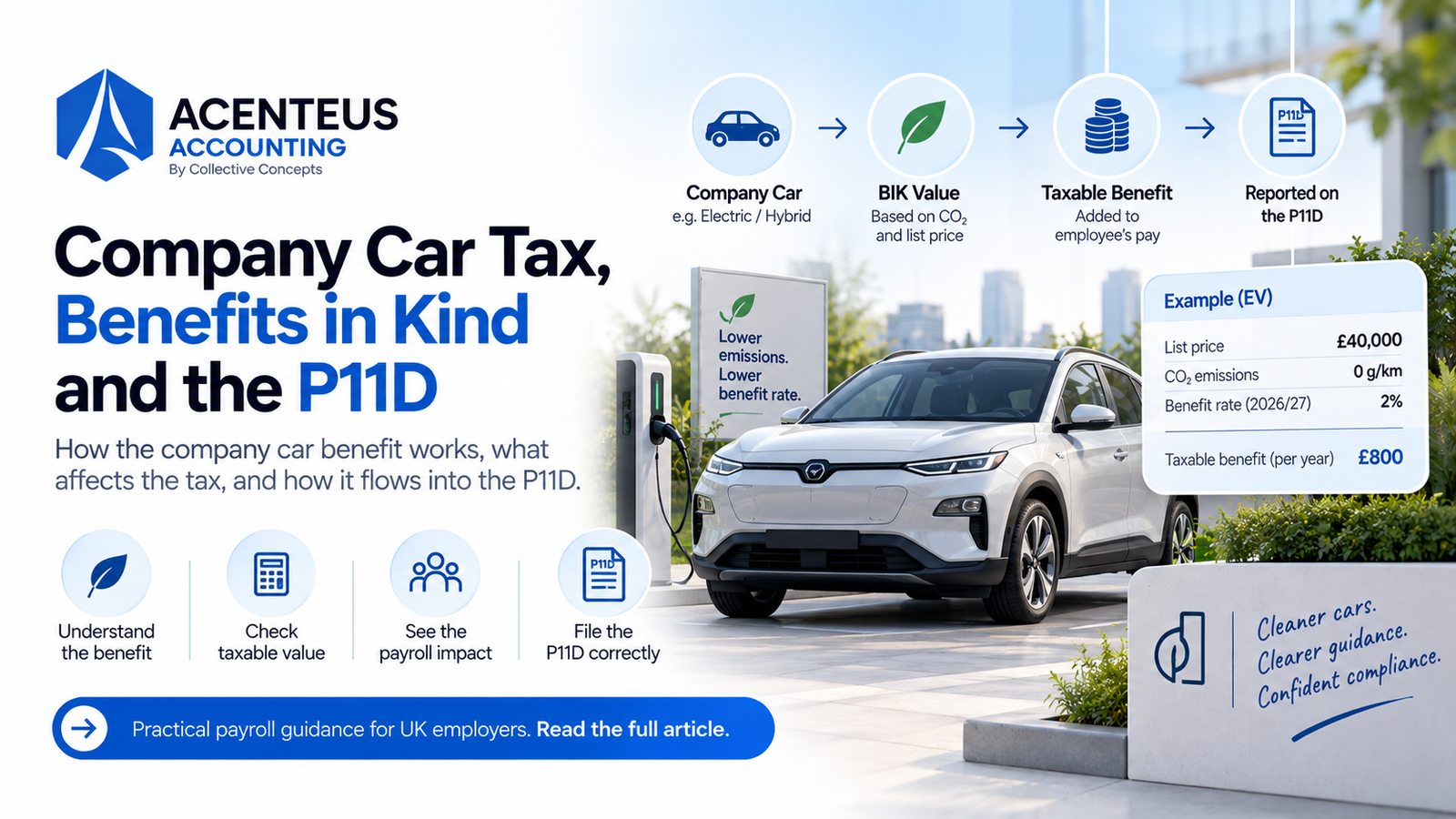
Company car tax is worked out by multiplying the car’s list price by an appropriate percentage set by its CO2 emissions, then taxing the result as a benefit in kind. In 2026/27 a zero emission car sits at 4% and the maximum for any car is 37%. The employee pays income tax on that figure. The employer pays Class 1A National Insurance on it at 15%, reports it on a P11D and a P11D(b) by 6 July, and pays the Class 1A by 22 July.
Almost every guide on this subject is written for the driver. This one is written for the person who has to report it. The calculation is the easy half. The half that generates penalties is the reporting, and from April 2027 that changes for good.
Key takeaways
- The formula: list price multiplied by the appropriate percentage equals the cash equivalent. Everything else follows from that one number.
- Electric still wins, by a lot: 4% against up to 37% means a 40% taxpayer can be better off by thousands a year on a similarly priced car.
- Free fuel is usually a bad deal: the car fuel benefit is £29,200 multiplied by your appropriate percentage, regardless of how little private fuel the employee actually uses.
- Mileage rates moved: the approved rate for the first 10,000 business miles rose to 55p from 6 April 2026, the first increase in 15 years. The rate above 10,000 miles stayed at 25p.
- Class 1A is the employer’s cost: 15% on the cash equivalent of every reportable benefit, and Employment Allowance does not cover it.
- Payrolling becomes mandatory: phased from 6 April 2027, starting with cars, car fuel, vans, van fuel and medical benefits.
What counts as a benefit in kind, and what does not?
A benefit in kind is something of value an employee gets from their employment that is not cash pay. A company car, private medical cover, an interest free loan, a gym membership paid by the company. If the employee could have bought it themselves and the company paid instead, assume it is reportable until you can point to an exemption.
The line that matters is benefit against business expense. A business expense is a cost the employee incurred wholly, exclusively and necessarily in doing the job, reimbursed at cost. That is not a benefit and does not go on a P11D. A laptop used for work is an expense. The same laptop given to the employee to keep is a benefit.
- Reportable: company cars and fuel, vans with significant private use, private medical insurance, beneficial loans over £10,000, living accommodation, assets transferred to an employee.
- Exempt: business travel and subsistence reimbursed at cost, one mobile phone per employee, workplace parking, employer pension contributions, and anything covered by a specific exemption.
- Grey area: anything with mixed business and private use. The test is the private use, not the business use, and HMRC will ask you to evidence the split.
The reason this matters before you touch a single figure: most P11D errors we see are not arithmetic. They are items that were classified as expenses when they were benefits, or benefits nobody knew had to be reported at all.
How does company car tax work?
Take the car’s P11D value, which is the list price including VAT, delivery and any optional extras, and multiply it by the appropriate percentage for its CO2 emissions. That gives the cash equivalent for a full year. The employee pays income tax on the cash equivalent at their marginal rate, and the employer pays Class 1A National Insurance on the same figure.
The P11D value is not what you paid. Dealer discounts, part exchange and finance deals are all ignored. Capital contributions from the employee reduce it, up to £5,000. Get the P11D value wrong and every downstream number is wrong too.
The 2026/27 appropriate percentages
The table below covers the bands most employers actually meet. The full list, including the NEDC and WLTP variants, is published by HMRC in 480 Appendix 2.
| Car | CO2 and electric range | Appropriate percentage 2026/27 |
|---|---|---|
| Fully electric | 0 g/km | 4% |
| Plug-in hybrid | 1 to 50 g/km, electric range 130 miles or more | 4% |
| Plug-in hybrid | 1 to 50 g/km, electric range 70 to 129 miles | 7% |
| Plug-in hybrid | 1 to 50 g/km, electric range 40 to 69 miles | 10% |
| Plug-in hybrid | 1 to 50 g/km, electric range 30 to 39 miles | 14.00% |
| Plug-in hybrid | 1 to 50 g/km, electric range under 30 miles | 16.00% |
| Petrol or hybrid | 55 g/km | 17.00% |
| Petrol or hybrid | 75 g/km | 21% |
| Petrol or hybrid | 95 g/km | 25% |
| Petrol or hybrid | 115 g/km | 29.00% |
| Petrol or hybrid | 135 g/km | 33.00% |
| Petrol or hybrid | 155 g/km and above | 37% |
Above 50 g/km the percentage rises by one point for every 5 g/km, until it hits the 37% ceiling at 155 g/km. That ceiling is the reason a very expensive petrol car and a moderately expensive one are taxed on the same percentage: the list price is doing all the work.
The diesel supplement
Diesel cars carry a 4% supplement on top of the CO2 based percentage, unless the car is certified to Euro standard 6d, in which case the supplement does not apply. The 37% maximum still applies after the supplement is added, per HMRC’s Employment Income Manual. Diesel hybrids are not caught by it at all.
Car fuel benefit, and why it is usually a bad deal
If the employer pays for any private fuel and the employee does not reimburse every penny of it, a separate fuel benefit applies. For 2026/27 it is £29,200 multiplied by the same appropriate percentage as the car, as set out in HMRC’s van and fuel benefit charges for 2026 to 2027.
The charge takes no account of how much private fuel the employee actually used. One private tank a month produces the same charge as 20,000 private miles. On a car at 29%, the fuel benefit alone is £8,468 of cash equivalent, which costs a higher rate taxpayer £3,387 in income tax and the employer £1,270 in Class 1A. For most employees the fuel card is worth less than the tax on it, and the fix is simple: the employee reimburses private fuel in full, and the benefit disappears entirely.
A worked example for one employee
Here is the full chain for one employee for one full tax year, on 2026/27 figures, comparing a petrol car against an electric one at a similar price. The employee is a higher rate taxpayer. Everything in the table follows from the two inputs: list price and appropriate percentage.
| Step | Petrol car, £38,000 list, 115 g/km | Electric car, £42,000 list, 0 g/km |
|---|---|---|
| Appropriate percentage | 29% | 4% |
| Cash equivalent of the car | £11,020 | £1,680 |
| Employee income tax at 40% | £4,408 a year, £367 a month | £672 a year, £56 a month |
| Employer Class 1A at 15% | £1,653 | £252 |
| Add private fuel | £29,200 x 29% = £8,468 | Not applicable, workplace charging is exempt |
| Employee tax on the fuel benefit | £3,387 | Nil |
| Employer Class 1A on the fuel benefit | £1,270 | Nil |
| Total employee tax | £7,795 | £672 |
| Total employer Class 1A | £2,923 | £252 |
The gap is not marginal. On these figures the petrol car and fuel card cost the employee £7,123 a year more in tax and the employer £2,671 more in National Insurance. If you want to check the employee’s side against the current bands, our guide to UK income tax rates for 2026/27 has them.
One number people miss: the employer’s Class 1A is not covered by Employment Allowance. Employment Allowance reduces Class 1 secondary contributions on wages, not Class 1A on benefits, so the £2,923 above is paid in full even by an employer claiming the allowance. We set out what the allowance does cover in our Employment Allowance 2026/27 guide.
How are vans and van fuel taxed?
Vans are taxed on a flat charge rather than a percentage of list price. For 2026/27 the van benefit charge is £4,170 and the van fuel benefit charge is £798. There is no CO2 scale and no list price calculation, which makes vans considerably simpler and usually cheaper.
| Charge | 2025/26 | 2026/27 | Employee tax at 20% | Employer Class 1A at 15% |
|---|---|---|---|---|
| Van benefit charge | £4,020 | £4,170 | £834 | £626 |
| Van fuel benefit charge | £769 | £798 | £160 | £120 |
| Both together | £4,789 | £4,968 | £994 | £745 |
The charge only applies where there is significant private use. Ordinary commuting in a van, plus insignificant private use such as a stop at the shop on the way home, does not trigger it. That exemption is generous and widely under claimed, but it needs evidence: a written private use policy, and mileage records that support it. A verbal instruction to the team is not evidence.
What are the approved mileage rates for 2026/27?
The approved mileage allowance payment for cars and vans rose to 55p per mile for the first 10,000 business miles from 6 April 2026, up from 45p. This was the first increase in 15 years. The rate above 10,000 miles stayed at 25p, per the GOV.UK announcement on increasing mileage rates.
| Vehicle | Rate to 5 April 2026 | Rate from 6 April 2026 |
|---|---|---|
| Car or van, first 10,000 business miles | 45p | 55p |
| Car or van, above 10,000 business miles | 25p | 25p |
| Motorcycle | 24p | 24p |
| Bicycle | 20p | 20p |
| Passenger payment, per passenger | 5p | 5p |
Pay at or below these rates and there is nothing to report. Pay above them and the excess is taxable pay. The change is worth checking on your own numbers: an employee doing 12,000 business miles can now be paid £6,000 tax free, against £5,000 last year.
Here is the part that has not reached most payroll policies yet. If you are still paying 45p, the employee can claim mileage allowance relief on the 10p difference, which on 10,000 miles is £1,000 of relief they have to go and ask HMRC for themselves. That is an avoidable piece of friction and a legitimate reason to revisit the policy now rather than at year end. Our UK payroll compliance guide covers the wider set of rates that moved this year.
How does salary sacrifice affect a benefit in kind?
Under the optional remuneration arrangement rules, where a benefit is provided through salary sacrifice you report the higher of the salary given up and the normal benefit in kind value. The rules exist precisely to stop salary sacrifice converting taxable pay into a cheaper benefit, and they are explained in HMRC’s salary sacrifice guidance.
There is one exception that matters commercially, and it is the reason electric car schemes exist. For cars with CO2 emissions of no more than 75 g/km you always use the normal benefit in kind rules, never the salary given up. An electric car at 4% therefore stays at 4% even when the employee has sacrificed several hundred pounds of gross pay a month for it. That is not a loophole, it is deliberate policy.
- Outside the OpRA rules: employer pension contributions, employer provided pensions advice, workplace nurseries, qualifying childcare where the arrangement started before 5 October 2018, and cycles and cycling safety equipment.
- Cars at 75 g/km or less: the normal benefit in kind charge always applies, which is what makes electric car salary sacrifice work.
- Everything else: compare the salary given up against the benefit value and report the higher figure.
Sacrifice also reduces the pay that pension contributions and statutory payments are calculated on, which is where schemes go wrong in practice rather than in theory. Our guide to auto-enrolment pension changes in 2026 covers that interaction.
Trivial benefits, staff parties and the rules that trip employers up
The trivial benefits exemption lets you give an employee something worth £50 or less without reporting it, provided four conditions are all met: it cost £50 or less, it is not cash or a cash voucher, it is not a reward for work or performance, and it is not in their contract. Break any one of the four and the whole thing becomes reportable, per HMRC’s trivial benefits guidance.
- The £50 is a cliff edge, not an allowance: a gift costing £52 is taxable on the full £52, not on the £2 above the limit.
- Directors of close companies have an annual cap: £300 a tax year across all trivial benefits, even where each one is under £50.
- A reward is never trivial: a £40 voucher for hitting a target fails the test, however small it is. The same voucher for a birthday passes.
- Salary sacrifice destroys it: a trivial benefit provided through a sacrifice arrangement loses the exemption and goes on the P11D.
The annual function exemption works differently and trips up more employers. You can spend up to £150 per head on annual social functions that are open to employees generally, as HMRC’s Employment Income Manual sets out. It is also a cliff edge: spend £160 a head and the full £160 is taxable, not the £10. And it has to be genuinely annual, so a one off celebration does not qualify however well intentioned.
If you do overspend, the usual answer is a PAYE Settlement Agreement, where the employer settles the tax and National Insurance on the employee’s behalf rather than putting a Christmas party on 60 people’s P11Ds. We cover the mechanics and the deadline in our guide to the PAYE Settlement Agreement.
Beneficial loans, medical cover and the rest
Two more that come up constantly. Employment related loans are exempt if the combined outstanding balance stays below £10,000 throughout the whole tax year, per HMRC’s guidance on exempt loans. Go £1 over at any point in the year and the whole loan is reportable, not just the excess, with the benefit calculated using HMRC’s official rate of interest.
Directors’ loan accounts catch people here. An account that is overdrawn at any point in the year by more than £10,000 is a reportable beneficial loan, and it is separate from the corporation tax charge under section 455. Private medical insurance is simpler: the reportable value is what the employer paid, and from April 2027 it is one of the first benefits that must be payrolled.
What is a P11D, and what is a P11D(b)?
A P11D is the form that reports the benefits in kind and expenses provided to one employee in a tax year. A P11D(b) is the employer’s declaration and Class 1A National Insurance return for all of them together. You file one P11D per employee who received reportable benefits, and one P11D(b) for the whole payroll.
The two are often confused because they arrive together, but they do different jobs. The P11D drives the employee’s tax, usually through a change to their tax code in the following year. The P11D(b) drives the employer’s Class 1A bill, which for 2026/27 is 15% of the total cash equivalent of all reportable benefits, per HMRC’s rates and thresholds for employers.
| What | Deadline | Who it affects |
|---|---|---|
| File P11D and P11D(b) for the tax year ending 5 April | 6 July | Employer |
| Give each employee a copy of their P11D | 6 July | Employee |
| Pay Class 1A National Insurance electronically | 22 July | Employer |
| Pay Class 1A National Insurance by cheque | 19 July | Employer |
Both forms must be filed online. Paper P11Ds are no longer accepted. If you want the whole employer calendar rather than these four dates, our UK tax year 2026/27 key dates and deadlines guide lists it in one place.
What happens if you file late or get it wrong
The late filing penalty for a P11D(b) is £100 per 50 employees for each month or part month it is late, as stated in HMRC’s deadlines guidance. Late payment of Class 1A attracts penalties and interest separately.
Read that penalty formula carefully, because it is per 50 employees and per month. An employer with 200 staff who files three months late is looking at £1,200 before any penalty for the payment itself. The exposure scales with headcount, which is why the same oversight costs a 20 person company £300 and a 500 person company £3,000.
Errors are corrected by submitting an amended P11D showing the correct total for the year, not the difference. The most common correction we see is a car reported for a full year when it was returned in January, and the second most common is a P11D value taken from the invoice rather than the list price.
Should you payroll benefits now, before it becomes mandatory?
Yes, for most employers, and the reason is timing rather than tax. Payrolling means putting the cash equivalent of a benefit through the payroll each pay period so the employee pays the tax as they go, instead of through a tax code adjustment a year later. You register with HMRC before the start of the tax year, and you stop filing P11Ds for the benefits you payroll.
Mandatory real time reporting of benefits in kind is being phased in from 6 April 2027, per HMRC’s guidance on the phased introduction. Registering voluntarily now means you make the change in a year of your choosing, with your own timetable and a P11D safety net still available, rather than in the year HMRC removes the choice.
| Phase | From | What it covers |
|---|---|---|
| Phase 1 | 6 April | Company cars, car fuel, vans, van fuel and employer provided medical benefits |
| Phase 2 | 6 April | Most other benefits in kind |
| Staying voluntary | No date announced | Employment related loans and living accommodation |
The practical work is not the registration, it is the data. Payrolling needs the benefit value known at the start of the year and adjusted in period when a car changes or an employee leaves, which is a different discipline from reconstructing the year each June. If your payroll software cannot handle in year benefit adjustments cleanly, find that out now rather than in April 2027. We compare the options for employers in our review of payroll software for UK small businesses, and the bureau grade products in payroll bureau software for practices.
What should you hand to a payroll partner, and what should you keep?
Hand over the process, keep the decisions. Benefits work splits cleanly into a repeatable compliance cycle, which a partner should run, and a small number of judgement calls that belong with whoever knows the business and carries the risk.
| Worth outsourcing | Why | Keep in house |
|---|---|---|
| P11D and P11D(b) preparation and filing | High volume, fixed format, one deadline a year, easy to quality check | Signing off the final declaration |
| Benefit data collection and reconciliation | Chasing car changes, leavers and insurance schedules is process work | Deciding what the company offers |
| Class 1A calculation and payment scheduling | Purely mechanical once the data is clean | Approving the payment |
| Payrolling setup and in period adjustments | Needs software discipline and a monthly rhythm | The decision to payroll and when |
| Mileage and expense policy administration | Rate changes and record keeping are ongoing | Setting the rate you pay |
| PSA preparation | Annual, technical, and easy to forget | Deciding what goes in it |
What should never be outsourced is the classification judgement on anything genuinely unusual, because that is where the risk sits and it needs someone who knows why the arrangement exists. A partner who tells you they will take that off your hands entirely is overselling.
How Acenteus Accounting helps
We run the benefits cycle as a rolling process rather than a June scramble: car and benefit changes captured as they happen, values reconciled to the insurance and lease schedules, P11Ds prepared and reconciled, Class 1A calculated and scheduled, and the declaration put in front of you to sign. That sits inside our bookkeeping and payroll service.
You do not have to take our word for how that feels to work with. We hold a verified profile on Clutch with a 5.0 rating from three client reviews. Shobhana Solanki, Managing Director of TAXTEK CAMBRIDGE LTD in Cambridge, whose engagement covers payroll administration, bookkeeping, VAT returns, account preparation and self assessment, wrote that our “openness to questions and feedback fostered a positive working relationship, which helps to build trust”. A director at a financial services company in Northern Ireland wrote that we “provide high-quality work at a cost-effective rate”.
The same reviews flag something worth repeating honestly: clients see room for closer workflow alignment and more proactive suggestions. That is a fair read of any outsourcing relationship in its first year, and it is the part we work hardest on, because benefits work in particular fails when the partner waits to be told a car has changed.
For accountancy practices the model is the same and the volume is different. P11D season lands on top of year ends, and the work is high volume, tightly defined and easy to review, which makes it the natural first thing to move. How the engagement runs is set out on our outsourcing for UK accounting firms page, and the case for moving payroll to a cloud based partner is in how cloud based payroll outsourcing cuts costs for UK practices.
If cost is the first question, our guide to payroll outsourcing costs in the UK sets out the models rather than making you ask. Otherwise, send us last year’s P11D file and we will tell you what we would have done differently.
Frequently Asked Questions (FAQ)
A P11D is the HMRC form an employer files to report the benefits in kind and expenses provided to an employee during a tax year. One is filed per employee who received reportable benefits, by 6 July following the end of the tax year, and the employee must be given a copy by the same date.
The P11D reports one employee's benefits and drives their tax code. The P11D(b) is a single employer declaration covering all employees and is the return for Class 1A National Insurance, which is 15% of the total cash equivalent for 2026/27.
Multiply the car's list price by the appropriate percentage for its CO2 emissions, then apply your income tax rate. A £38,000 petrol car at 115 g/km gives a cash equivalent of £11,020, which costs a higher rate taxpayer £4,408 a year. The same driver in a £42,000 electric car pays £672.
Choose a car with low CO2 emissions, since the percentage matters more than the price at the bottom of the scale. Decline the fuel card and reimburse private fuel instead. Check whether a capital contribution of up to £5,000 is worth making. For diesels, confirm the car is Euro 6d certified so the 4% supplement does not apply.
55p per mile for the first 10,000 business miles in a car or van and 25p above that, from 6 April 2026. Motorcycles are 24p, bicycles are 20p and the passenger payment is 5p per passenger per mile.
Not if it is paid at or below the approved rates. Anything paid above them is taxable pay. If your employer pays below the approved rate, you can claim mileage allowance relief from HMRC on the difference.
There is no limit for most employees, provided each benefit costs £50 or less and meets all four conditions. Directors of close companies are capped at £300 across the tax year.
6 July following the end of the tax year, for both the P11D and the P11D(b). Class 1A National Insurance is due by 22 July electronically, or 19 July by cheque.
Yes, if you received reportable benefits and they were not payrolled. The employer must give you a copy by 6 July. If the benefits were payrolled, you get the information in a statement instead and there is no P11D.
An arrangement where an employee gives up part of their gross salary in return for a company car. For cars emitting 75 g/km or less, including all electric cars, the normal benefit in kind charge applies rather than the salary given up, which is what makes electric car schemes cost effective.